
The office probably already tells the story. One person is taking a client call in a stairwell. Two colleagues are booking meeting rooms just to get ten minutes of quiet. A manager wants to support hybrid work, but the floorplate still behaves like a noisy call centre. This is the problem behind most searches for office partitioning walls. It isn’t about adding panels. It’s about getting focus, privacy and adaptability back into the working day.
That pressure isn’t niche. The wider market has moved because workplaces have changed. Europe, including the UK, accounts for around 30% of the global office modular partition walls market valued at $15 billion USD annually, driven by demand in offices, healthcare and education, according to Archive Market Research. The demand is real because the pain is real.
For facilities managers, the question isn’t whether space division matters. It does. The question is whether fixed partitions are still the right answer. In many workplaces, they aren’t. The smarter route is a mix of flexible partitioning and high-performance pods, designed around how people work today. That’s the same shift shaping open-plan office design for 2026.
Table of Contents
- Beyond the Buzz The Truth About Your Open-Plan Office
- The Old Way of Dividing Space Traditional Partitions
- The Modern Solution The Rise of the Office Pod
- Finding Your Perfect Pod A Guide to Our Brands
- Beyond the Look Key Specifications and Compliance
- Smart Procurement The Shift to Flexible and Sustainable Futures
- Your Action Plan From Layout to Launch
- Create Your Future-Ready Workplace Today
Beyond the Buzz The Truth About Your Open-Plan Office
Open plan promised energy and delivered noise
The standard open-plan office usually fails in a very predictable way. It looks collaborative from a distance, but the daily experience is interruption, lack of privacy and nowhere to reset. Staff drift from desk to kitchen to corridor because the workspace doesn’t offer enough settings for focused work, private calls or small meetings.
That’s why office partitioning walls became such a dominant conversation in workplace design. Teams needed a way to put boundaries back into open space without returning to rows of sealed offices.
Practical rule: If people keep leaving the desk area to find privacy, the layout has already failed.
The mistake is treating every noise issue as a furniture issue. It isn’t. It’s a planning issue. A floorplate needs a clear mix of open collaboration space, enclosed focus space and transitional areas where people can work without disturbing others.
Partitioning should solve a business problem
Facilities managers don’t need more generic “breakout zones”. They need solutions that reduce friction. That means asking blunt questions.
- Where are confidential calls happening now: If the answer is corridors or parked cars, private space is missing.
- Where does focused work happen: If staff need headphones all day, the acoustic environment is wrong.
- What changes in six or twelve months: If headcount, team structure or attendance patterns may shift, inflexible construction is a risk.
Traditional office partitioning walls can help. But in a modern workplace, the strongest solution often combines selective partitions with enclosed acoustic pods. That approach creates privacy exactly where it’s needed, without locking the whole office into a layout that won’t age well.
The Old Way of Dividing Space Traditional Partitions
Why traditional systems took over
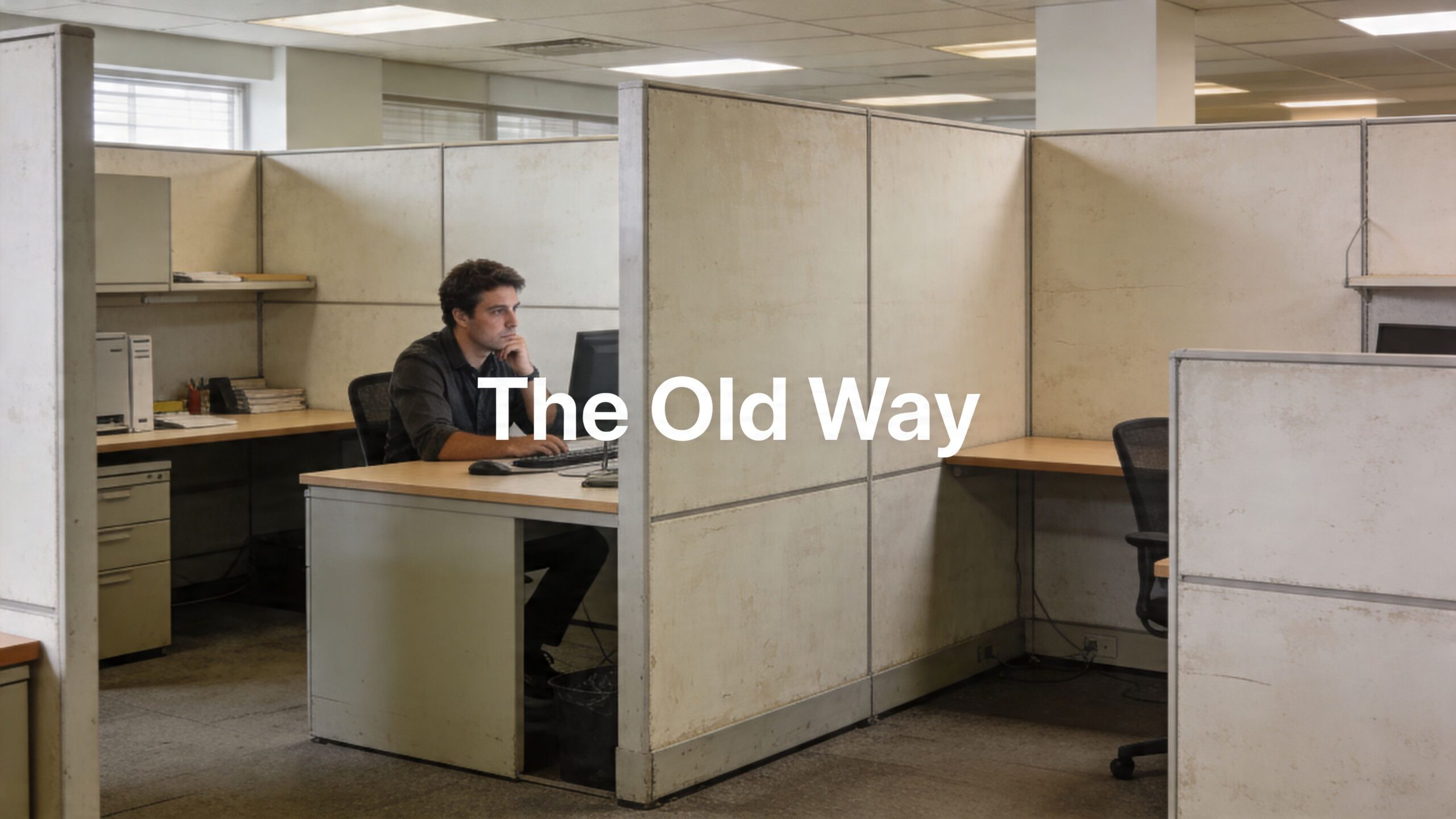
Traditional partitions earned their place. The shift away from permanent masonry walls to modular systems began in the 1970s and 80s, and by 2023, 82% of UK facilities managers reported using office partitions primarily to address acoustic challenges in open-plan settings. The same source notes that noise reduction via modular walls improved employee satisfaction scores by 18%, according to Mannlee Commercial Workplace.
That history matters. Traditional office partitioning walls gave employers a practical way to carve meeting rooms, private offices and quiet corners out of open floorplates. Glass systems, framed systems and solid demountable systems all still have a role. For that category, Logika partition systems are a relevant reference point when a project needs relocatable walling rather than standalone pods.
Where fixed partitions fall short now
The problem is that many traditional systems still behave like a compromise between old construction and modern flexibility. They divide space, but they don’t always solve the core user experience.
A basic partitioned room often needs separate work on lighting, power, ventilation and acoustic detailing. It can also take more planning to change later. That matters in hybrid workplaces where occupancy patterns can shift quickly.
A fixed partition makes sense when the room use is stable. It becomes expensive when the room use keeps changing.
Three issues come up repeatedly:
- Reconfiguration pain: A room built for one team size may be wrong six months later.
- Acoustic inconsistency: A visual barrier isn’t always an acoustic barrier.
- Construction disruption: Even demountable systems can involve more coordination than teams expect.
Traditional partitions still suit some projects well. They’re strong for perimeter meeting rooms, management offices and permanent zoning. But when the brief calls for speed, mobility and fully integrated privacy, they start to look slow and rigid compared with pods.
The Modern Solution The Rise of the Office Pod
A pod is not just a small room
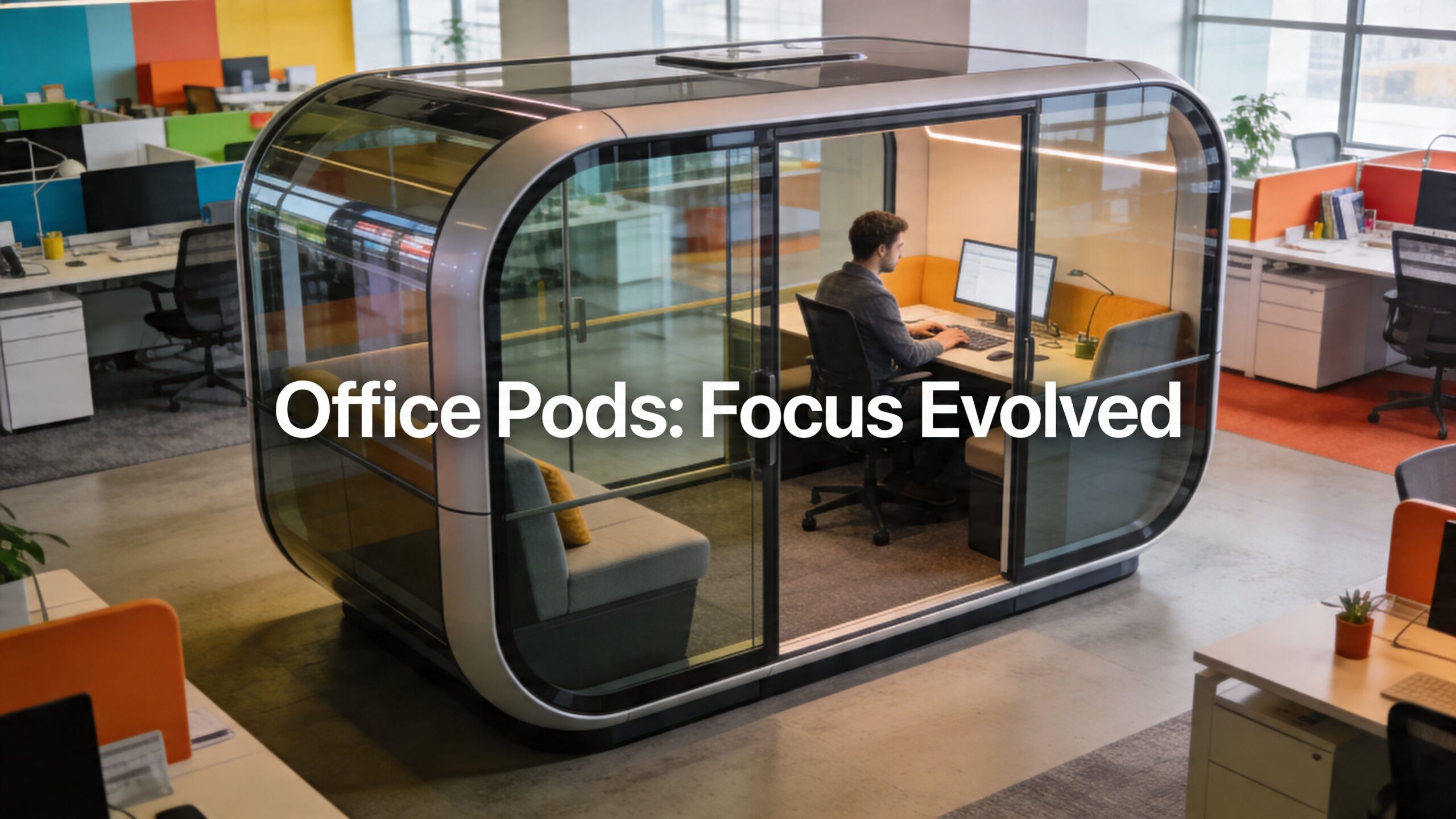
An office pod is the modern answer to the old partitioning problem. It doesn’t just mark out space. It creates a self-contained working environment with privacy, acoustic separation and built-in functionality.
That difference is bigger than it sounds. A pod doesn’t ask a facilities team to build a room and then sort the details later. The lighting, ventilation, seating, table format and power access are usually part of the solution from the start. That’s why pods feel less like construction and more like deployment.
The strongest workplace schemes now use pods as targeted infrastructure. One-person pods absorb private calls. Small meeting pods stop two-person conversations leaking across the office. Larger enclosed booths give project teams somewhere to work without occupying formal meeting rooms all day.
For broader workplace planning, office space design thinking is shifting in the same direction. Layouts need settings, not just square metres.
Why pods suit hybrid workplaces better
Hybrid work has made adaptability more valuable than permanence. Some teams need enclosed space every day. Others need it only at peak moments. Pods handle that variation better than many fixed builds because they give a workplace enclosed capacity without turning the whole floor into hard construction.
Key advantages stand out.
- Acoustic control: Pods are built around privacy and focus, not just visual division.
- Integrated features: Lighting, airflow and power are part of the working environment.
- Faster deployment: They avoid much of the disruption associated with traditional room creation.
- Future flexibility: Many models can be relocated if the office changes.
Workplace test: If a space needs to perform on day one without a long chain of follow-on works, a pod is usually the cleaner solution.
This video gives a useful sense of how pods function in real workplaces.
Pods also improve the social balance of an open office. They allow open collaboration to stay open, while giving people somewhere to retreat when the task needs concentration or discretion. That is a far better model than trying to make every desk support every type of work.
Finding Your Perfect Pod A Guide to Our Brands
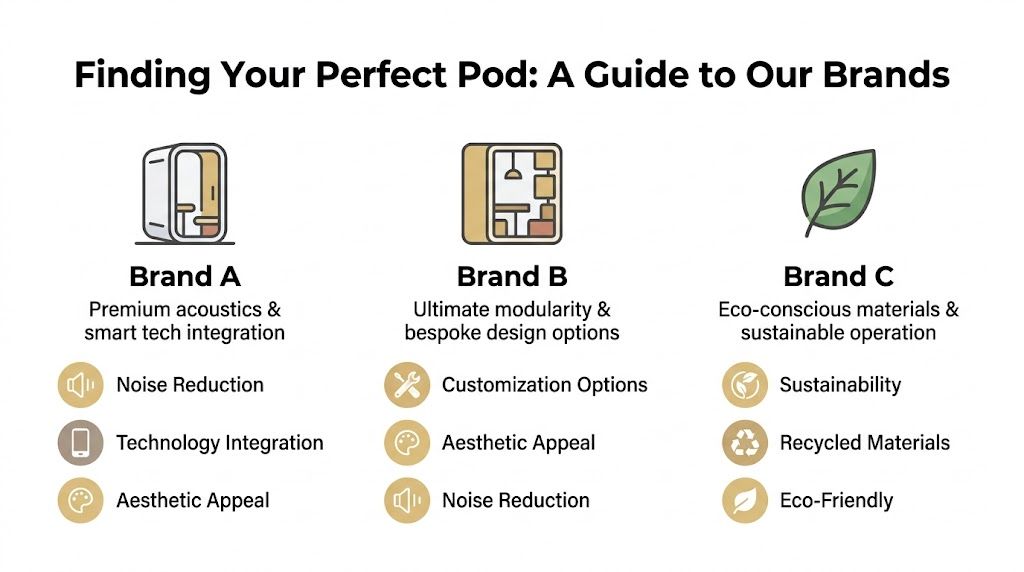
A good pod choice starts with pressure points on the floor. Where are people getting blocked. Calls taken at desks. Managers hunting for private space. Project teams borrowing meeting rooms for work that needs two hours, not twenty minutes. Define that operational problem first, then choose the brand and format that fits it.
Match the pod to the task
Framery fits offices that need a proven range across solo, small meeting and larger collaboration settings. It suits facilities teams that want a familiar specification route and a refined finish without sacrificing acoustic performance.
BlockO makes sense where modular planning is a priority. It works well in layouts that will keep changing, especially where pods need to feel like part of the wider interior scheme rather than standalone boxes dropped onto the floorplate.
Kabin is a practical choice for projects that need enclosed space fast and without unnecessary complexity. If the brief is straightforward and the business wants clear function, Kabin deserves serious consideration.
Vetrospace suits workplaces that put equal weight on comfort, finish and privacy. It is a strong fit for executive areas, client-facing zones and offices where visual quality matters alongside day-to-day performance.
If you are still comparing pods to fixed office partitioning, start by reviewing soundproof office partitions and pod alternatives. That comparison helps clarify when a pod solves the problem faster and with less disruption.
One supplier in this area, Gibbsonn, provides these brands alongside planning, installation and aftercare, allowing facilities teams to source products and manage delivery through a single point of contact.
Pod Solutions at a Glance
| Pod Use Case | Typical Capacity | Key Feature | Ideal For | Recommended Brands |
|---|---|---|---|---|
| Phone privacy | Solo | Enclosed call space | Sales floors, open offices, reception-adjacent areas | Framery, Kabin |
| Focus work | Solo | Quiet concentration zone | Hybrid teams, hot-desking environments | Framery, Vetrospace |
| Quick meetings | 2 to 4 people | Fast access to enclosed discussion space | Project teams, managers, interviews | BlockO, Framery, Vetrospace |
| Team collaboration | Small groups | More generous internal layout | Workshops, creative sessions, problem solving | BlockO, Vetrospace |
| Flexible overflow space | Varies | Easy integration into changing layouts | Coworking, serviced offices, growth-stage businesses | Kabin, BlockO, Framery |
Use a simple filter when shortlisting.
- Constant phone traffic: put solo pods close to dense desk areas, not hidden in a quiet corner no one will use.
- Confidential one-to-ones: choose compact meeting pods with stronger acoustic separation and clear booking rules.
- Creative teamwork: prioritise larger interiors, better sightlines and layouts that support longer sessions.
- Mixed-use offices: standardise around one pod family where possible. It makes planning, maintenance and future expansion easier.
The right pod removes a recurring operational headache and keeps the floorplan flexible.
When external pods make more sense
Some space problems should not be forced back into the main office. If the internal layout is already tight, an external pod can create meeting, interview or focus capacity without stripping desks or reworking core circulation.
That is why The Meeting Pod Co has a clear role in the mix. External pods suit sites that need a separate visitor setting, a quieter destination away from the main floor, or added enclosed space while a wider workplace reconfiguration is still being planned.
Before specifying any pod, internal or external, keep compliance in view. This building regulations guide is a useful reference for the wider framework facilities teams need to check during procurement.
Beyond the Look Key Specifications and Compliance
A pod that looks good and performs badly is a liability. Facilities managers need better questions than “Does it fit the style?” The serious issues are acoustics, fire performance, glazing safety, ventilation and how the product sits within the building’s compliance framework.
Acoustics come first
Acoustic underperformance is one of the fastest ways to waste budget. Post-2023 hybrid work trends show that 68% of UK facilities managers report challenges integrating partitions compliant with Building Regulations 2010, and non-compliant acoustic partitions contribute to 25% higher noise complaints in London-based firms, according to MW Workstation.
That’s the warning sign. A workplace can spend money on enclosure and still end up with complaints if specification is weak.
For partitioning systems, advanced products such as feco partition walls achieve sound insulation values up to Rw,P = 52 dB, with fire resistance ratings up to 90 minutes, according to the feco partition wall technical document. For office environments, practical specification often means checking whether the system can support the level of speech privacy the space needs.
Facilities teams that want a plain-English refresher on the wider legal framework may find this building regulations guide useful alongside product-specific technical reviews.
Specification rule: Don’t approve an acoustic product until the supplier explains what the rating means in day-to-day use.
For broader acoustic planning, soundproof office partitions are part of the same conversation. Privacy only works if the user can feel it.
Glass fire safety and practical compliance
Glass specification is another area where vague language causes problems. In UK office partitioning walls, glass must align with standards such as BS EN 12600 and Approved Document K. The verified data shows that tempered or laminated glass of at least 10 mm is mandated for heights over 800 mm in collision-prone areas, and systems such as Aluprof MB-45 OFFICE use 10-12 mm acoustic glass providing sound reduction up to 39-45 dB according to the Aluprof partition systems document.
The practical takeaway is simple.
- Check glass type early: Don’t assume standard glazing is suitable.
- Review fire requirements by location: The same product may not suit every part of the building.
- Ask about ventilation in use, not on paper: Comfort falls fast in poorly ventilated enclosed spaces.
- Confirm maintenance access: Filters, electrics and finishes all need a workable service plan.
A compliant pod or partition isn’t just safer. It’s easier to defend internally when procurement, estates and health and safety all start asking the same questions.
Smart Procurement The Shift to Flexible and Sustainable Futures
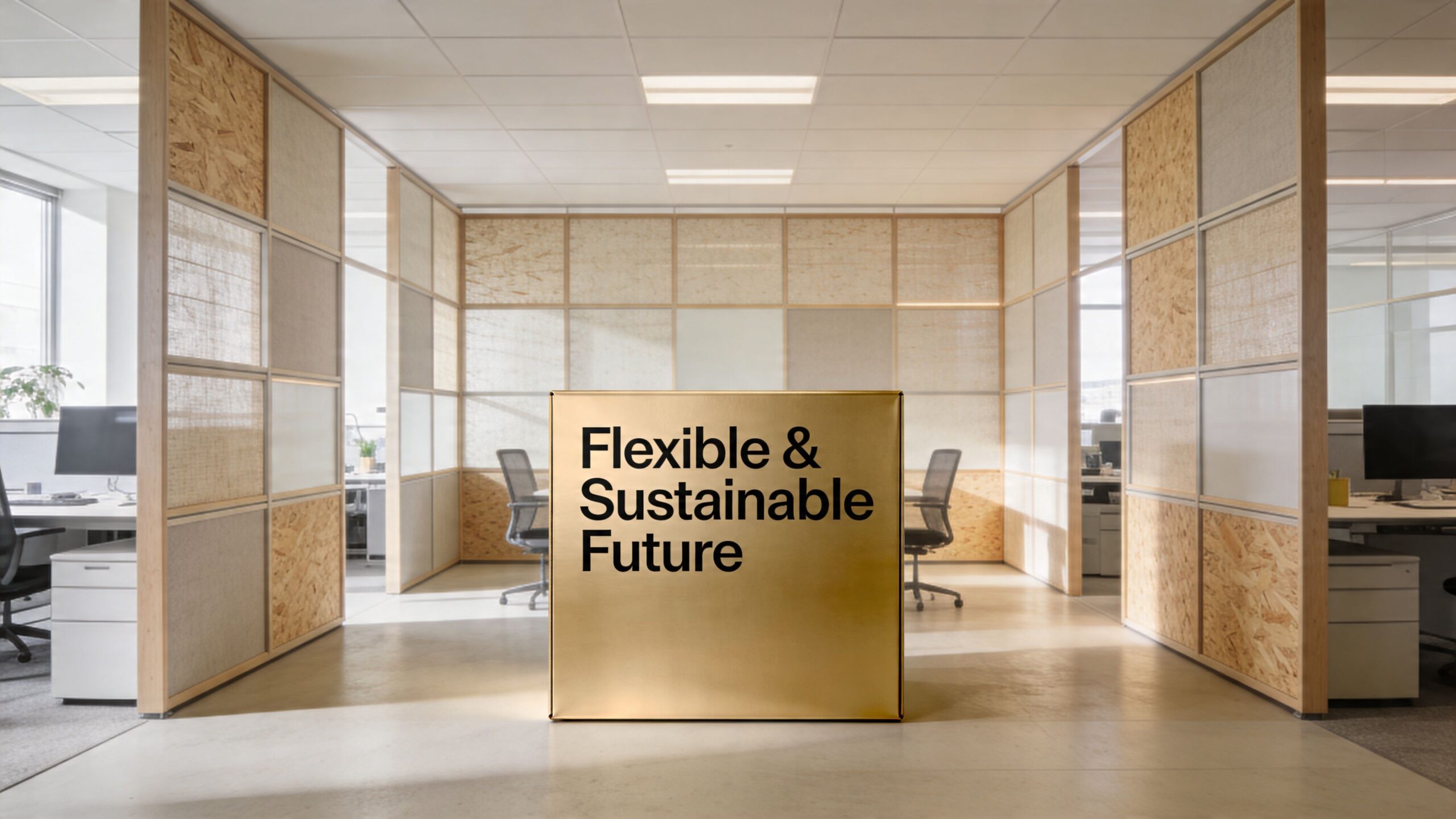
Buying everything outright is often the wrong move
A lot of workplace projects still default to ownership. That’s often lazy procurement. If attendance patterns, team shape and lease strategy are still moving, locking capital into fixed solutions can be the least flexible option on the table.
That matters more now because cost pressure is real. UK office fit-out costs rose 8.2% year on year, and rental models like Framery Subscribed can offer 30-50% savings versus purchase on a total cost of ownership basis. The same verified dataset notes that 55% of workplace managers now actively seek rental pods for agility, according to Doors22.
That’s why pod rental deserves serious attention. Framery Subscribed gives organisations a route into acoustic pods without the same upfront commitment as purchase. For businesses managing phased moves, uncertain growth or trial deployments, that’s often the smarter commercial decision.
Rental fits the circular economy better
There’s also a sustainability argument, and it’s stronger than most fit-out teams admit. Fixed construction usually assumes permanence. Modern workplaces rarely stay still long enough to justify that assumption.
Rental and redeployment fit the circular economy more naturally because the product can stay in use across different organisations and different layouts rather than being stripped out and discarded. That thinking aligns with Gibbsonn’s sustainability approach, where reuse, refurbishment and responsible procurement matter more than one-off installation.
For readers tracking broader workplace trends, latest insights on flexible and sustainable office design add helpful context around how office strategy is evolving.
A practical comparison makes the point clearer.
| Procurement Route | Best Fit | Main Advantage | Main Risk |
|---|---|---|---|
| Outright purchase | Stable long-term layouts | Asset ownership and permanence | Reduced flexibility if needs change |
| Pod rental | Hybrid teams and uncertain growth | Lower upfront commitment and easier scaling | Less suitable if the exact same layout is guaranteed long term |
| Traditional fixed partitions | Permanent room creation | Strong for established enclosed spaces | Harder to adapt and may create more disruption |
Renting pods isn’t a compromise. In many workplaces it’s the more disciplined choice.
The strongest procurement strategy usually mixes methods. Permanent needs can justify fixed solutions. Variable needs should stay variable.
Your Action Plan From Layout to Launch
Good workplace projects don’t start with products. They start with behaviour. If the brief begins with “Where can a pod fit?” the process is already backwards. The right question is “Which work activity is currently unsupported?”
Start with behaviour not furniture
A facilities manager can move quickly by following a short audit.
Map the noisy moments
Identify where calls, quick meetings and concentration clashes are happening now.Separate permanent from variable needs
A fixed leadership suite is one thing. A fluctuating demand for phone privacy is another.Decide what should be enclosed
Not every task needs four walls. Enclose only the activities that suffer in open plan.Check adjacency
Pods work best where they are close to demand, but not dropped into circulation routes that create new disruption.
Staff behaviour is the clearest brief. Watch what they do when the office stops supporting them.
Plan delivery installation and upkeep properly
Once the layout logic is clear, execution gets easier. The practical checklist is straightforward.
- Power and data: Confirm what the pod needs and where feeds will come from.
- Access routes: Measure lifts, doorways and delivery paths before ordering.
- Floor loading and services: Coordinate with building management early.
- User guidance: Decide whether pods are bookable, first-come-first-served or assigned to teams.
- Maintenance ownership: Someone needs responsibility for cleaning, servicing and reporting faults.
Installation day should feel organised, not dramatic. The smoother projects usually involve one coordinated plan covering delivery sequencing, assembly area, final placement and user handover. After that, the main job is management discipline. Pods fail when organisations treat them as novelties instead of shared workplace infrastructure.
Create Your Future-Ready Workplace Today
Old-fashioned office partitioning walls still have their place. But most modern workplaces need more than division. They need agility, privacy, acoustic control and procurement options that match uncertain business conditions.
That’s why pods have become the sharper answer. They solve immediate workplace problems without forcing the office into a rigid future. They support focused work, better meetings and a calmer daily experience. They also fit a more flexible and more sustainable view of workplace investment.
The next step should be practical. Shortlist the spaces that are underperforming. Decide which activities need enclosure. Then test the pod formats that fit the behaviour of the team. A showroom visit helps. Seeing the products in person makes specification far easier, especially for organisations comparing brands, sizes and acoustic feel. Booking an appointment and visiting the Bishop's Stortford showroom is a sensible way to make a confident decision.
Ready to reshape the workplace with smarter pod solutions, flexible procurement and a layout that supports how people work? Speak to Gibbsonn, book an appointment, and visit the showroom in Bishop's Stortford to see the options in person.