
A facilities manager usually notices the problem long before anyone else says it out loud. The changing room starts to feel tired. Doors slam. Metal dents. Damp kit lingers too long. Staff squeeze around each other at peak times, then avoid the space altogether because it feels noisy, exposed and badly planned.
That’s a significant issue with most lockers for changing rooms. The locker itself isn’t the only problem. The whole room has been treated as a leftover utility zone when it should support wellbeing, order and privacy just as much as the main workplace.
A smart upgrade fixes storage, yes. But the better move is broader. It creates a space that’s secure, easy to clean, pleasant to use and far more useful than a row of boxes against a wall.
Table of Contents
- Reimagining Your Changing Room From Utility to Asset
- Defining Your Core Needs Before You Specify
- Choosing Your Locker Material Metal vs Laminate vs Plastic
- Essential Features Security Ventilation and Smart Technology
- Beyond Storage The Rise of the Acoustic Privacy Pod
- Smart Finances Pod Hire and the Circular Economy
- Planning Your Space Layouts and Integration
- Your Next Step Towards a Better Workplace
Reimagining Your Changing Room From Utility to Asset
At 8:45 on a wet Tuesday, the changing room tells staff what kind of employer they work for. If they walk into noise, crowding, damp kit on benches and battered lockers, the message is clear. The space was built to store belongings, not to support people.
That is a mistake.
A changing room sits at a key point in the working day. It handles the transition from commute to work, from shift to home, from public mode to private routine. Treat it as a leftover service room and it will keep causing friction. Plan it properly and it starts improving wellbeing, order and usable floor space across the building.

The brief has changed
Lockers were originally specified for a narrow job. Secure personal items. Store uniforms. Keep circulation under control. That utilitarian mindset still shapes many projects, even in offices and mixed-use workplaces that now expect far more from support spaces.
The expectation has shifted. Staff want practical storage, but they also want dignity, privacy and a room that does not feel like the worst part of the building. Facilities managers should respond to that shift in the same way they respond to better open-plan office design for focus, privacy and flow. Support spaces affect workplace experience just as much as desks and meeting rooms do.
“A changing room shouldn’t feel like the forgotten end of the building. It should feel like part of the workplace.”
What a better changing room does
A good scheme does more than line up lockers against a wall.
- Supports wellbeing: Staff can change, store belongings and compose themselves without being rushed or exposed.
- Improves space efficiency: Clear zones for storage, changing and short private use stop the room being clogged by one activity.
- Raises workplace standards: A polished office paired with a poor changing room creates an obvious credibility gap.
- Adds flexibility: Traditional lockers can sit alongside acoustic privacy pods, giving people a place for a private call, a quiet reset or a discreet moment away from busy circulation.
That last point is where many upgrades become far more valuable. If the room already carries footfall, services and amenity value, it can do more than hold coats and bags. It can become a compact, multi-functional asset that supports active travel, hybrid routines and employee comfort without demanding a separate room elsewhere.
Replacing old lockers with new lockers may tidy the space. Replanning the room around storage, privacy and flow will improve how the workplace works.
Defining Your Core Needs Before You Specify
Most locker mistakes happen before any product is chosen. The brief is too vague. Someone asks for “more lockers” when the underlying need is better storage for cyclists, secure laptop stowage, or a layout that doesn’t collapse at busy times.
Start with users, not units.
Build the brief around actual behaviour
A changing room used by office staff is different from one used by engineers, gym members or airport teams. The right specification depends on what people bring, when they arrive and how long they occupy the space.
A simple needs review should answer four questions:
- Who uses the room
- What they need to store
- When the room is busiest
- What else the space must support apart from storage
If that sounds basic, good. Overcomplicated briefs often miss practical problems.
Separate user groups before discussing locker sizes
Different users create different demands:
- Cyclists and runners: They need room for shoes, helmets, wet clothing and wash kits.
- Desk-based staff: They often need secure space for bags, coats and occasional tech.
- Uniformed teams: They may need separation between clean and used items.
- Shift workers: They create concentrated peaks, not steady all-day usage.
A facilities team should walk the room at opening time, lunchtime and end of shift. The space tells the truth faster than a spreadsheet does.
Practical rule: If bags are left on benches or floors, the issue usually isn’t behaviour. It’s poor locker capacity, awkward dimensions or weak layout planning.
Define the room’s operational priorities
A good specification balances several needs at once. That makes a short requirement list useful.
| Priority | What to confirm |
|---|---|
| Security | Are valuables being stored or only clothing and shoes |
| Moisture | Is the room dry, damp or regularly wet |
| Turnover | Do users access lockers once a day or repeatedly |
| Cleaning | Can staff clean around and beneath units easily |
| Experience | Does the room need to feel basic, premium or brand-aligned |
Once those answers are clear, selection becomes much easier.
Don’t treat storage in isolation
Changing rooms usually connect to wider workplace storage habits. Teams often need a joined-up approach between personal storage near desks and secure storage near showers, changing areas or welfare spaces. A broader review of office storage ideas often helps expose duplication and dead space.
Three specification errors appear repeatedly:
- Buying every locker in one size: This wastes space and frustrates users with larger kit.
- Ignoring peaks: A room that feels fine at midday may fail completely at 8.30 am.
- Overfocusing on purchase price: Cheap units can become expensive when repairs, corrosion and replacement hit.
The strongest brief is blunt, practical and based on use. It doesn’t chase catalogue features for their own sake. It solves daily friction.
Choosing Your Locker Material Metal vs Laminate vs Plastic
Material choice decides whether the room will still look good in a few years or start failing almost immediately. Many projects go astray at this point. A locker that looks acceptable on a tender sheet can be completely wrong for a humid end-of-trip room or a high-traffic staff facility.
There isn’t one best material for all lockers for changing rooms. There is a best material for the environment.
Metal still has a place, but only when specified properly
Metal lockers remain a valid choice in many dry workplace settings. They’re familiar, widely available and can be cost-effective. But thin, low-grade units often disappoint fast.
In UK changing rooms, metal lockers must comply with BS 4680:1996, and in damp environments phenolic laminate or HDPE lockers outperform metal by 59x in impact resistance and offer 99% bacteria resistance due to non-porous surfaces, leading to 25% lower lifecycle costs, according to this breakdown of locker durability and hygiene performance.
That single comparison should shape most material decisions.
A simple decision guide
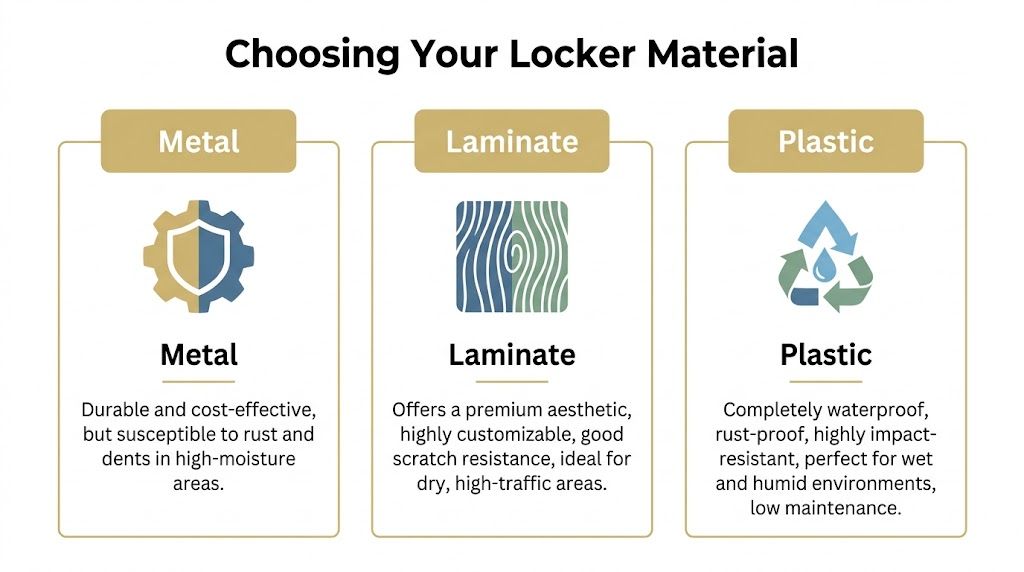
| Material | Best fit | Main strength | Main weakness |
|---|---|---|---|
| Metal | Dry staff areas and budget-led projects | Familiar and robust when compliant | Can dent, corrode and age badly in damp use |
| Laminate | Premium interiors and design-led environments | Strong appearance and good surface quality | Not the first pick for persistently wet conditions unless specified carefully |
| Plastic | Wet, humid and heavy-use changing rooms | Waterproof, highly impact-resistant, low maintenance | Can feel more utilitarian if aesthetics aren’t handled well |
Where metal works and where it doesn’t
Metal is sensible when the room is dry, the users are relatively light-touch and the visual language suits an industrial finish. In a corporate basement changing room with controlled humidity, a good metal locker can perform well.
It’s a poor choice when the room is wet, crowded or aggressively used. Repeated impacts, moisture and cleaning cycles expose weak construction quickly. Doors twist. Corners chip. Rust becomes visible. The room starts looking neglected even when cleaning standards are fine.
A cheap metal locker often ends up costing more because it drags the whole room down long before the end of the fit-out cycle.
Laminate and plastic solve different problems
Laminate suits projects where appearance matters as much as function. It gives specifiers a broader design palette and can sit comfortably in premium staff amenity spaces, higher-end leisure environments and brand-conscious workplaces.
Plastic, especially HDPE, is the bluntly practical answer for damp and punishing use. It resists water, takes knocks well and is easier to keep looking presentable in settings where wet kit and frequent cleaning are normal.
A useful rule of thumb helps here:
- Choose metal for dry environments with tighter budgets and sensible usage.
- Choose laminate when the room sits closer to the workplace brand experience.
- Choose plastic or phenolic when water, hygiene and durability drive the brief.
Don’t let aesthetics override environment
Facilities teams sometimes choose a material because it matches a moodboard. That’s backwards. The environment should decide the shortlist first. The finish and colour should come second.
The best changing rooms do both. They use the right substrate for performance, then bring in a cleaner visual tone through colours, hardware and layout. That approach protects the investment and stops the room ageing before the rest of the workplace does.
Essential Features Security Ventilation and Smart Technology
A locker shell matters, but features decide whether the room runs smoothly. Security, ventilation and access control shape the daily experience more than is commonly expected.
If users can’t trust the lock, can’t air out damp kit or can’t access a locker easily, the specification has failed.
Security should match what people actually store
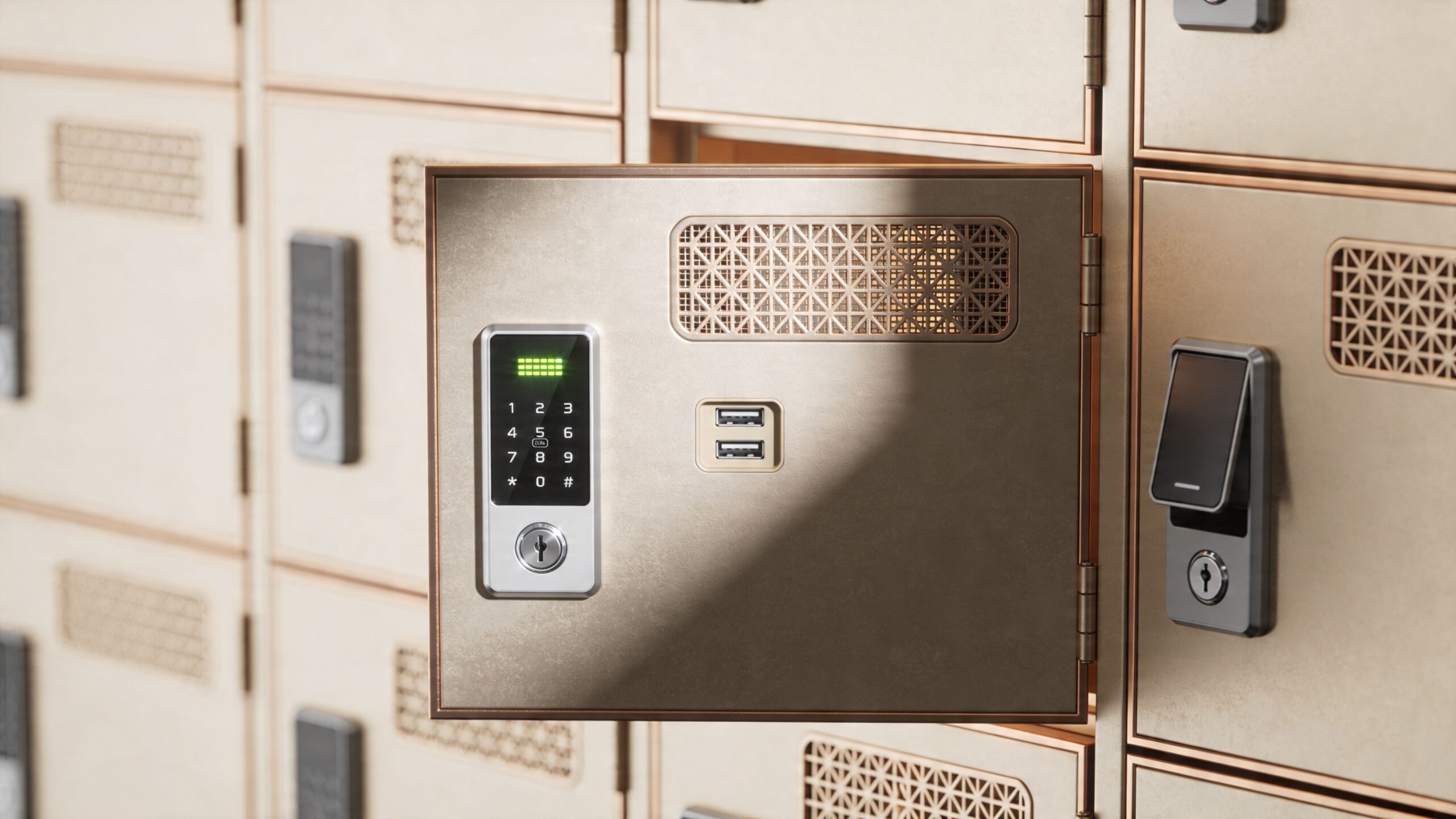
Not every room needs advanced digital access. Some still work well with straightforward mechanical solutions. But a modern workplace changing area often stores more than coats and shoes. Staff may leave bags, phones, wallets and work devices.
That shifts the conversation from basic closure to reliable lock management.
A practical hierarchy works well:
- Padlock-ready doors: Good for simple, user-managed systems.
- Mechanical combination locks: Better when key loss is a regular headache.
- Digital keypads and RFID access: Stronger for managed facilities, rotating users and cleaner administration.
- Smart lockers with app or integrated access control: Best where the building already runs on connected systems.
For teams reviewing lock options in more detail, this guide to cabinet door lock security is a useful reference point because it breaks down the security logic behind lock types clearly.
Ventilation is not optional
Poor ventilation ruins changing rooms. It drives odour, slows drying and makes even a clean room feel unclean. Vented doors, internal airflow and sensible spacing all matter.
Post-pandemic hygiene expectations have pushed this further. Health and Safety Executive guidance requires secure, cleanable storage to help prevent slips and contamination, and facilities adopting enhanced hygiene measures including antimicrobial surfaces and better ventilation in changing areas can reduce certain workplace incidents by up to 15% in high-traffic zones, according to this overview of locker and room hygiene considerations.
That’s a strong reason to stop treating ventilation as a cosmetic detail.
Smart features worth paying for
Not every smart feature earns its keep. Some do.
- Digital keypad access: Reduces lost key administration.
- USB charging: Useful in commuter-heavy staff environments.
- Touch-friendly and easy-clean surfaces: Support hygiene and maintenance.
- Occupancy visibility: Helps where lockers are shared or assigned dynamically.
The right feature set depends on how the facility operates. A small office changing room might only need dependable mechanical locking and good airflow. A larger multi-user site may benefit from digital control and easier reassignment.
A short product video often helps stakeholders move from theory to practical understanding:
The best feature is simplicity
Overcomplication causes support calls. The best lockers for changing rooms are easy to understand at first glance. A user shouldn’t need instructions to lock a door, find a vent path or charge a device.
“If the lock confuses users or the ventilation underperforms, the room feels badly managed no matter how new it is.”
A cleaner brief usually wins. Choose the strongest combination of security, airflow and low-friction access. Leave gimmicks out.
Beyond Storage The Rise of the Acoustic Privacy Pod
Most changing room briefs ignore the biggest comfort problem in the space. Noise.
Doors close. People talk. Hairdryers run. Hard surfaces bounce sound around. Traditional specifications deal with durability and layout but rarely with acoustic comfort. That’s a mistake, especially in modern offices where wellbeing and privacy are meant to be built into the environment.
Why pods belong near changing facilities
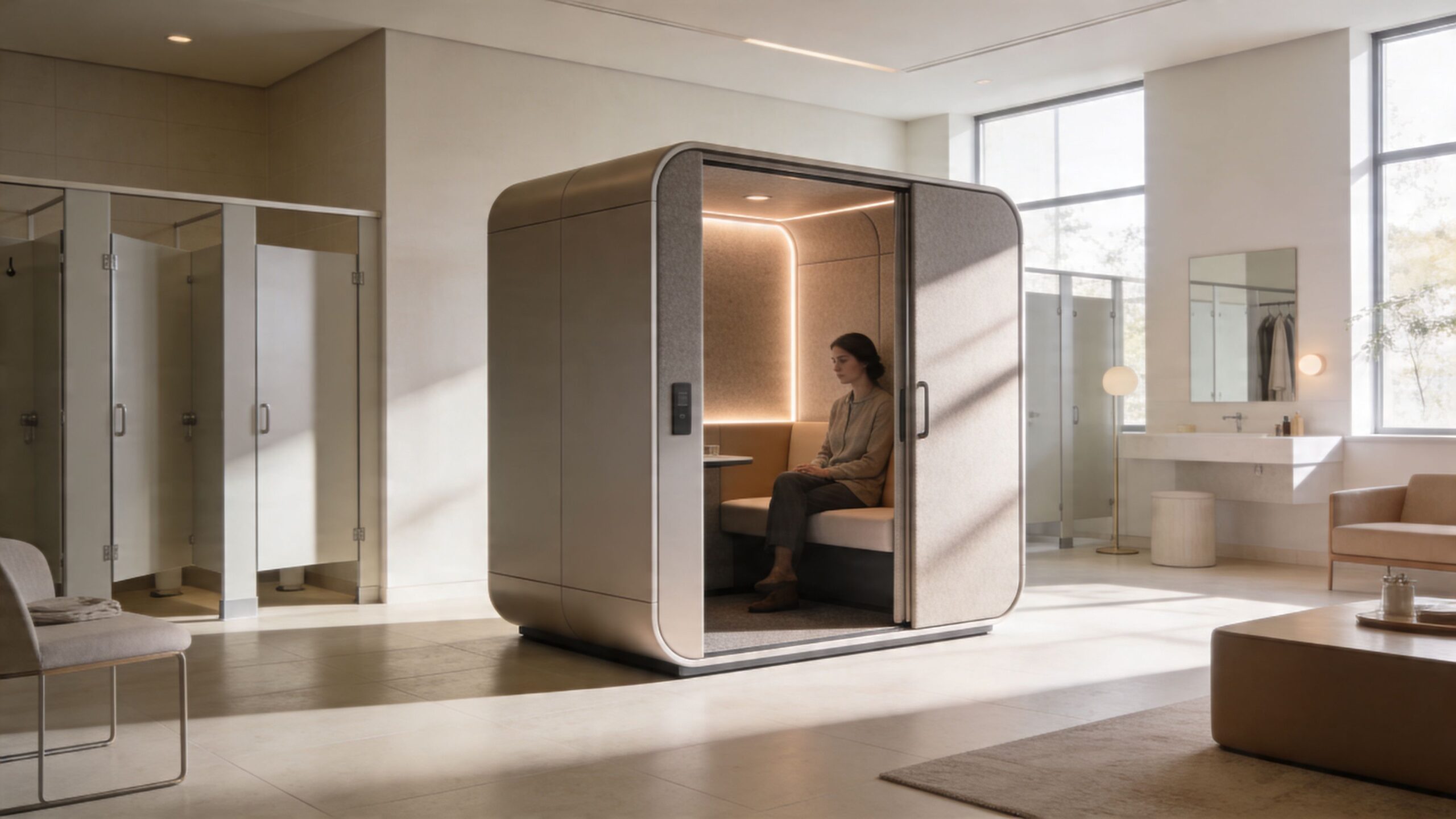
A strong changing area isn’t just a place to store kit. It’s a transition zone. Staff arrive from a commute, change, regroup and move into the day. Some need privacy for a call. Some need a quiet minute before heading into an open-plan office. Some need separation from the noise outside.
That’s where acoustic pods change the brief completely.
A key gap in the market is that traditional changing room specifications focus on durability and security but fail to address how noise affects wellbeing and privacy. Integrating acoustic solutions like pods addresses that gap, as highlighted in this note on acoustic performance in changing room environments.
This is not replacing lockers. It’s upgrading the room
The strongest approach is hybrid. Use lockers for secure storage. Add acoustic solutions for privacy, quiet work, decompression or short calls.
That changes the room from a single-function space into a multi-purpose amenity. In the right setting, one pod can support:
- Private calls before meetings
- A quiet reset point after an active commute
- A discreet place for wellbeing or personal admin
- Spillover privacy close to showers and end-of-trip facilities
This matters in offices where every square metre needs to work harder.
Which pod styles suit these spaces
Different pod brands fit different workplace characters and budgets.
- Framery works well when acoustic performance and polished user experience sit high on the list.
- Blocko suits teams wanting a strong balance of practicality and clean design.
- Kabin can fit compact footprints where flexibility matters.
- Vetrospace is a strong option when visual quality and premium feel carry weight.
The right pod doesn’t need to dominate the room. It just needs to solve a real privacy problem.
Noise is part of the changing room brief whether the specification acknowledges it or not.
A better experience improves space value
An opportunity exists for many facilities managers to create quick strategic value. A changing room rarely gets budget priority, but when it includes privacy and acoustic relief it starts serving multiple workplace needs at once.
That’s especially useful in offices under pressure to prove space quality, not just space quantity. A locker row stores belongings. A pod-supported changing zone supports people.
Smart Finances Pod Hire and the Circular Economy
Capital spend isn’t the only route to a better space. That matters because many workplace teams know what they want but struggle to release budget for outright purchase, especially when priorities compete across the building.
Flexible procurement changes the conversation.
Hire can be the sharper commercial move
For pods, hiring often makes more sense than buying. It protects cash flow, reduces the barrier to entry and lets a business respond to change without locking itself into a rigid asset decision.
That’s why office pod rental deserves a place in workplace planning. It gives facilities leaders a way to trial, scale or phase pod deployment with less financial friction.
This is particularly relevant where changing rooms sit inside a broader amenity upgrade. The lockers may be a fixed fit-out choice. The pod element can stay flexible.
Framery Subscribed fits changing workplaces
Subscription models are no longer niche. They align neatly with hybrid occupancy, phased refurbishment and uncertain headcount planning. A service such as Framery Subscribed is a practical example of that thinking in action.
The appeal is straightforward:
- Predictable monthly cost: Easier to plan than a large one-off purchase.
- Operational flexibility: Better suited to changing layouts and evolving teams.
- Faster adoption: Premium acoustic solutions become easier to approve.
- Lower commitment risk: Helpful when a business wants evidence before expanding a scheme.
Circular economy thinking is no longer optional
Facilities decisions now sit under wider ESG and sustainability scrutiny. That makes the circular economy more than a nice story. It becomes part of the business case.
Hiring, refurbishing, reusing and extending the life of quality products is often smarter than repeated low-cost replacement. That applies especially to workplace pods, where durable products can stay in use across layout changes and fit-out cycles.
A clear sustainability strategy also helps internal approval. Workplace teams can point to environmental value as well as user value. Broader commitments around sustainability and circular thinking support that case.
Commercial view: The cheapest route at purchase stage is often the least flexible route over the life of the workplace.
A changing room upgrade doesn’t need to be financially blunt. Lockers can be specified for lifespan. Pods can be funded with flexibility. That combination is often the smartest mix.
Planning Your Space Layouts and Integration
A great product in the wrong layout still fails. Space planning decides whether the room feels calm or chaotic.
Most changing rooms underperform because too many functions are jammed into one zone. Storage, changing, waiting, circulation and privacy all compete with each other. The fix is zoning.
Start with movement, not furniture
The first planning question isn’t how many lockers fit on a wall. It’s how people move through the room.
A practical sequence usually looks like this:
- Arrival
- Locker access
- Bench or changing point
- Shower or wash area if included
- Exit or transition back into the workplace
When that sequence gets crossed up, congestion appears fast. People stop in front of locker doors. Bags block routes. Wet and dry use starts to overlap.
Use clear zones for clear behaviour
The strongest layouts create obvious areas without overbuilding the room.
- Locker zone: Keep it legible and easy to scan.
- Changing zone: Benches should support use without obstructing doors.
- Private zone: Acoustic booths or pods should sit just outside the busiest path, not in it.
- Separation points: Where visual or functional division is needed, partitions from Logika can help define the room cleanly.
That approach improves the room even before any high-end finishes are added.
Pods work best at the edge, not the centre
An acoustic pod placed in the middle of a circulation route becomes an obstacle. Put it on the perimeter, near but not inside the busiest locker traffic. That preserves access and gives the pod user real privacy.
For larger campuses, overflow amenity areas or sites that need external flexibility, The Meeting Pod Co also opens up options beyond the main internal footprint.
A few layout principles make a major difference:
- Protect sight lines: Staff should understand the room immediately on entry.
- Keep wet and dry areas distinct: Even without formal partitions, the room should signal where each activity belongs.
- Avoid deep dead corners: They collect clutter and reduce comfort.
- Leave cleaning access: If cleaners can’t reach around units easily, the room won’t stay presentable.
Design for dignity, not just density
That’s the part many schemes miss. Squeezing in more lockers may look efficient, but it often reduces usability so sharply that the room performs worse.
The best changing room layouts give people enough privacy, enough space and enough clarity to move through the room without friction.
Good planning makes ordinary products perform better. Bad planning can make premium products feel mediocre. Layout is not the final layer. It is the foundation.
Your Next Step Towards a Better Workplace
A facilities manager walks into a changing room on a Monday morning and sees the usual signs of a room that is doing the bare minimum. Bags are piled where they should not be. People are waiting for space. The room stores belongings, but it does little to support the working day.
That is the point to act.
A changing room upgrade should improve more than the lockers. It should improve how the space works, how people feel using it, and how much value you get from every square metre. The strongest schemes combine dependable storage with well-placed privacy solutions, so one room can support changing, secure storage, quiet calls, personal reset time, and short moments of focus.
Facilities managers do not need another product list. They need a clear brief that fits the building, the users, and the wider workplace plan.
The best brief combines proven basics with modern amenity thinking
Start with the fundamentals. Secure lockers. Hard-wearing materials. Good ventilation. Easy cleaning. Locks that suit the risk level and user profile.
Then go further. Add privacy where the room needs it. Improve acoustics where noise spills into the user experience. Look for underused edges or awkward corners that could house a compact pod instead of being wasted. That is how a changing room stops being a support space and starts becoming a workplace asset.
“In the modern workplace, the spaces between the desks are just as important as the desks themselves. Your changing room is a prime opportunity to show your team you care about their entire day, not just the hours they spend at their screen.”
A direct next move
Review the room as if you were planning it from scratch. Watch how people enter, change, store items, wait, and leave. Check where congestion builds. Check whether your finishes still match the setting. Ask whether a privacy pod could give the room a second job without disrupting circulation.
Seeing options in person helps. Booking an appointment at the Bishop’s Stortford showroom gives you the chance to compare pod models, test layouts, and make faster decisions based on what fits the space.
A better changing room is achievable. Gibbsonn helps organisations create better workplace environments with premium acoustic pods, privacy solutions and expert space planning. To discuss a project, book an appointment, or arrange a visit to the Bishop’s Stortford showroom, use the button below.