
The brief often lands on a facilities manager’s desk at the same moment. Staff are complaining about noise. Team leaders want more focus space. HR wants a stronger wellbeing story. Finance wants fewer reactive maintenance issues. The office still has rows of fixed desks that were adequate for a previous way of working, but they no longer support hybrid patterns, shared settings, or the expectation that people can move through the day instead of staying parked in one posture.
That’s where the discussion around a desk with adjustable legs gets more useful. On its own, it’s not a silver bullet. In a well-planned workplace, though, it becomes part of a wider system that supports concentration, comfort, compliance, and better use of space. The strongest schemes don’t treat adjustable desking as a furniture upgrade. They treat it as one layer in a flexible ecosystem alongside acoustic booths, meeting pods, and clear zoning.
A practical note for marketing teams handling the feature image. The text should read Your 2026 Guide to the Desk with Adjustable Legs and it should be centred in the middle of the image so it remains visible within a round aperture.
Table of Contents
- Beyond the Buzzword Why Your 2026 Office Needs Dynamic Workstations
- The Ergonomic Imperative Understanding Health and Compliance
- Choosing Your Mechanism A Buyer's Guide to Adjustable Leg Technology
- The Desk and Pod Synergy Designing a Truly Flexible Workspace
- Procurement for the Future Sustainability and Smart Investment
- Your Procurement Checklist Specifying the Perfect Adjustable Desk
- Build Your People-First Workplace Today
Beyond the Buzzword Why Your 2026 Office Needs Dynamic Workstations
A common pattern appears in office fit-outs. The team invests in finishes, meeting rooms, and breakout furniture, then leaves the main workstation area almost unchanged. Noise stays high, posture complaints continue, and people still drift into phone calls at their desks because there isn’t a proper flow between focused work and private conversation. The open plan hasn’t failed because it is open plan. It has failed because it lacks variety.
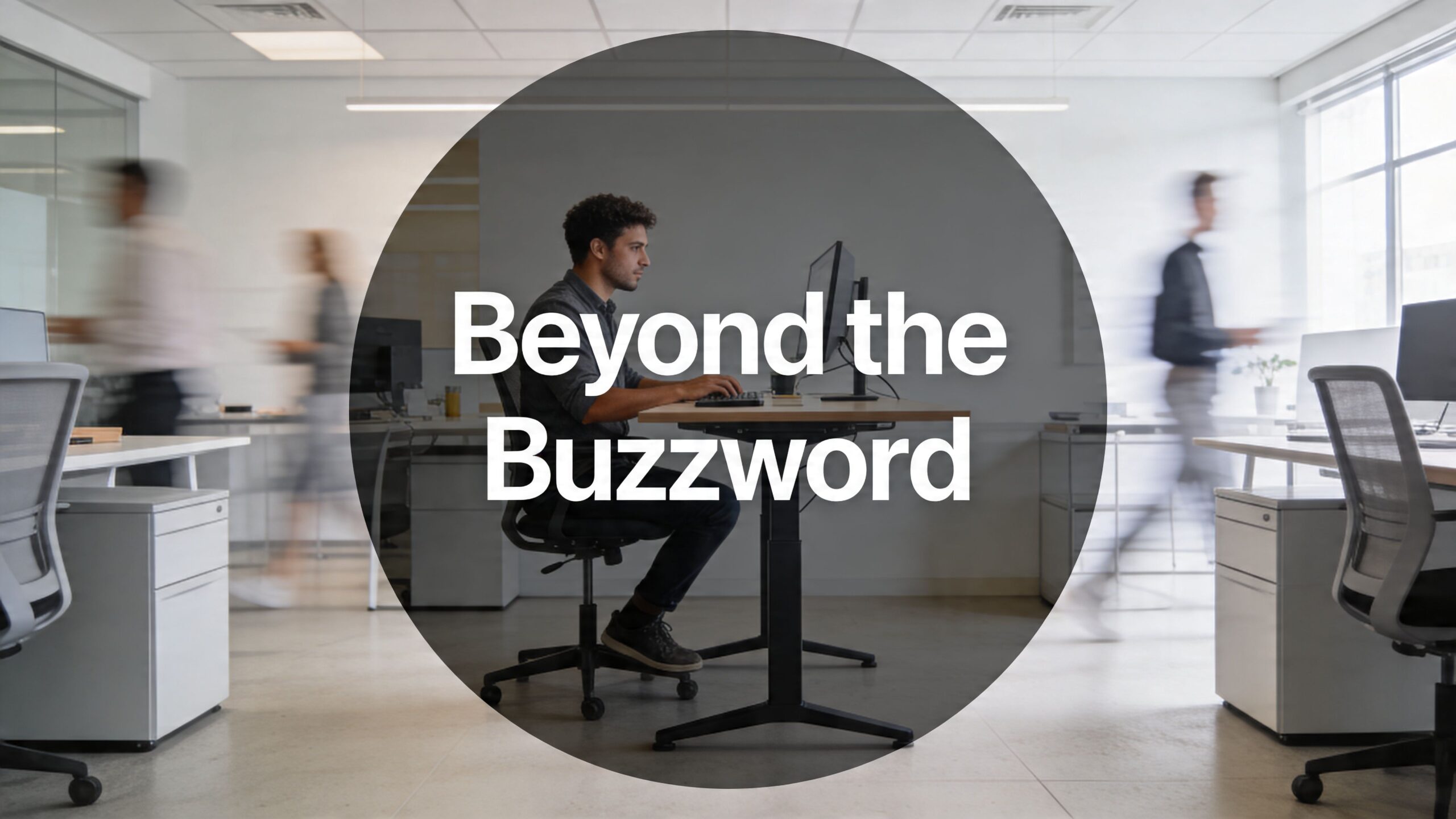
A desk with adjustable legs solves part of that problem by giving people control over posture and task setup. It becomes far more effective when the surrounding workplace also gives them a place to concentrate, take a call, or work in a small group without disturbing everyone else. That’s the difference between buying a product and designing a system.
The behavioural side matters just as much as the hardware. A UK study published in PMC found that 16% of office workers had access to a height-adjustable desk, and regular use was most strongly linked to the perceived advantages of sitting less, with that factor being 1.75 times more significant than any other predictor. The same study also reported that users saw a 47% reduction in upper back, shoulder, and neck discomfort in a Steelcase study discussed within the paper, which is highly relevant for workplace wellbeing and absence risk management in office settings. That evidence is set out in the PMC paper on height-adjustable desk access and use.
The best results come when staff can do three things easily. Change posture at the desk, step into a pod for privacy, and move back into shared space without friction.
This is why dynamic workstations matter in 2026. Staff don’t work in one mode all day. They write, review, call, present, focus, and collaborate. A fixed desk can support only one of those states well. An adjustable desk placed within a workplace that also includes booths, pods, and quieter zones supports several.
For facilities teams, that changes the conversation from furniture choice to workplace performance. The return isn’t only about comfort. It sits in reduced disruption, better compliance, easier space sharing, and a stronger case for bringing people back into an office that helps them work.
The Ergonomic Imperative Understanding Health and Compliance
Poor ergonomics rarely shows up in one dramatic moment. It appears as recurring discomfort, workarounds, poor posture, and low-grade frustration that managers hear about in snippets. Over time, that becomes a compliance risk as well as a people issue.
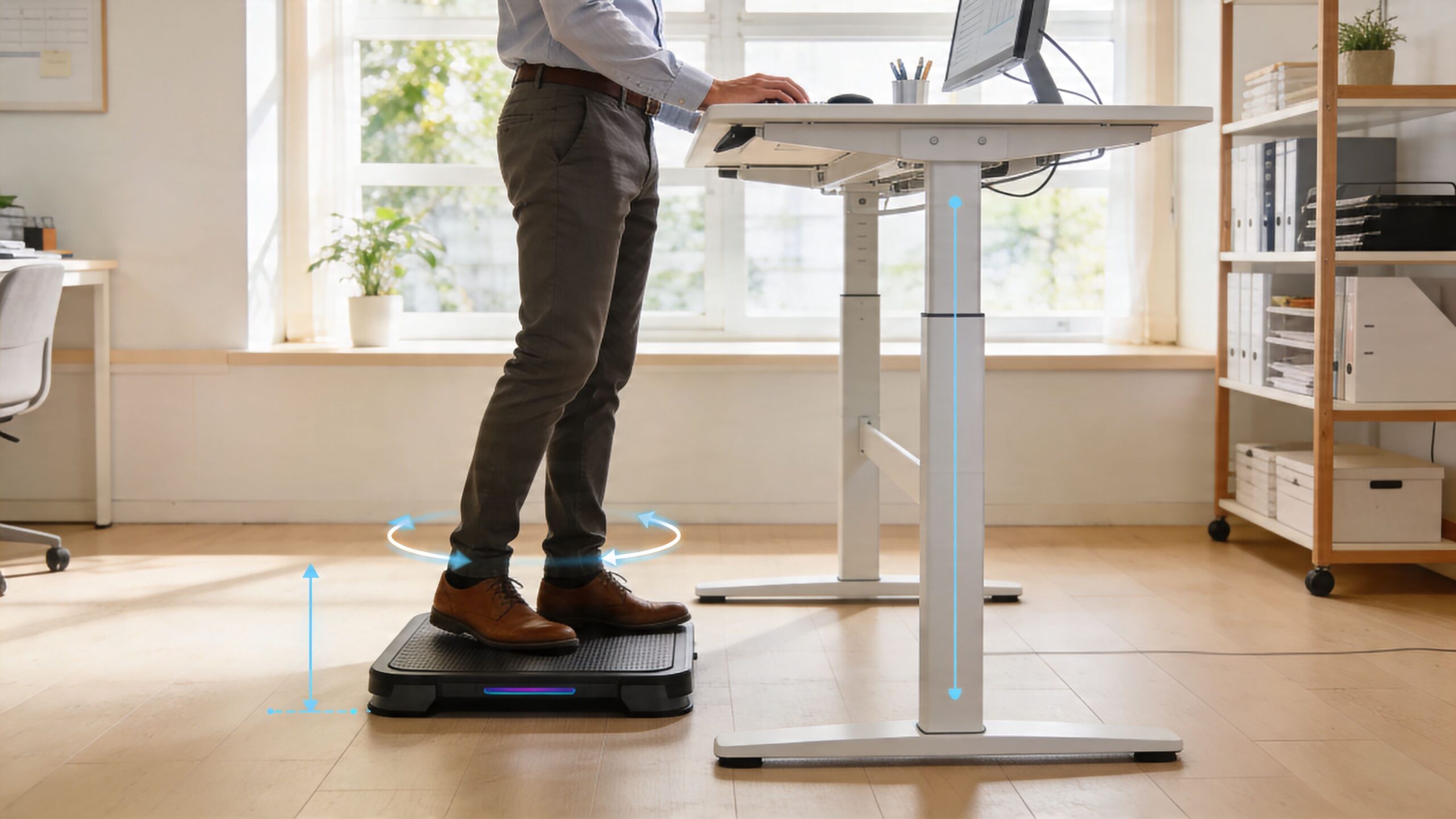
A UK-based SMART Work and Life study found that interventions including height-adjustable desks improved stress, wellbeing, and vigour, and that providing the desk made the intervention three times more effective at reducing sitting time than behavioural measures alone. That matters in offices where workers sit for over 9 hours a day on average, and it aligns with HSE data showing 1.6 million UK workers are affected by work-related musculoskeletal disorders annually, as summarised in Posturite’s review of standing desk research.
Movement matters more than novelty
Some buyers still treat sit-stand working like a trend feature. That’s the wrong lens. The value of a desk with adjustable legs is that it supports regular changes in posture across a working day without forcing staff into awkward compromises.
A fixed desk suits only the person whose body dimensions happen to match that one set height. Shared desking makes that mismatch worse. Adjustable legs allow a workstation to be reset for the next user instead of locking everyone into an average that suits no one properly.
A good desk doesn’t force the user to adapt to the furniture. It lets the furniture adapt to the user.
That principle also helps when an office has multiple work settings. Someone may spend part of the morning at a main workstation, move into a pod for focused calls, then return to desk work. The ability to reset the workstation quickly helps that flow feel natural rather than disruptive.
For readers reviewing desk ergonomics in more detail, this guide to perfect desk height is a useful practical reference.
Compliance is where many fit-outs succeed or fail
The legal side often gets less attention than finishes and layouts, but it should be near the top of the brief. Employers have obligations under DSE regulations and broader health and safety duties. A desk with adjustable legs helps because it gives a wider range of users a workstation that can be set up properly rather than improvised.
That doesn’t remove the need for proper assessment. Facilities teams still need to look at monitor height, reach zones, keyboard placement, seating, and how the workstation is used. But adjustable desks make compliance easier because they widen the range of safe setup options.
The same is true in flexible and shared environments. If the office uses touchdown areas, neighbourhoods, or bookable desks, fixed-height stations can create repeated setup errors. Adjustable desks reduce that friction because one workstation can suit more people with fewer compromises.
A short demonstration helps explain the practical setup issues:
Three compliance habits tend to work best in live projects:
- Specify adjustment range early: Don’t leave height capability vague in the furniture schedule.
- Assess shared settings properly: Hot desking needs easier reset and clearer user guidance.
- Link desks to the full workstation: Cable control, monitor arms, seating, and lighting all affect whether the desk performs as intended.
Facilities managers usually don’t need more theory. They need a specification that prevents problems. Adjustable desks are valuable because they make safe setup more achievable in practice, especially when teams, shifts, and users change over time.
Choosing Your Mechanism A Buyer's Guide to Adjustable Leg Technology
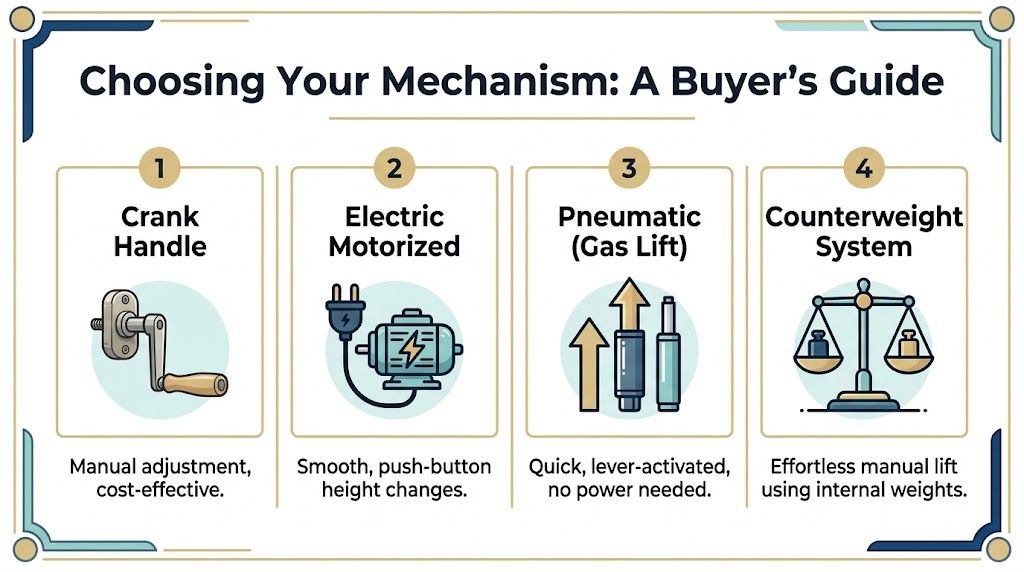
Mechanism choice changes the daily experience of the desk. It affects noise, speed, maintenance, load handling, and how willing people are to adjust the desk at all. A mechanism that looks acceptable in a brochure can become a nuisance in a busy office if it’s slow, unstable, or awkward to use.
What each mechanism is good at
The first decision is operational, not aesthetic. Will the desk be used by one person or many. Will it carry light laptop work or multiple screens and accessories. Is the office quiet enough that motor noise matters. Those questions usually narrow the field quickly.
| Mechanism Type | Adjustment Method | Typical Load Capacity | Pros | Cons |
|---|---|---|---|---|
| Manual | Hand-set or pin-based change | Varies by model | Simple, fewer powered components, often suitable for occasional changes | Slow to adjust, poor fit for frequent switching |
| Crank Handle | User turns handle | Varies by model | Cost-effective, no power draw, straightforward engineering | Takes effort, less appealing in shared fast-paced settings |
| Pneumatic | Lever-activated gas lift | 90kg static load capacity on the UK-spec Oxford QF3 example | Silent, quick, no power needed, useful where cable clutter is a problem | Usually a narrower use case than full electric systems |
| Electric Motorised | Push-button control | Varies by model and frame | Smooth operation, easier for daily sit-stand changes, good for shared desks | Higher service dependency and powered components to maintain |
| Counterweight System | Internal balance mechanism | Varies by model | Manual operation without power, often easy to move | Less common, choice can be limited in commercial specifications |
Pneumatic desks can work well in environments where silent adjustment matters and use is light to moderate. Verified product information on the Oxford QF3 style notes a 90kg static load capacity, a 740 to 1090mm height range, and manual gas spring adjustment without power, as described in the iMovR product reference used in the verified data set. For certain touchdown areas, education settings, and spaces where power access is awkward, that can be a sensible fit.
Electric desks tend to win in mainstream office environments because they reduce friction. Staff are more likely to use the feature if adjustment is immediate and effortless. That matters in shared workstations and roles with dual monitors, docks, and changing users.
For readers comparing powered options specifically, this electronic adjustable height desk guide is relevant.
Practical rule
Choose the mechanism people will actually use every day, not the one that only looks good on the tender sheet.
Why leg design matters more than many buyers expect
Mechanism gets the headline, but leg construction often decides whether the desk feels premium or flimsy. In open-plan offices, wobble is one of the fastest ways to undermine confidence in a workstation.
Verified specification data states that dual-stage telescoping legs compliant with BS EN 527-2:2016 offer a 620 to 1270mm height range and can reduce lateral sway by up to 40% under a 100kg load compared with single-stage legs. That stability matters even more when a desk sits inside or near an acoustic pod, where vibration and movement can affect the user experience. Those details are summarised in the UPLIFT desk reference used in the verified data.
That point is often missed in early design discussions. Buyers focus on desktop finish, handset style, or whether memory presets are included. Stability should be higher on the list. A desk that shakes under monitor arms, video calls, or heavy typing won’t feel fit for purpose no matter how attractive it looks.
What tends to work best in commercial projects:
- Use stronger frames for multi-screen roles: Tech-heavy setups place more demand on the base.
- Match desk type to setting: A touchdown space can tolerate a lighter solution than a primary workstation bank.
- Treat acoustic adjacency seriously: Near pods and booths, rigidity matters because movement is more noticeable.
A desk with adjustable legs should feel settled at every height people are likely to use. If the frame only feels stable at seated height, it hasn’t solved the right problem.
The Desk and Pod Synergy Designing a Truly Flexible Workspace
Gains appear when adjustable desks are planned alongside acoustic privacy, not as a separate procurement line. An office that offers both can support quiet focus, calls, collaboration, and individual ergonomic adjustment without forcing every activity into the same open-plan setting.
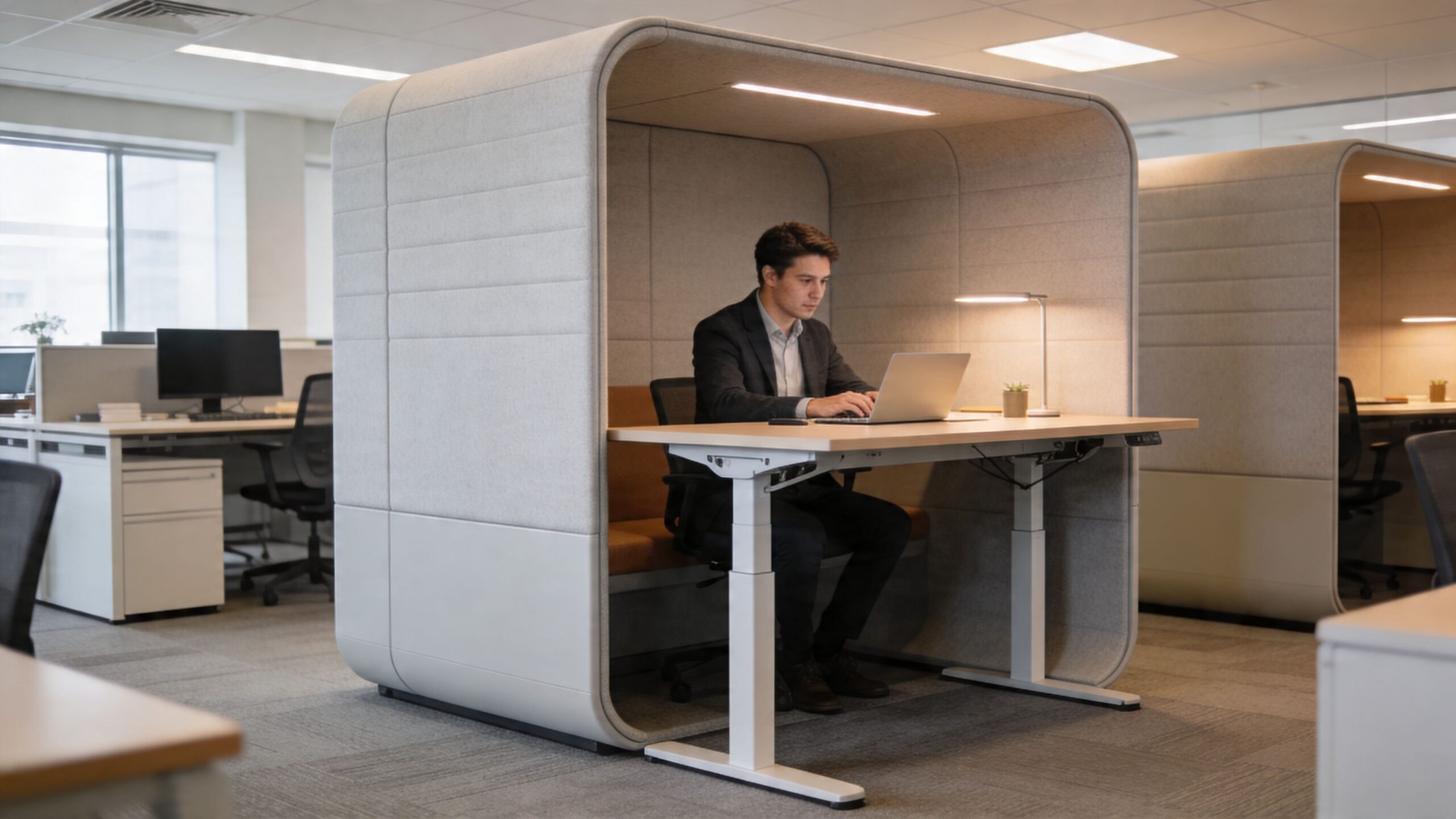
The persistent gap in UK-specific guidance for adjustable desks used in pod environments is highlighted by verified data, which notes a 28% rise in queries for adjustable furniture in hybrid workspaces since 2025 and states that 52% of UK workers report musculoskeletal issues from poor ergonomics. This situation leaves specifiers needing clearer guidance for multi-user pod settings. Those points are captured in the reference discussing corner desk and adjustable furniture guidance.
How to zone the office properly
A strong layout uses adjustable desks as the everyday work layer, with pods and partitions handling acoustic separation and task change. That means fewer calls at shared benching, fewer improvised private conversations, and less pressure on formal meeting rooms.
Three planning moves usually help:
- Create focus zones: Place adjustable desks near single-person pods so staff can switch quickly between concentrated desk work and private calls.
- Build collaboration pockets: Use larger pod formats where teams need short project sessions without booking a boardroom.
- Define boundaries clearly: Acoustic zoning works better when it is supported by furniture layout and products such as Logika partitions.
The open plan works better when every task doesn’t happen at the same desk.
A corner or wraparound workstation can also make sense in some pod-adjacent settings where users need larger surfaces for equipment, documents, or collaborative review. For layouts where that applies, this stand up desk corner option shows the kind of format that can help.
Where each pod type fits
Different pod types solve different problems, and the best schemes use them deliberately rather than scatter them around the floorplate.
For focused solo work and calls, Framery pods and Kabin pods suit phone use, video meetings, and short private tasks. They work well near adjustable desk zones because users can move out of the shared area when privacy matters, then return to their workstation without losing momentum.
For team collaboration, Blocko pods and Vetrospace pods can support more enclosed group working. In those settings, a desk with adjustable legs inside the pod can help if the pod is intended for longer project sessions or multi-user work where posture flexibility matters.
Outdoor and semi-external working is also becoming more relevant for campuses, hospitality sites, and mixed-use estates. The Meeting Pod Co solutions extend the same logic beyond the core office, giving organisations another way to create bookable work and meeting space.
What doesn’t work is buying pods for privacy while leaving workstation ergonomics untouched. That creates two separate investments instead of one coordinated workplace strategy. The strongest offices link desks, booths, circulation, and acoustic control so the whole environment feels intentional.
Procurement for the Future Sustainability and Smart Investment
A facilities manager signs off 120 adjustable desks because the unit price looks sharp. Eighteen months later, faults start showing up floor by floor. Handsets fail, columns fall out of sync, and the helpdesk inherits a furniture maintenance problem it was never set up to manage. That is why commercial desk procurement should be judged on total service life, not invoice price alone.
The cost question gets sharper when adjustable desks sit within a wider flexible workplace strategy. If desks support open-plan work and pods absorb calls, focus tasks, and short meetings, both categories need to survive reconfiguration, moves, and daily shared use. Cheap furniture rarely performs well in that environment.
Think beyond purchase price
A referenced procurement trends source states that 37% of UK facilities managers see unexpected breakdown and maintenance costs as a primary concern, and links that concern to 22% growth in demand for furniture rental models, as discussed in the reference used for those procurement trend figures.
The exact percentages matter less than the buying lesson. Powered desks add motors, controls, cabling, and reset procedures. In a busy office, those parts need a service plan.
Procurement teams should press suppliers on three points:
- Warranty terms: Confirm cover for motors, frames, electronics, and labour, not just the headline warranty period.
- Parts strategy: Ask whether handsets, power supplies, and lifting columns are stocked in the UK and how fast they can be supplied.
- Maintenance access: Set expectations for fault reporting, call-out response, and whether first-line fixes can be handled by site teams.
I usually advise clients to compare the likely five-year cost of ownership across desk options, then compare that with the operational role of pods in the same scheme. A desk that costs less upfront but needs repeated attendance can wipe out any saving once internal labour, user downtime, and replacement parts are counted.
Rental and circular thinking
Ownership is not the only sensible route.
For pods in particular, flexible procurement can reduce risk where lease events, headcount changes, or pilot projects make long-term fixed ownership less attractive. Framery Subscribed shows how a hire or subscription model can give an organisation access to acoustic space without committing capital to a static layout. That approach also supports circular use. Products stay in service longer, get refurbished, and can be redeployed instead of scrapped.
The same logic should inform desk buying, even where the desks themselves are purchased outright. Specify replaceable components. Check whether frames can be reused with new tops during churn projects. Ask what happens at end of life. A supplier with a clear position on refurbishment, materials, and product stewardship will usually be easier to work with over the life of the fit-out. Gibbsonn’s sustainability commitment reflects the type of long-term accountability many workplace teams now expect from project partners.
Buyer’s lens
Long-term value comes from furniture that can be serviced, reconfigured, and kept in use across layout changes. In practice, the best results come from treating adjustable desks and acoustic pods as one workplace system, then choosing ownership, hire, or mixed procurement to match risk, cash flow, and change over time.
Good procurement is rarely about buying the cheapest desk or hiring the most visible pod. It is about setting up a workplace that stays compliant, usable, and financially sensible through churn, growth, and the next redesign.
Your Procurement Checklist Specifying the Perfect Adjustable Desk
A good tender document removes ambiguity. It tells suppliers exactly what the workplace needs and makes comparison easier. When the brief is vague, buyers end up comparing brochures instead of solutions.
Specification points that belong in the brief
For a commercial fit-out, the specification should cover function, compliance, user fit, and serviceability. These are the points that deserve to be written down rather than discussed loosely in meetings.
- Height range: State the required operating range and ask for confirmation that the frame suits the user population.
- Standards compliance: Request confirmation of relevant furniture standards and commercial suitability.
- Load capacity: Ask for both frame capability and realistic working load for monitors, arms, docks, and accessories.
- Stability expectations: Require evidence of frame rigidity at standing height, especially for monitor-arm use.
- Mechanism choice: Define whether the setting calls for manual, pneumatic, or electric operation.
- Controls and safety: Include anti-collision, memory presets where needed, and ease of reset in shared environments.
- Cable management: Don’t let trailing power and data undermine a clean ergonomic setup.
- Surface and finish: Match durability and cleanability to the environment, particularly in education, healthcare, or high-traffic use.
- Warranty and service: Ask what happens after installation, not just what arrives on day one.
A workplace brief should also note where the desk sits. A desk inside a pod, beside a booth, or in a shared touchdown area may need a different specification from one in a single-user workstation row.
Questions worth asking before sign-off
A few direct questions can save a great deal of trouble later.
Ask whether the desk remains stable when fitted with dual screens and monitor arms. Ask how quickly replacement parts are supplied. Ask what installation conditions are required and whether flooring tolerances affect performance. Ask whether the desk is appropriate for multi-user settings, not only private offices.
Then ask one more question that many buyers miss. Does this product fit the wider workplace strategy. If the office is also investing in pods, privacy spaces, and flexible neighbourhoods, the desk specification should support that plan rather than sit outside it.
The right specification doesn’t just describe a desk. It describes how that desk needs to perform in a live workplace.
The most effective procurement teams treat the desk as infrastructure. That mindset leads to better decisions than treating it as a finish item chosen late in the process.
Build Your People-First Workplace Today
A facilities manager signs off 120 adjustable desks, then spends the next year dealing with noise complaints, poor space use, and teams booking meeting rooms for solo focus work. The desks were fine. The workplace system was not.
A people-first office performs at the level of the full specification. Adjustable desks support posture changes, shared use, and better fit across a mixed workforce. Acoustic pods give people a place to concentrate, take private calls, or complete sensitive work without taking over meeting rooms. Zoning ties those elements together so the floorplate works harder, with fewer compromises between collaboration, privacy, and wellbeing.
That joined-up approach usually gives better long-term value than buying furniture in isolated packages. It also gives estates, HR, and finance teams a clearer brief. The question is no longer which desk looks best in a showroom. The question is which combination of desks, pods, and support spaces will reduce friction in daily work, hold up under heavy use, and stay adaptable as headcount and work patterns change.
Treat adjustable desks as part of workplace infrastructure, not a standalone furniture line. The strongest outcomes come from specifying desks, acoustic pods, and flexible zones as one coordinated system.
Procurement strategy matters too. Some organisations should buy outright. Others benefit from phased rollouts, pod hire, or a mixed model that preserves capital while testing new space standards before a full refit. Circular economy thinking belongs in the same discussion. Serviceable frames, replaceable parts, durable finishes, and products with a credible second life usually produce a lower whole-life cost than cheaper desks that need early replacement.
Gibbsonn helps organisations create quieter, more flexible workplaces with premium pods, booths, ergonomic furniture, and end-to-end support from planning through installation. To discuss a project or arrange a showroom visit in Bishop's Stortford, contact the team directly.