

A familiar workplace pattern keeps repeating across the UK. Teams return to the office for collaboration, then spend half the day hunting for somewhere quiet to take a call, hold a private conversation, or run a short meeting without disturbing everyone nearby.
That’s why searches for meeting pods for sale aren’t really about furniture. They’re about fixing a workplace that no longer works as intended. Facilities managers need a practical way to add privacy, improve acoustics, support hybrid work, and do it without launching a full refurbishment.
For most organisations, the right pod becomes a small piece of workplace infrastructure. It gives people a place to focus, talk, meet, and reset, while helping estates teams avoid the cost and disruption of building permanent rooms too early.
Table of Contents
- The Modern Office Problem and The Pod Solution
- The Ultimate Checklist for Choosing Your Meeting Pod
- Exploring Your Pod Options A Look at Leading Brands
- Smart Procurement Purchase Hire or Subscribe
- Planning Your Space for Seamless Installation
- The Business Case for Meeting Pods Cost and ROI
- Frequently Asked Questions on Compliance and Costs
The Modern Office Problem and The Pod Solution
Open-plan offices solved one problem and created another. They made space feel more connected and flexible, but they also made routine work much harder. Calls spill into walkways. Short huddles turn into background noise. Concentration breaks every few minutes.
That pressure has grown since hybrid working became standard. The Office for National Statistics reported a 62% rise in flexible working arrangements in 2023, which helps explain why businesses now need office layouts that support a wider mix of tasks, from quiet focus to video calls and team catchups, as noted in this meeting pods market overview from MarkNtel Advisors.
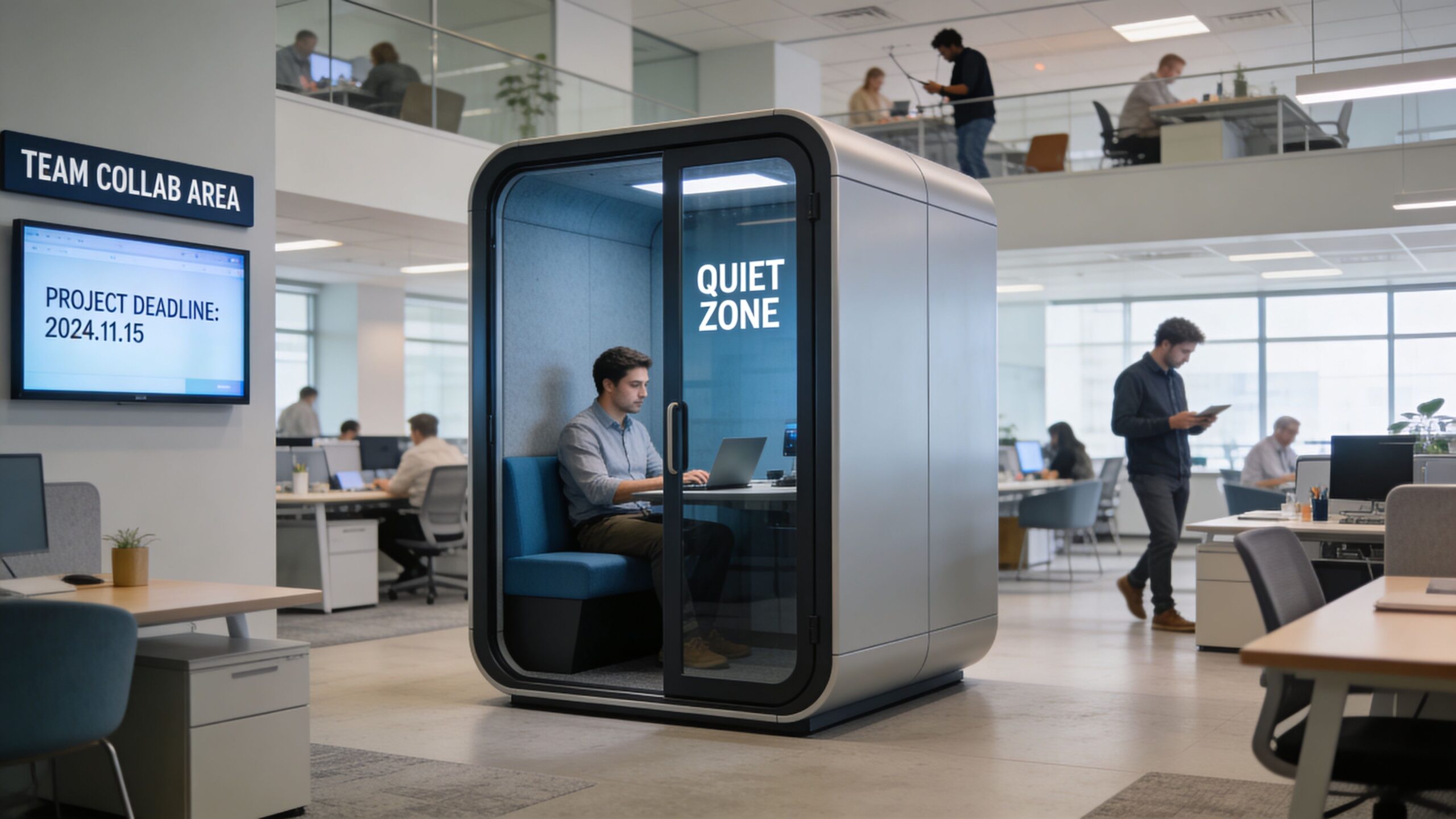
A pod works because it creates a third space inside the office. It isn’t a full meeting room and it isn’t an open desk. It’s a defined environment for a specific task, usually calls, one-to-ones, focused work, or small group meetings.
The demand shift has been sharp. According to BlueWeave Consulting’s meeting pods market report, demand for office pods surged by 75% after the 2020 lockdowns, while open-plan offices make up 68% of UK workspaces and saw productivity fall by 15-20% due to noise distractions. The same source notes that office applications now control 41% of the pod market share.
Practical reality: most teams don’t need more desks. They need better settings for the work they’re already trying to do.
Traditional partitions still have a role. For zoning, visual screening, and general space definition, partitioning can be effective. Anyone considering that route should also look at office partitioning walls from Logika. The trade-off is acoustic integrity. A partition can separate people visually, but it usually won’t deliver the enclosed privacy, speech control, ventilation, and integrated services that a dedicated pod can provide.
Pods also solve a planning problem. Fixed rooms commit floor area permanently. A well-chosen pod gives facilities teams speed and flexibility. It can be placed where pressure is highest, near a busy department, beside collaborative benches, or in underused corners that aren’t working hard enough.
What works in practice
A good pod strategy usually starts with task mapping rather than product browsing.
- Call-heavy teams need enclosed single or small pods near their workstations.
- Managers and HR teams need privacy for sensitive conversations.
- Project groups benefit from enclosed 2 to 4 person settings for short bursts of collaboration.
- Coworking operators often need adaptable assets that can move with occupancy changes.
What doesn’t work
Problems usually start when pods are bought on looks alone.
- Oversized pods consume prime floor space and stay underused.
- Underspecified acoustic models disappoint users quickly.
- Poor placement near circulation routes or noisy print zones reduces performance.
- No service plan means ventilation filters, lighting, and wear issues get ignored.
Meeting pods for sale should be treated as workplace tools, not decorative add-ons. When they’re specified properly, they reduce friction across the office and give staff a quiet place to get on with the job.
The Ultimate Checklist for Choosing Your Meeting Pod
Buying a pod gets easier when the decision is broken into the details that affect daily use. Visual design matters, but it shouldn’t be the first filter. Performance, compliance, and user comfort should lead.
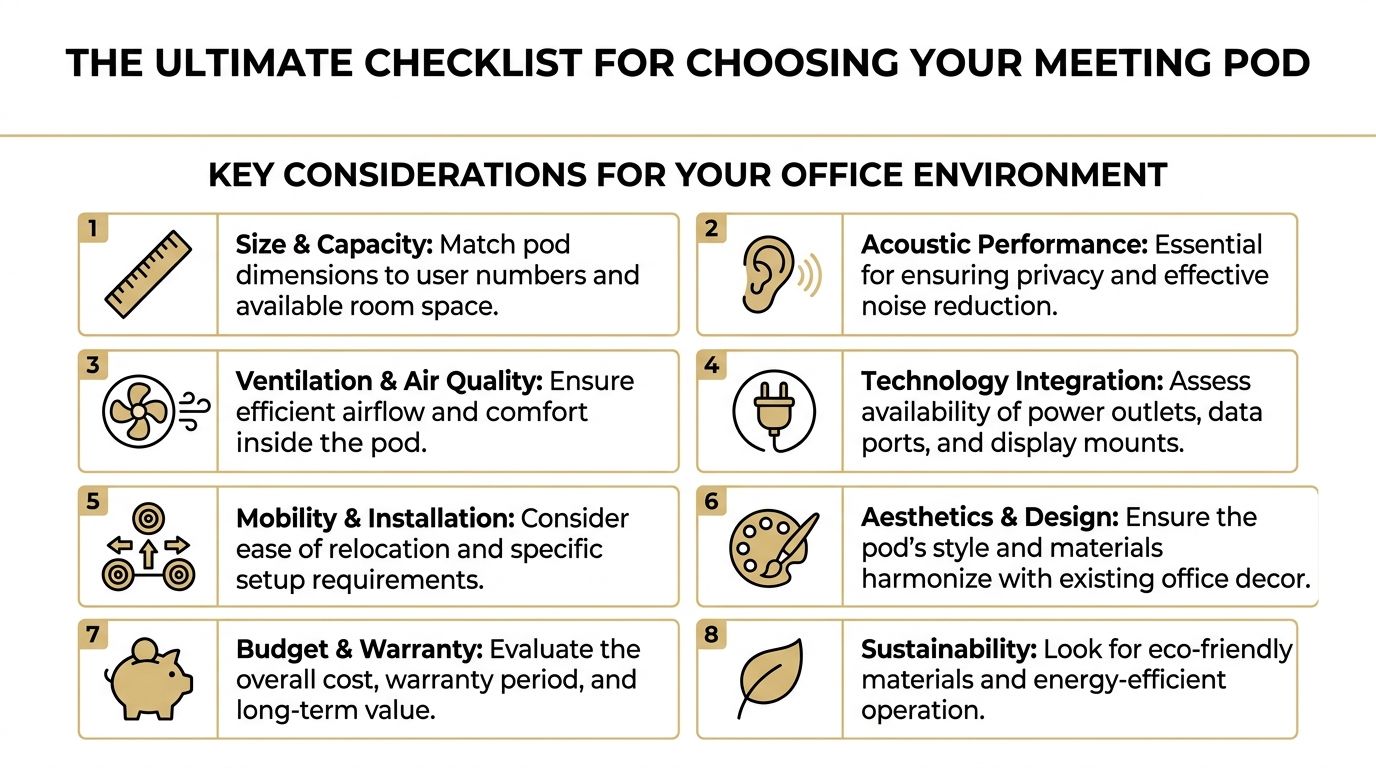
Acoustic performance
If a pod doesn’t control sound properly, people stop trusting it. That’s the quickest route to underuse.
High-performance acoustic meeting pods achieve sound reduction indices of 40-45 dB, which significantly outperforms standard partitions and leads to a 65% drop in external noise, with meeting productivity increasing by an estimated 28%, according to this acoustic meeting pod overview.
A useful benchmark for many UK projects is Rw 42dB+. In practical terms, that’s where a pod starts to feel meaningfully separate from the surrounding office rather than just screened off.
“If staff can still hear the office clearly inside the pod, the specification was too light for the task.”
What to check:
- Certified acoustic data rather than marketing language.
- Door seals and glazing quality because weak points often sit around joins.
- Intended use because a focus booth, a phone pod, and a meeting pod need different levels of privacy.
Dimensions and footprint
A pod has to fit both the building and the behaviour of the team using it. That sounds obvious, but many projects go wrong here.
A two-person booth can work well for quick one-to-ones and video calls. A four-person pod suits interviews, team huddles, or client meetings. The mistake is specifying capacity by maximum occupancy rather than real use. If a pod is regularly booked by two people, buying a much larger model often wastes floor area.
Key checks include:
- Clear circulation space around the pod
- Door swing and access route
- Ceiling height and any bulkheads
- Nearby desks and whether pod use will disrupt them
Ventilation and air quality
People notice poor air quality immediately, especially in enclosed settings used back-to-back. If a pod feels stuffy after one meeting, complaints follow fast.
Good ventilation matters as much as acoustics. The better models provide active airflow that keeps the pod comfortable through repeated use. That becomes even more important in schools, healthcare settings, coworking floors, and high-traffic offices where occupancy turns over all day.
M and E integration
The pod has to support the job being done inside it. That means checking power, lighting, and connectivity before ordering.
Questions worth asking early:
- Power. Are users charging laptops and phones inside?
- Data. Is hardwired connectivity needed or is wireless enough?
- Lighting. Is it suitable for video calls and screen work?
- AV provision. Will the pod need a display mount or booking panel?
It's often that cheap products show their limits. A smart-looking pod with awkward cable access or poor internal lighting creates friction every day.
Fire and safety compliance
UK projects require more care than many online product pages suggest. Fire safety should never be treated as a generic tick-box.
Facilities managers should ask for evidence of relevant material performance, fire ratings, and documentation that aligns with the intended environment. In regulated spaces, that conversation needs to happen before procurement sign-off, not after delivery is booked.
Accessibility
Accessibility starts with entry and circulation, but it doesn’t end there. A compliant approach considers manoeuvring room, thresholds, door operation, internal layout, and whether the pod can be used comfortably by different people.
That matters in corporate workplaces and becomes critical in public, education, and healthcare settings. If the brief includes inclusive use, accessibility should be built into the specification from the first shortlist.
Customisation and branding
Visual fit still matters. A pod sits in the middle of a live working environment, so finishes, upholstery, glazing manifestation, and external colour all affect adoption.
Useful customisation tends to focus on function first.
- Material palette should match the wider fit-out.
- Internal finish should support the intended mood, whether calm, formal, or creative.
- Branding elements should be subtle enough that the pod still feels usable by everyone.
Warranty and support
A pod is not a one-off parcel drop. It’s a workplace asset with moving parts, electrical elements, airflow systems, wear surfaces, and frequent users.
Look closely at:
- Warranty length and what it covers
- Availability of maintenance support
- Lead times for replacement parts
- Installer responsibility after handover
Strong support matters just as much as strong specification. The pod that looks cost-effective on day one can become expensive if aftercare is weak.
Exploring Your Pod Options A Look at Leading Brands
The market is broad, but most projects narrow down quickly once the brief is clear. Some clients need premium acoustic performance and smart technology. Others need flexible modularity, a softer design language, or pods suited to health-sensitive settings.
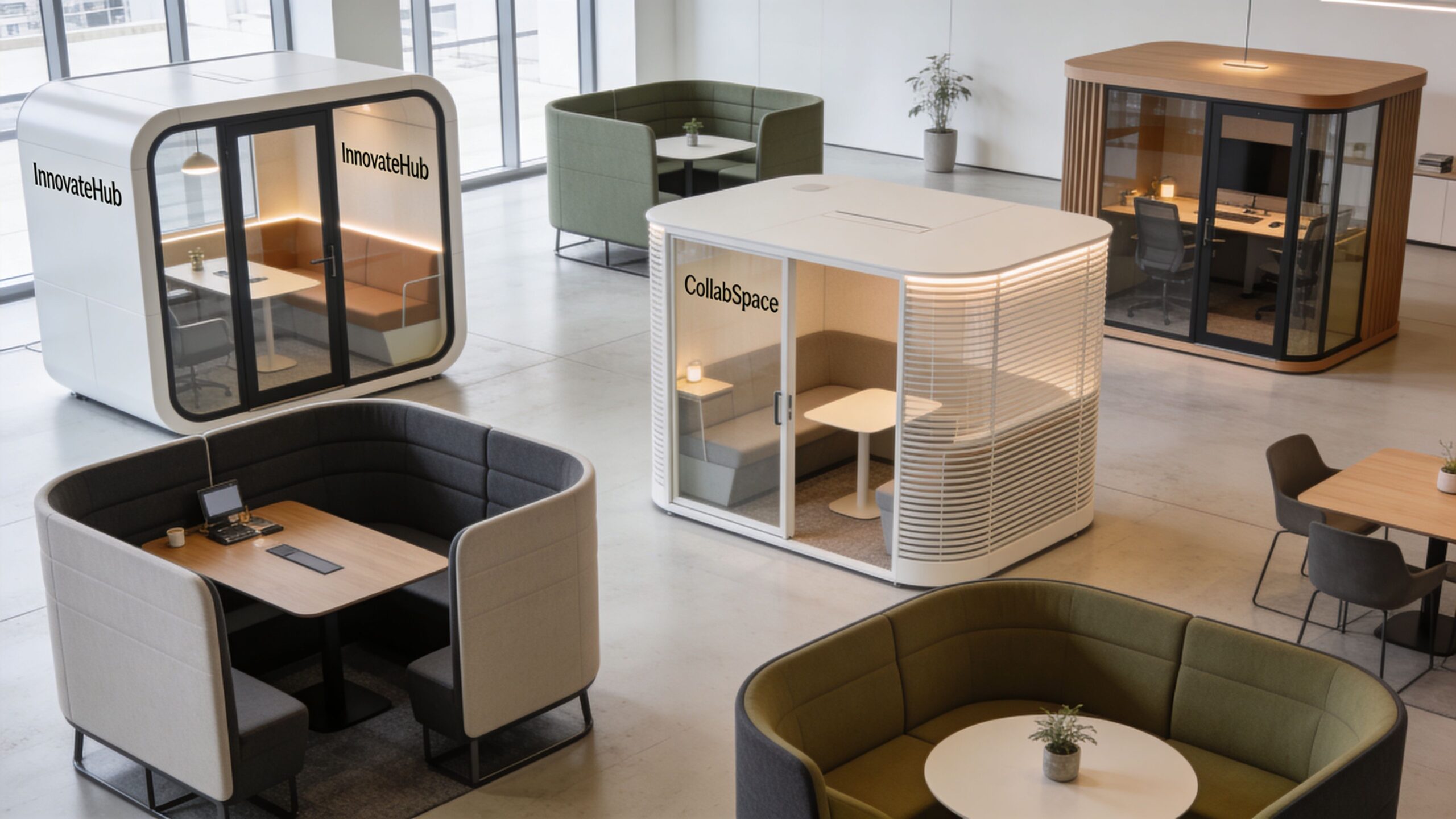
A practical shortlist should compare products by use case rather than by brochure style. That’s often the fastest way to avoid overbuying or picking the wrong format.
Framery
Framery meeting pods are often considered when the brief calls for a refined acoustic product with integrated workplace technology. They suit organisations that want enclosed environments for focused work, calls, and formal meetings where user experience matters as much as appearance.
For many specifiers, Framery becomes the benchmark against which other pod options are tested, particularly on acoustic detail, ventilation quality, and internal finish.
BlockO
BlockO pods suit projects where modularity and layout flexibility matter. They work well in agile environments that may change configuration over time, especially where workplace teams want privacy settings without committing to heavy permanent construction.
That can be useful in growing offices, shared spaces, and fit-outs where the final balance between collaboration and enclosure is still evolving.
A useful comparison point for broader space zoning is this guide to office partitioning walls. Partitions and pods can work together, but they solve different acoustic and privacy problems.
Kabin
Kabin pods tend to appeal when the project brief includes natural materials, calm interiors, and a softer workplace feel. They’re a sensible fit for organisations that want privacy without making the office feel hard or overly technical.
That often suits studios, people-focused workplaces, education settings, and brands that want warmth in the finished scheme.
A closer look at different pod formats can help visualise the options:
Vetrospace
Vetrospace pods are regularly specified for settings where hygiene, cleanability, and enclosed comfort carry extra weight. That makes them relevant for sectors where estates teams need products that support both user wellbeing and operational practicality.
The right pod here isn’t just about how it looks on a showroom floor. It’s about how it performs day after day in a demanding live environment.
External pods
Not every privacy problem sits inside the office. External pods from The Meeting Pod Co open up additional workspace beyond the building footprint, which can be useful for hospitality venues, campuses, transport sites, and organisations looking to create quiet meeting space outdoors.
For buyers searching meeting pods for sale, that wider portfolio matters. The strongest solution is rarely the same across every site or every team.
Smart Procurement Purchase Hire or Subscribe
The buying route shapes the project almost as much as the pod itself. Some organisations want a fixed capital purchase and long-term ownership. Others need flexibility because team size, lease length, or occupancy patterns may change.
One of the biggest issues is cost visibility. A British Institute of Facilities Management survey referenced here found that 73% of UK managers cite hidden installation costs as a major barrier to pod adoption. The same source notes that flexible models such as Framery Subscribed can cut upfront capital expenditure by up to 60%, and that 55% of coworking operators are shifting to subscriptions.
When purchase makes sense
Direct purchase often suits stable workplaces with a clear long-term headcount and an established fit-out strategy. If the business knows where the pod will live and how it will be used for years ahead, ownership can be the straightforward route.
Purchase can work well when:
- The office footprint is settled
- Capital budget is available
- Brand control and fixed asset ownership matter
- The pod is part of a wider permanent refurbishment
When subscription or hire fits better
Subscription and hire models suit uncertainty better. That includes growing teams, temporary swing space, pilot projects, coworking sites, and businesses that don’t want to tie up capital in assets that may need relocating or upgrading.
For UK buyers exploring office pod hire, Framery Subscribed is one of the clearest examples of this model in practice. It gives organisations access to pod solutions without the same upfront commitment as direct purchase.
Embrace agility. A subscription model allows your workspace to evolve with your business, eliminating the risk of owning outdated assets.
There’s also a sustainability case. Subscription models can support a more circular approach because products stay in active use for longer and are managed with refurbishment, redeployment, and lifecycle thinking in mind. That aligns with broader workplace goals around reducing waste and avoiding unnecessary replacement. More detail sits within Gibbsonn’s sustainability and circular economy approach.
| Consideration | Direct Purchase | Subscription / Hire |
|---|---|---|
| Upfront cost | Higher initial spend | Lower initial commitment |
| Budget treatment | Capital-led decision | Often easier to align with flexible operating needs |
| Flexibility | Best for stable layouts | Better for changing headcount or short leases |
| Maintenance approach | Usually managed separately | Often built into the service model |
| Upgrade path | Replacement can be slower | Easier to scale, swap, or extend |
| Risk of mismatch | Higher if needs change | Lower when the brief is still evolving |
A buying route should match workplace certainty. If the team is still testing usage patterns, hire or subscription often reduces risk. If the environment is established and unlikely to move, purchase may be the cleaner answer.
Planning Your Space for Seamless Installation
A pod can be beautifully specified and still fail if it lands in the wrong place. Site planning decides whether the finished installation feels intuitive or awkward.
Space planning first
Placement starts with workflow. The pod should sit close enough to the people who need it, but not so close that queues, door traffic, or noise build up around nearby desks.
Three checks matter early:
- Access routes so the pod doesn’t obstruct circulation or escape paths
- Power and data proximity so cabling doesn’t become an afterthought
- Ceiling and service coordination especially where lighting, sprinklers, rafts, or bulkheads could affect fit
Some workplaces also need supporting finishes around the pod. In spaces with exposed ceilings or awkward service zones, drop ceiling kits can help create a cleaner and more controlled setting around enclosed products.
Site rule: if a pod looks dropped into leftover space, usage usually reflects that.
Delivery and installation day
Most facilities teams want certainty here. They need to know how the pod arrives, how long the space is disrupted, and what building management should expect.
A well-run installation normally covers pre-delivery checks, access confirmation, floor condition review, assembly sequencing, and final snagging. If loading access is tight, or the route includes lifts, narrow corridors, or protected finishes, that should be reviewed before the install date is agreed.
For live offices, timing matters as much as technical fit. Early planning reduces the chance of disturbing teams, damaging common parts, or finding out too late that the chosen route won’t work.
Aftercare and day-to-day use
Handover shouldn’t stop at assembly. Staff need to understand how the ventilation, lighting, occupancy controls, and booking process work if the pod is going to earn its keep.
Aftercare usually comes down to a few simple habits:
- Keep vents and airflow paths clear
- Report wear early
- Clean glazing and touchpoints regularly
- Review usage after the first few weeks
That final point matters. If one pod is fully booked and another sits empty, the issue is often placement or pod type rather than demand.
The Business Case for Meeting Pods Cost and ROI
A facilities manager usually sees the cost question in two forms. Finance asks what the pod costs to buy or hire. Staff ask why they still have to take confidential calls in breakout space or book meeting rooms for ten minutes of focused discussion.
That gap is where the business case sits.
What cost really means
For teams comparing meeting pods for sale, the upfront figure is only the starting point. A sound appraisal looks at the full life cost and the operational value of adding enclosed space without building work.
That means pricing up:
- The pod itself, whether purchased, hired, or taken on subscription
- Delivery, assembly, and any access-related installation costs
- Power, data, and testing of integrated electrical components
- Cleaning, servicing, and replacement parts over time
- The floor area the pod will occupy
- The value of private conversations, focus time, and reduced room pressure
In the UK, compliance can change the budget as well. A pod with lighting, ventilation, sockets, or USB charging should be checked as part of the building’s wider electrical safety process. If your landlord, insurer, or health and safety lead asks for evidence after installation, having the right paperwork matters more than saving a small amount on day one. For sites that need electrical verification as part of occupation or alteration records, an EICR certificate may form part of that process.
A practical way to assess ROI
The cleanest ROI cases rarely come from headline price alone. They come from solving a known workplace problem that already has a cost.
Start with a simple question. What is happening today because the pod is not there?
Common answers include managers taking HR calls in stair cores, project teams blocking open desks for quick stand-ups, or staff occupying a six-person meeting room for a one-to-one. Those are not minor irritations. They waste bookable space, reduce privacy, and interrupt nearby teams.
A straightforward internal calculation can look like this:
| ROI input | What to estimate |
|---|---|
| Pod cost | Purchase price or monthly hire/subscription, plus install spend |
| Primary users | Which team will use it most often |
| Current problem | Lost focus time, room shortages, lack of confidential space |
| Usage rate | How many sessions a day the pod is likely to handle |
| Alternative cost | The cost of partitioning, relocation, or continued disruption |
I usually advise clients to test two comparisons. First, compare the pod against doing nothing for 12 months. Second, compare it against creating a fixed room through fit-out works. In many UK offices, especially leased space, the second option becomes more expensive once approvals, contractors, fire implications, and reinstatement risk are included.
Where pods tend to pay back fastest
Pods usually show the clearest return in three situations.
The first is high-demand office space where enclosed rooms are always fully booked. The second is hybrid offices that need a mix of open collaboration and short private calls. The third is leased workplaces where the business wants flexibility rather than another permanent built room.
Acoustic performance has a direct bearing on return. If speech privacy is poor, staff avoid the pod and the business case falls apart quickly. Facilities teams weighing pods against other acoustic interventions should also review this guide to soundproof office partitions for UK workplaces, especially where the issue is broader than one enclosed booth.
One more trade-off is worth stating plainly. The cheapest pod is often not the cheapest option over its useful life. If ventilation is weak, if accessibility has been overlooked, or if the finish does not stand up to daily use, the pod may create complaints instead of solving them. A slightly higher-spec model that meets the brief properly is often easier to defend to finance, because it gets used.
Frequently Asked Questions on Compliance and Costs
UK compliance questions tend to surface late. A team picks a pod on looks, lead time, or price, then legal, estates, or health and safety asks for fire documents, acoustic evidence, or accessibility details before sign-off. It is far easier to check those points during shortlisting than to reopen the whole decision at purchase order stage.
Do meeting pods meet UK acoustic rules
Acoustic performance depends on the pod, the room around it, and the type of conversations it needs to contain. A pod used for private HR calls needs a different standard of speech privacy from one used for informal project catch-ups.
Ask for measured acoustic test data, not marketing terms such as "soundproof". In practice, facilities managers should also check how the pod will sit within the wider acoustic plan for the floor, because a pod can solve one problem while leaving general office noise untouched. If you are weighing pods against broader interventions, this guide to soundproof office partitions for UK workplaces is a useful comparison point.
What fire safety documents should be checked
Request evidence for the reaction to fire of internal finishes, upholstery, glazing, and wall construction, along with product information for any powered components. Suppliers should be able to explain what standards their materials have been tested to and what that means for an occupied UK workplace.
The pod also needs to fit your building's own fire strategy. A unit that is acceptable in one office may raise questions in another because of escape routes, detector coverage, sprinkler layouts, or landlord rules. This is usually where early coordination with building management saves time.
Are pods suitable for wheelchair users
Some are. The detail matters.
Check clear door width, threshold design, internal turning space, table height, handle type, and whether a wheelchair user can approach and use the pod without help. The route to the pod matters just as much as the pod itself, especially in a dense open-plan office where circulation space gets squeezed over time.
Brochure renders are not enough here. I always advise clients to review dimensioned drawings and, where possible, test access in person before approval.
What extra costs usually get missed
The common omissions are delivery restrictions, floor loading checks, out-of-hours installation, power connection, commissioning, and ongoing maintenance. In leased offices, reinstatement risk should also be costed properly, particularly if the pod needs hard wiring or alterations to the base build.
Procurement model changes the picture as well. A purchased pod may be cheaper over a longer occupation, while hire or subscription can make more sense for project space, swing space, or businesses that expect to move within a few years.
Do pods need electrical checks after installation
If the pod has lighting, ventilation, sockets, USB charging, or booking controls, the electrical scope should be treated like any other workplace installation. Confirm who is responsible for final connection, testing, and handover records before the pod arrives on site.
For many London projects, facilities teams also want a practical reference point for the inspection side of compliance. This guide to an EICR certificate sets out what that check is intended to confirm.
How should compliance and cost be balanced during procurement
Start with the intended use, then test each pod against three filters. Will people use it. Does it meet the building's compliance requirements. Does the procurement route suit the length and certainty of your occupation.
That usually rules out the false economy options quickly. A low-cost pod with weak ventilation, limited accessibility, poor paperwork, or awkward servicing requirements often costs more in management time and user complaints than a better-specified model with clear documentation. For teams comparing a wide range of interior and exterior meeting pods, the safest route is to shortlist products that can be defended technically as well as commercially.
For advice suited to your needs, workplace planning support, or to compare options across interior and exterior pods, contact us. Facilities and design teams are also welcome to book an appointment and visit the showroom in Bishop's Stortford to see products, finishes, and layouts in person.