
A familiar problem plays out in offices every day. A manager books a meeting table for a quick project check-in, only to find that half the discussion is drowned out by nearby calls, passing conversations, and the general buzz of an open-plan floor. The team leaves with action points, but also with repeated questions, missed details, and the sense that the space worked against the meeting instead of supporting it.
That’s why old-style meeting room designs no longer hold up. Hybrid work has changed what offices need. Teams don’t need endless large boardrooms sitting empty for most of the week. They need a mix of private call spaces, compact huddle areas, quiet focus zones, and enclosed pods that people can use without disrupting everyone around them.
The shift is already happening. In the UK, 66% of businesses plan to redesign office spaces to incorporate more flexible meeting pods and booths, with redesigned rooms seeing a 246% utilisation boost globally, mirrored in UK open-plan transformations. At the same time, 73% of UK workers want continued flexibility, which makes better meeting spaces a practical requirement rather than a design extra, according to meeting room design utilisation data from Density.
The strongest response is simple. Stop treating the meeting room as one fixed room type. Build a workplace made up of smaller, better-performing spaces, and make acoustic pods the centre of that strategy.
Table of Contents
- Introduction Is Your Office Killing Collaboration
- Rethinking the Meeting Room From Boardrooms to Booths
- The Science of Silence and Acoustic Pod Performance
- Planning Your Space Layouts Ergonomics and Technology
- Beyond the Basics Accessibility Compliance and Sustainability
- Smart Procurement Renting vs Buying and Calculating ROI
- Conclusion Your Future-Ready Workplace Starts Here
- Frequently Asked Questions About Office Pods
Introduction Is Your Office Killing Collaboration
Collaboration suffers when the room itself creates friction. People repeat themselves. Remote participants miss half the conversation. Staff avoid booking the room because it feels exposed, awkward, or too formal for the task. That isn’t a people problem. It’s a design problem.
Most open-plan offices were never properly rebalanced for hybrid work. They kept the same noisy floorplate, the same oversized meeting rooms, and the same assumption that privacy could be improvised. It can’t. Confidential conversations, quick one-to-ones, focused video calls, and small project huddles all need different settings.
Practical rule: If staff keep leaving their desks to find somewhere quiet, the workplace already has a meeting room design problem.
The answer isn’t to add more traditional rooms. It’s to create a smarter mix of enclosed spaces that support different kinds of work. A phone booth handles private calls. A compact four-person pod supports short decision-making sessions. A larger enclosed pod gives teams a dedicated collaboration space without committing permanent floor area to another built room.
That shift also gives facilities teams more control. Pods are faster to integrate than many fixed-room refurbishments, easier to position within changing layouts, and far better aligned with the way offices operate now.
Rethinking the Meeting Room From Boardrooms to Booths
A facilities manager reviews room-booking data on Monday morning and sees the same pattern again. Large meeting rooms are blocked out for two-person calls, small conversations spill into open areas, and staff keep hunting for privacy that the floorplate does not provide. That is not inefficient booking behaviour. It is a design brief the office is currently failing.
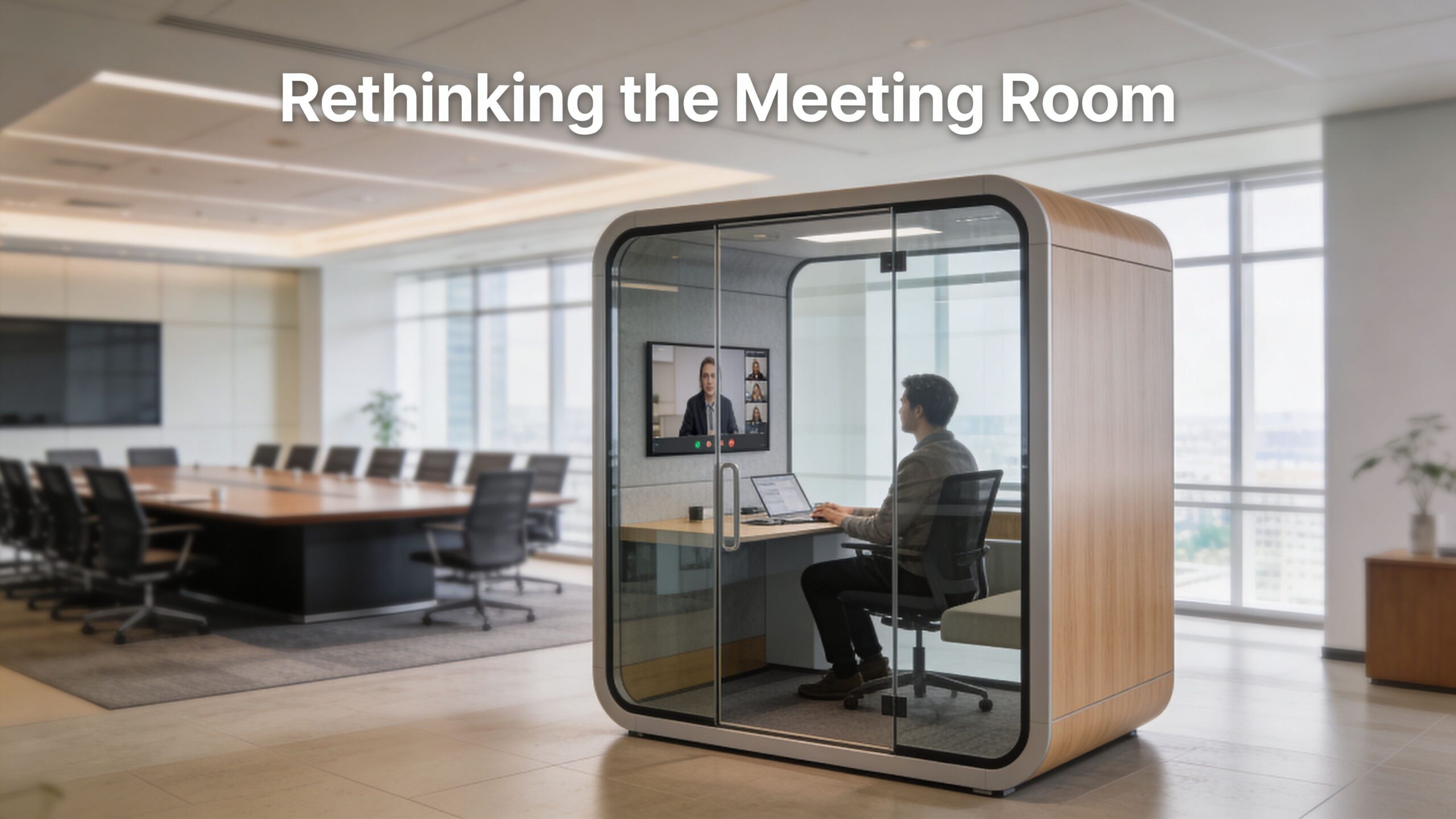
The old model treated the meeting room as a fixed destination. Modern offices need a range of enclosed settings sized to the work itself. Acoustic pods sit at the centre of that shift because they solve the two problems traditional boardrooms handle badly. Privacy for small groups and flexibility for changing layouts.
Match the space to the meeting
Start with activity, not furniture.
A private video call needs one seat, strong speech privacy, reliable ventilation, and power. A project check-in needs enough space for a small group to speak clearly and share a screen. A client conversation needs a more polished environment, but it still does not need a permanent built room if a pod can deliver the same function with less disruption and lower fit-out risk.
A practical space mix looks like this:
- For private calls and focused video meetings use a compact Framery pod. It gives one person an enclosed, bookable space without sacrificing a full room.
- For quick team huddles and short reviews use a BlockO pod or another compact multi-person booth. These settings suit fast decisions and informal collaboration.
- For enclosed meetings where finish and client perception matter consider a Vetrospace pod. It works well in executive areas, meeting suites, and premium front-of-house environments.
- For sites with pressure on internal floor area use The Meeting Pod Co exterior pods. They create usable meeting capacity without forcing another internal rebuild.
The point is simple. Stop assigning every meeting the cost base of a full room.
Cut oversized rooms back to what you actually use
Many offices still carry too much legacy space. The classic boardroom was built for status, scheduled meetings, and predictable attendance. Hybrid work changed all three.
Facilities teams should review room demand and remove the dead space from the plan. In practice, that usually means fewer oversized rooms and more enclosed small-format settings. Pods make that adjustment faster because they avoid much of the disruption, programme length, and irreversible construction spend that comes with building new partitioned rooms.
That matters financially. A pod-led approach lets you add meeting capacity in stages, test demand before committing more capital, and adapt the layout if team sizes change or departments move.
Small meetings need privacy, speed, and clear audio. They do not need a twelve-seat table.
Use pods as the default. Use partitions with intent.
Pods should carry the bulk of private, short-duration meeting demand. They are the most effective answer for one-to-ones, video calls, interviews, manager check-ins, and compact collaboration.
Partitions still have a role. Use them to reshape underperforming rooms, define quiet zones, or improve separation between teams. Gibbsonn also supplies soundproof office partitions for meeting room reconfiguration when a full pod is not the right fit. For specialist partition systems, Logika is a useful option to consider.
Good meeting room design does not start with a boardroom schedule. It starts with the demand profile of the office, then builds around the most frequent use cases. In most UK workplaces, that means more booths, more small enclosed pods, and fewer expensive rooms sitting half empty. If speech clarity is already undermining performance, this guide on how to improve sound in meeting rooms is a useful reference alongside your space planning.
The Science of Silence and Acoustic Pod Performance
Noise ruins meetings faster than poor décor ever will. People can tolerate an average chair for half an hour. They cannot tolerate poor speech clarity, echo, or a constant layer of background distraction.
In UK open-plan offices, noise often exceeds 55 dBA, causing a 66% drop in speech intelligibility and a 20-30% loss in productivity. High-performance acoustic pods can reduce internal noise to 40 dBA and enable up to 25% faster task completion, according to workplace acoustic data on flexible office design.
What the numbers actually mean
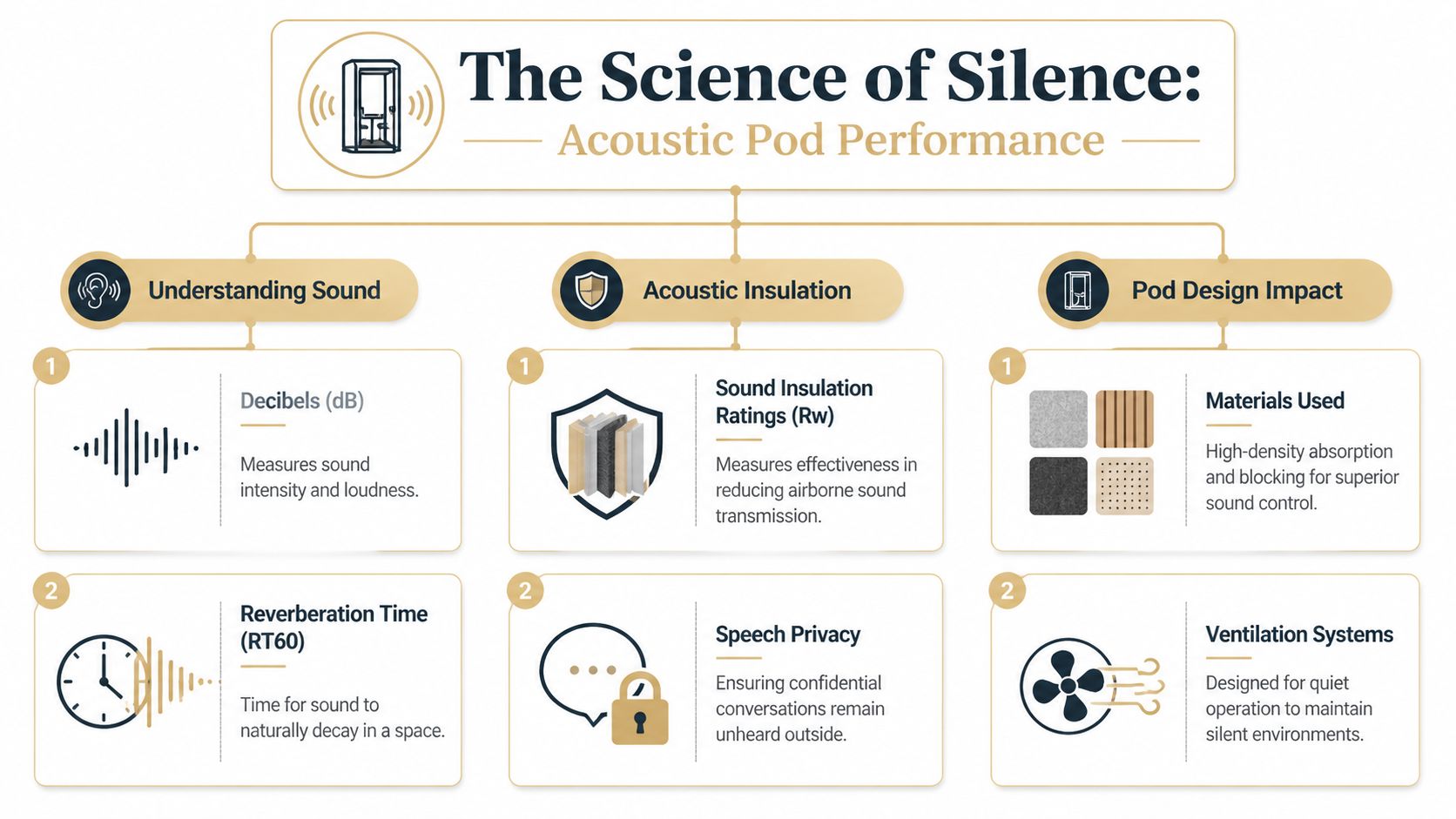
Facilities managers don’t need an acoustics degree, but they do need to understand a few terms.
| Term | What it means in practice | Why it matters |
|---|---|---|
| dBA | The level of sound people hear in a space | Higher background noise makes speech harder to follow |
| RT60 | How long sound lingers before it fades | A long reverberation time creates echo and muddies speech |
| Rw | A rating for airborne sound insulation | A stronger rating helps stop conversations leaking out |
If a room sounds harsh or speech feels blurry, reverberation is usually part of the problem. If confidential calls can be overheard, insulation is the problem. Good pods tackle both.
For teams trying to improve sound in meeting rooms, the basics still apply. Reduce hard reflective surfaces, control echo, and create real enclosure rather than relying on wishful thinking.
Why acoustic pod design matters
A pod works because it combines several acoustic elements in one controlled envelope. That includes glazed doors designed for sound reduction, absorbent internal panels, carefully sealed joints, and ventilation systems that don’t turn the pod into a noisy fan box.
Some enclosed products also solve the privacy issue better than many ad hoc office rooms. A properly specified pod doesn’t just feel quieter. It improves speech clarity inside while limiting what people outside can hear.
A practical selection checklist should include:
- Check internal sound character. Quiet isn’t enough if the pod still sounds echoey.
- Look at door and glazing quality. Weak glass and poor seals undermine the whole unit.
- Ask about ventilation noise. Fresh air matters, but so does low operational sound.
- Review integration with the wider space. Surrounding finishes and nearby activity still influence performance.
One further option for open environments is to combine enclosed pods with soundproof office partitions. That approach can improve the wider acoustic environment around the pod instead of treating it as an isolated fix.
Planning Your Space Layouts Ergonomics and Technology
A pod can solve privacy and noise problems, then fail on day one because it was dropped into the wrong part of the floor. Facilities managers see this all the time. A high-spec pod beside a breakout zone turns into a visible waste of budget, while a smaller pod placed well gets used constantly.
Start with zoning not furniture
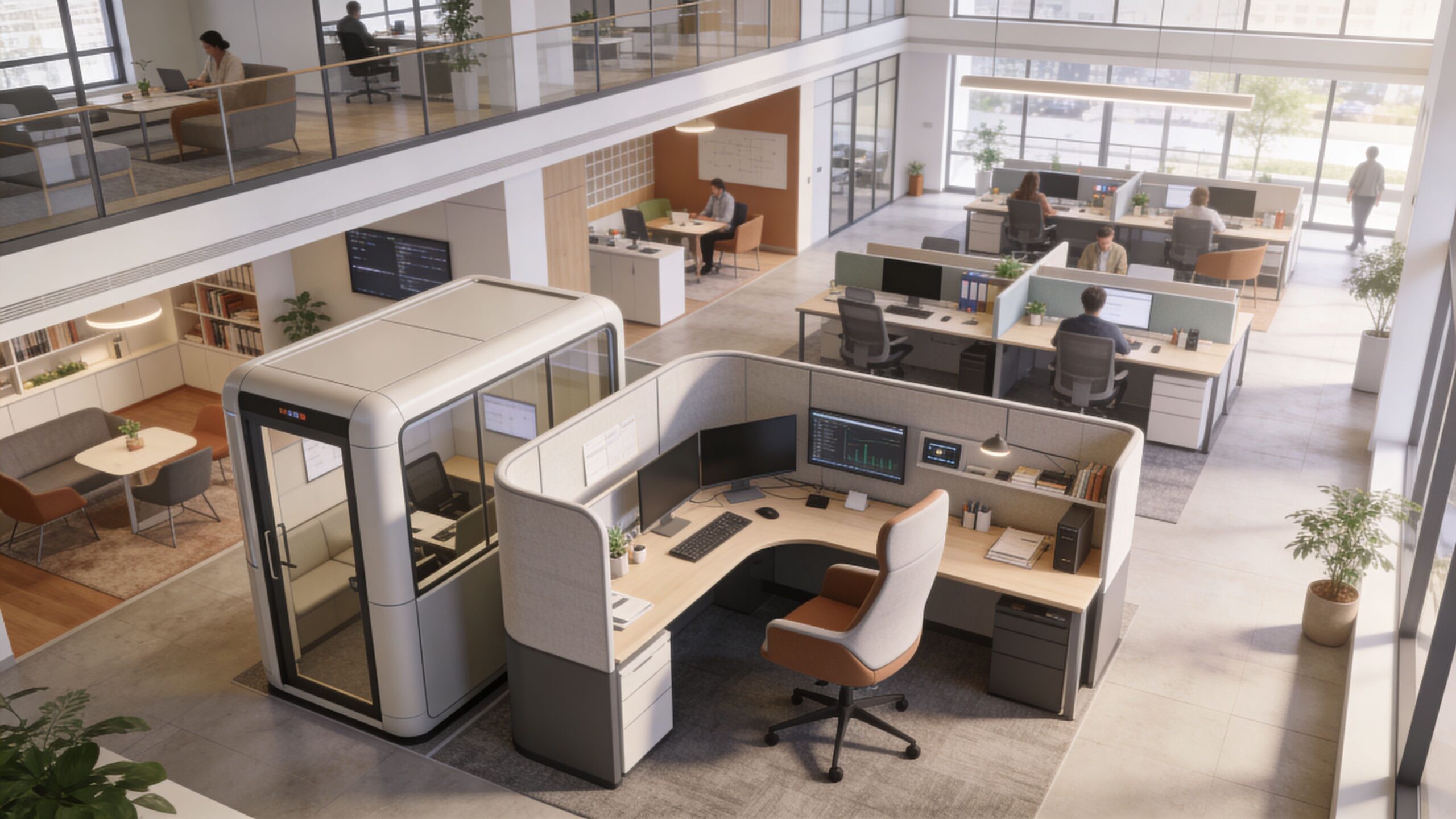
Meeting room design starts with movement, noise, and task type. Furniture comes later. Acoustic pods work best when they sit inside a clear planning strategy, not as a last-minute fix for a floorplate that never had enough enclosed space.
Guidance cited by Workplace Insight points to the value of giving focused work and short meetings their own dedicated settings rather than forcing every interaction into open-plan space. That principle matters because pod performance is shaped as much by context as by specification.
Use this sequence:
- Map disruption points such as kitchens, printer bays, circulation routes, lockers, and informal touchdown areas.
- Place single-person and two-person pods near the teams that need them so staff use them for calls, focused work, and quick private conversations.
- Keep larger collaboration pods close to active team zones where short huddles and hybrid check-ins already happen.
- Protect sightlines and access routes so pods feel easy to find and simple to book.
- Leave enough clearance around each pod for circulation, servicing, and door swing.
For wider floorplate decisions, office layout planning for different workplace zones should be set early in the brief, before procurement starts.
Build pods people will actually use
Usage is the true test. If staff avoid the pod, the investment is failing.
The biggest problems are predictable. Seats are too upright for a 30-minute meeting. Tables are too small for laptops and notebooks. Lighting makes video calls look flat or harsh. Ventilation feels weak after ten minutes, so people prop the door open and destroy the acoustic benefit they paid for.
Specify for real behaviour:
- Supportive seating that suits short meetings and longer video calls
- Table heights and depths that comfortably handle laptop work
- Integrated power and charging within easy reach
- Lighting positioned for faces and screens, not just general illumination
- Ventilation with enough airflow for occupied sessions
- Controls that are obvious on first use
Good pod design reduces friction. Staff should walk in, plug in, close the door, and get on with the meeting.
Teams also need a reliable way to see availability and manage occupancy. meeting room agents can support that by improving visibility across desks and rooms, which helps pods get used properly instead of being claimed informally.
Technology should feel invisible
Bad meeting tech wastes time and makes small rooms feel worse. The right setup keeps hybrid meetings short, clear, and predictable.
Put the camera at a natural sightline. Use microphones that pick up speech without forcing people to lean across the table. Choose screens sized for the pod, not for a boardroom. Keep cable management tidy and controls simple enough that visitors can use the room without calling IT.
Integrated pod systems usually beat retrofitted ones on cost and reliability. They reduce installation work, avoid messy add-ons, and give facilities teams fewer failure points to manage over the life of the product. That matters even more in the UK, where office teams are under pressure to improve space efficiency without committing to expensive building work.
This short video shows the kind of practical setup details facilities teams should review before specifying any pod solution.
Beyond the Basics Accessibility Compliance and Sustainability
A lot of meeting room designs look fine in renders and fall apart in delivery. The usual problem is that compliance was treated as someone else’s job. It isn’t. Facilities managers need acoustic performance, accessibility, and operational practicality resolved before products are ordered.
Compliance has to be designed in early
A 2023 UK Government report found that 68% of public sector facilities initially fail acoustic compliance audits under BB93, and accessible pod design also needs to address DDA requirements such as 900mm clear door widths, as outlined in this overview of overlooked compliance issues in meeting room design.
That matters well beyond education. Healthcare, airports, local government, and shared commercial workplaces all face the same risk. A pod that looks sleek but doesn’t satisfy acoustic or access needs becomes a liability.
A proper compliance review should cover:
- Acoustic suitability for the use case and sector
- Door widths and thresholds for accessibility
- Safe power and ventilation integration
- Placement within escape routes and circulation space
- Whether the product supports the specific standards relevant to the building
Compliance isn’t a paperwork task at the end. It’s a design decision at the start.
Sustainability is now a buying decision
Sustainability should also influence specification. Durable pods with replaceable parts, long product life, and flexible relocation potential support a more circular approach than one-off built rooms that become redundant after a layout change.
That’s one reason rental and reuse models are becoming more attractive. They reduce waste, make workplace changes easier, and avoid locking an occupier into fixed assets too early. Organisations also increasingly want suppliers who can align with their own reporting and environmental goals. A useful starting point is Gibbsonn’s sustainability and circular economy approach, which outlines how workplace products can support more responsible procurement choices.
Smart Procurement Renting vs Buying and Calculating ROI
Most procurement mistakes happen because the discussion starts with purchase price instead of business impact. That’s the wrong sequence. The question is whether a pod solves costly problems faster and more flexibly than the alternatives.
Capex and Opex solve different problems
Buying works when an organisation has a stable brief, a long planning horizon, and capital available. Renting works when headcount is shifting, workplace strategy is evolving, or finance teams want flexibility.
That’s where Framery Subscribed pod rental stands out as a practical model. It allows organisations to bring in office pods through an operational cost structure rather than a full upfront capital purchase. For many hybrid workplaces, that’s the cleaner fit because demand changes faster than traditional fit-out cycles.
A direct comparison helps.
| Procurement route | Best fit | Main advantage | Main trade-off |
|---|---|---|---|
| Buying | Stable long-term layout | Full ownership from day one | Higher upfront commitment |
| Renting | Changing hybrid demand | Flexibility and easier scaling | Ongoing operating cost |
There’s also a wider estates benefit. Renting can help teams trial pod types, prove usage patterns, and adjust the workplace mix without committing too early to a permanent estate decision.
How to make the financial case
The business case is stronger than many teams assume. A 2025 CIPD UK Workplace Wellbeing Survey found that unaddressed noise distractions cost businesses £1,200 per employee annually, and the total cost of ownership for an acoustic pod installation can be recouped in as little as 14 months, according to this analysis of meeting room design and workplace productivity costs.
That changes the conversation. Pods are not just furniture. They are a response to lost focus, wasted floor space, meeting inefficiency, and avoidable disruption.
A sensible ROI review should look at:
- Productivity leakage from noise and interrupted work
- Pressure on existing meeting rooms and underused large spaces
- The value of flexible deployment when teams grow or reorganise
- Operational savings from avoiding heavier building works
Facilities teams should also remember the hidden running-cost side of workplace upgrades. If a project includes electrical changes or wider fit-out works, even related measures such as reviewing whether Power Factor Correction can save energy and costs can support a broader efficiency conversation with finance and estates stakeholders.
Where pods sit within a wider workplace programme, office partitioning walls can also support a more balanced fit-out strategy by combining enclosed pod spaces with adaptable zoned areas.
Conclusion Your Future-Ready Workplace Starts Here
The old formula no longer works. One or two formal rooms cannot carry the full weight of hybrid work, confidential calls, fast team decisions, focused solo work, and wellbeing expectations. Modern meeting room designs need variety, privacy, and acoustic control built into the plan from the start.
Acoustic pods solve the biggest workplace problems directly. They reduce noise disruption, create usable private space, support better hybrid meetings, and give facilities teams far more flexibility than fixed-room thinking. They also make financial sense when measured against lost productivity, wasted floor area, and the cost of heavier refurbishments.
For organisations reviewing layouts, comparing pod brands, or considering rental instead of purchase, there’s real value in seeing the products in person. A showroom visit helps decision-makers judge acoustic feel, finish quality, comfort, and scale far more accurately than a brochure ever will.
To discuss options properly, book an appointment and visit the showroom in Bishop’s Stortford. For a direct conversation about workplace needs, product fit, and next steps, use the button below.
Frequently Asked Questions About Office Pods
Are office pods only useful in large open-plan offices
No. They work in large offices, smaller workplaces, coworking environments, education settings, healthcare estates, and public sector sites. The value comes from solving specific problems such as privacy, noise, and lack of bookable small meeting space.
Can pods be customised for branding and technology
Yes. Many pod ranges allow choices around finishes, glazing, seating, tables, power, and AV integration. That matters because a pod used for confidential calls needs a different setup from a pod used for team huddles or client meetings.
Is renting better than buying
It depends on the organisation’s planning horizon. Renting suits changing workplaces and uncertain headcount. Buying suits more fixed environments with long-term layout certainty. The right answer is the one that matches business reality rather than internal habit.
Do pods require ongoing maintenance
They do, but it’s manageable when planned properly. Ventilation, lighting, door hardware, booking systems, and finishes all need periodic attention. That’s another reason facilities teams should think beyond the pod itself and consider installation, aftercare, relocation, and support as part of the specification decision.
Gibbsonn helps UK organisations plan, specify, install, and support acoustic pods, booths, and privacy solutions for offices, education, healthcare, hospitality, airports, and government spaces. To discuss a project, compare pod options, or arrange a showroom visit in Bishop’s Stortford, contact the team through Gibbsonn.