

A London facilities manager often reaches the same point. The office is full, the meeting rooms are booked, private calls spill into corridors, and staff wear headphones just to get through routine work. The fit-out still looks good on paper, but the day-to-day experience has become noisy, dense, and tiring.
That is why sleep pods in london have moved from curiosity to practical workplace conversation. London already uses pods in hospitality, airports, shelters, and offices. For workplace teams, the key question isn't whether pods are interesting. It's whether they solve enough of the right problems to justify the floor space, budget, and project effort.
Table of Contents
- The Modern Problem Pods Solve in London Workplaces
- Defining the Modern Office Pod and Its Uses
- The Business Case for Investing in Acoustic Pods
- Buying vs Hiring Pods in 2026 The Financials
- Planning Your Pod Project Key Technical Considerations
- From Showroom to Site A Step-by-Step Installation Guide
- Your Next Steps to a Quieter London Office
The Modern Problem Pods Solve in London Workplaces
The typical London office problem isn't just noise. It's competing needs in the same footprint. One person needs a confidential HR call, another needs a place to decompress, a project team needs to meet quickly, and a manager needs somewhere quiet enough to think clearly for half an hour.
In many open-plan offices, all of that happens in the wrong places. Calls move to stairwells. Sensitive conversations happen in half-glazed rooms. Focus work gets pushed to home days. The result is friction that shows up in complaints, booking conflicts, and poor use of expensive floor space.

Why London has become a pod city
London has already accepted the logic of compact private spaces. In October 2025, Zedwell opened the world's largest capsule hotel at Piccadilly Circus with nearly 1,000 sleep pods, showing how strongly the city is moving toward compact spaces for rest and focus, as reported by Globetrender on Zedwell's Piccadilly Circus opening.
That matters to workplace teams because the cultural barrier has dropped. Staff no longer see pods as strange or niche. They understand the value of a small, enclosed, well-designed space when the wider building is crowded and overstimulating.
Practical rule: Pods work best when they solve a specific behaviour problem, not when they're added as a design feature with no operating plan.
What works and what doesn't
What works is precision. A pod placed near dense desk banks can absorb calls that would otherwise disrupt dozens of people. A reclined rest pod in a wellness room can support shift workers, neurodiverse staff, or employees managing long commutes. A small meeting pod can stop two-person catch-ups from occupying formal boardrooms.
What doesn't work is vague intent. A facilities team that buys one pod because "staff wanted quiet space" often ends up with the wrong format, wrong location, and wrong usage pattern. Pods need clear use cases, simple etiquette, and placement that reflects how the office behaves.
A second mistake is assuming one solution fixes every issue. Sleep pods in london may attract attention, but the most effective workplace strategy usually combines several formats. Quiet booths for calls, enclosed meeting pods for collaboration, and in some cases a dedicated rest space for recovery. The goal isn't novelty. It's operational relief.
The pressure on facilities managers
Facilities managers are usually caught in the middle. Leadership wants better employee experience. Staff want more privacy and fewer distractions. Landlords want minimal building disruption. Finance wants flexibility. Pods sit at the intersection of all four pressures because they can create usable enclosed space without a traditional construction programme.
That is why pods have become a practical answer to a modern London problem. Not because they are trendy, but because they let workplaces add privacy, focus, and recovery space inside buildings that were never designed for today's pattern of work.
Defining the Modern Office Pod and Its Uses
A workplace pod isn't one thing. It is a category of enclosed, purpose-built space designed to deliver privacy, acoustic control, and predictable user experience without permanent construction. Some are for calls. Some are for meetings. Some are for focus work. Some are suited to rest and recovery.
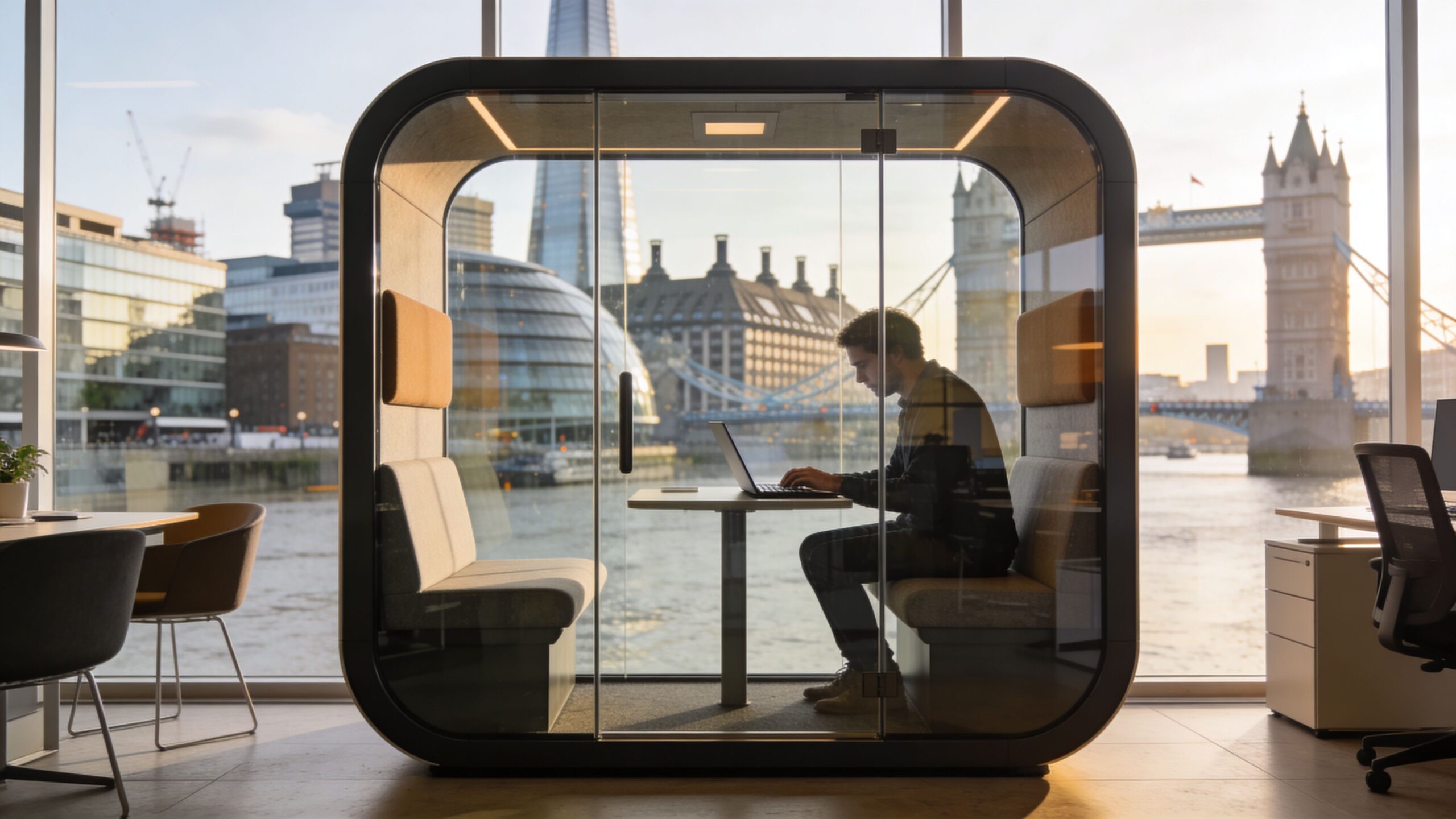
London's pod ecosystem already spans multiple sectors. Airports use self-service EnergyPods, shelters use humanitarian sleeping pod designs, and offices use workplace booths and enclosed rooms. That range is described in this overview of London's pod ecosystem. For a facilities manager, that diversity is helpful. It proves the format is adaptable, but it also means specification needs discipline.
Private focus and call pods
The most common workplace pod is the single-person acoustic booth. This format is for video calls, concentrated tasks, or short periods of privacy in a busy office. It replaces the corridor call, the occupied meeting room, and the awkward search for somewhere to speak without disturbing others.
Products such as Framery acoustic pods are often chosen when the brief is simple. Strong acoustic performance, fast installation, and predictable daily use. These work well near desking areas, touchdown zones, and shared floors where staff need access within seconds rather than after a room booking.
Another strong use case is deep work. A pod doesn't need to be large to be useful. For many staff, the ability to close a door, control noise, and work without visual interruption is enough to make an open-plan office usable again.
Meeting pods for small teams
When teams need to speak together, a single-person booth isn't enough. In these situations, enclosed meeting pods become valuable. They support quick project check-ins, one-to-ones, confidential conversations, and hybrid calls without pushing every discussion into a formal meeting suite.
Options such as Kabin office pods and BlockO pods suit this category well because they create small-footprint meeting space that feels intentional rather than improvised. For an office with too few rooms and too many informal meetings, this can change circulation and booking pressure quickly.
A useful rule is to match pod size to conversation type. Two- to four-person pods are usually the sweet spot for busy offices. Larger pods can be effective, but they need stronger demand and better planning around circulation.
The video below gives a useful sense of how enclosed workplace pods function in practice.
High-performance pods for specialist settings
Some environments need more than general acoustic relief. Legal teams, healthcare settings, senior leadership spaces, and customer-facing support teams may need a pod with a more refined acoustic envelope, stronger material quality, or a more architectural finish.
That is where Vetrospace pods often enter the conversation. These are better suited to offices where finish quality matters as much as function, or where speech privacy needs closer attention. In practice, these pods often appear in executive zones, premium client-facing floors, and design-led interiors where a basic booth would look too temporary.
A good pod should remove a problem from the floorplate. If staff still hover outside waiting, avoiding it, or misusing it, the specification was wrong.
External pods when the building is the constraint
Sometimes the issue isn't internal layout. It is lack of internal capacity. Listed buildings, shared tenancy arrangements, and space-constrained sites can make internal reconfiguration difficult. In those cases, external pod structures can create additional usable room without a full extension project.
Solutions such as external workplace pods from The Meeting Pod Co are useful for overflow meeting space, separate focus rooms, visitor areas, or wellness functions. They are especially relevant where planning around disruption, tenancy, and business continuity is more important than creating a permanent internal room.
The practical point is simple. Sleep pods in london may be the phrase people search, but the workplace market is broader. The right pod is the one that solves one operational problem cleanly, fits the building, and gets used every day.
The Business Case for Investing in Acoustic Pods
The business case starts with a simple comparison. Pods cost money, but unmanaged distraction costs money too. So does underused floor space. So does forcing staff to book oversized rooms for very small interactions.
What budget holders actually care about
Most budget holders won't approve pods because they look modern. They approve them when the proposal improves how the office performs. That usually means one or more of the following:
- Better use of existing space: Pods create enclosed rooms without a traditional build programme. That can be faster and less disruptive than constructing permanent partitions. In some layouts, pods work well alongside soundproof office partitions or with more flexible zonal planning through Logika partitions.
- Fewer blocked meeting rooms: Small private conversations stop consuming large rooms meant for bigger groups.
- Improved employee experience: Staff get access to privacy on demand rather than by exception.
- More credible return from office policies: If a company expects people on site, it needs to offer conditions that support focused work and confidential discussion.
A sensible financial discussion often includes the wider framework used for workplace technology upgrades. This guide to ROI for property technology upgrades is useful because it pushes teams to evaluate operational value, not just purchase price.
Why the timing matters
The market direction supports the case for acting sooner rather than later. The European sleeping pods market was valued at USD 121.7 million in 2025 and is projected to grow at a 7% CAGR from 2026 to 2033, according to Grand View Research's Europe sleeping pods market outlook. That doesn't prove every office needs pods, but it does show demand is rising across sectors.
For London workplaces, that trend matters in two ways. First, it signals that compact private space has moved into the mainstream. Second, it means occupiers who delay may end up making reactive choices later, usually under more pressure and with less design control.
The strategic advantage of flexibility
Pods also support a more flexible property strategy. A company can test where enclosed spaces are most needed, then adapt. That is much harder with fixed construction. A pod can move with a re-stack, support a pilot floor, or help a tenant improve usability without reopening a full fit-out.
The strongest business case isn't "pods are the future". It is more practical than that. A pod can turn dead friction into usable space, reduce day-to-day disruption, and help an office function more like the workplace people were promised.
Buying vs Hiring Pods in 2026 The Financials
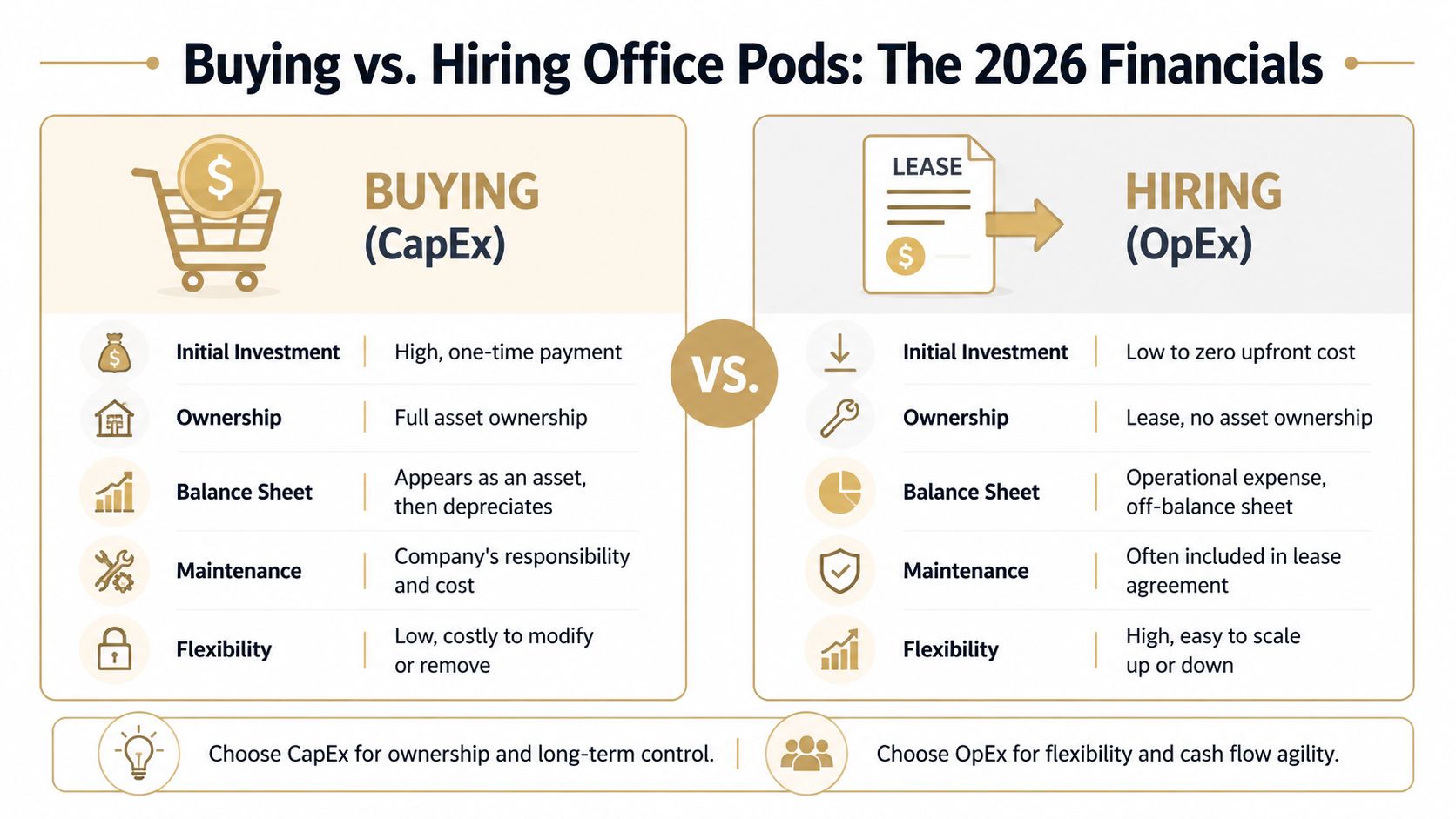
The financial decision is rarely just buy or don't buy. In practice there are three routes. Outright purchase, conventional rental, and subscription. Each suits a different budget structure and a different level of operational certainty.
Where buying works best
Buying suits organisations with a settled workplace strategy, approved capital expenditure, and confidence that the pod layout is unlikely to change soon. It also suits occupiers that want full ownership and expect long-term use.
There are clear advantages. The asset is yours. The specification can be aligned tightly to the fit-out. There is no dependency on a lease term. But buying also fixes the decision early. If headcount changes, if a floor is restacked, or if the original brief turns out to be wrong, the pod can become harder to reposition economically.
Where rental and subscription make more sense
Rental works better where flexibility matters more than ownership. That often includes growing businesses, coworking operators, project offices, and firms testing attendance patterns. Lower upfront commitment can remove a major barrier, especially when finance wants operating expenditure rather than capital expenditure.
For teams considering flexibility, office pod rental options are worth reviewing because they allow real operational testing. A business can prove demand before locking itself into a permanent arrangement.
A more advanced model is Framery Subscribed. This is useful when a team wants premium pod quality with a more adaptable commercial structure. It can suit businesses that expect change, want maintenance wrapped into the arrangement, or prefer a procurement route that feels closer to a managed service than a one-off purchase.
The sustainability angle matters too. Flexible pod models can support refurbishment, reuse, and longer product life, which aligns well with Gibbsonn's circular economy and sustainability approach.
Pod Procurement Models Compared Buy vs Rent vs Framery Subscribed
| Attribute | Outright Purchase | Traditional Rental | Framery Subscribed |
|---|---|---|---|
| Initial spend | High upfront commitment | Lower upfront commitment | Lower upfront commitment with a managed approach |
| Ownership | Full ownership | No ownership | No ownership |
| Budget treatment | Best suited to CapEx planning | Best suited to OpEx planning | Best suited to OpEx planning |
| Maintenance responsibility | Usually sits with the buyer unless separately contracted | Often included depending on agreement | Structured to support ongoing service needs |
| Flexibility | Lowest flexibility once installed | More flexible than purchase | High flexibility for changing workplace needs |
| Best fit | Stable layouts and long-term certainty | Shorter-term need or pilot use | Premium pod use with strategic flexibility |
| Circular economy fit | Depends on internal reuse plans | Better potential for reuse across terms | Strong fit for reuse and lifecycle thinking |
Decision filter: If the office strategy is fixed, buying can be rational. If the occupancy model is still evolving, flexibility usually beats ownership.
For many London occupiers in 2026, the commercial issue isn't whether pods are affordable in the abstract. It is whether the procurement route matches the uncertainty of the office plan. That is why subscription is gaining traction. It acknowledges that the building may stay the same while the way people use it keeps shifting.
Planning Your Pod Project Key Technical Considerations
A pod project can look simple from a distance. It isn't. The fastest way to create problems is to focus on finishes and ignore compliance, ventilation, acoustics, access, and maintenance. A facilities manager needs a checklist, not a mood board.
The compliance checks that matter first
UK workplace pod installations need to meet technical and regulatory requirements. The verified benchmark set includes fire retardant materials meeting BS 5852 standards, minimum 30dB sound insulation capabilities, and minimum air exchange rates of 4 cycles per hour, based on UK workplace sleep pod compliance and performance standards.
Those figures matter because they translate directly into user experience. If acoustic performance is weak, speech leaks and trust disappears. If ventilation is poor, the pod feels stuffy and people avoid it. If materials or egress are not handled properly, the project becomes a risk issue rather than a workplace improvement.
The same source notes that most contemporary nap pods occupy between 1.5–3m² of floor space. That is useful for planning because it confirms pods can fit into many wellness rooms and break areas without major structural work, provided circulation and access are thought through.
Accessibility cannot be an afterthought
Many projects falter when confronting practicalities. A pod may look inclusive in a brochure and still be difficult to use in reality. Door widths, thresholds, internal turning space, handle design, lighting control, glazing manifestation, and wayfinding all matter. So does the emotional experience of entering an enclosed space.
In London, this matters even more because the accessibility gap is well established. 24% of working-age adults have disabilities, around 10.1 million people, and 9% report mobility issues, while only 37% of budget hotels were found fully compliant with Equality Act 2010 standards in a UK hospitality accessibility audit, according to this accessibility discussion on capsule hotels and inclusion. For workplace teams considering sleep pods in london or related enclosed spaces, that is a warning. Inclusion can't be assumed.
A pod that only works for confident, able-bodied users is not a complete workplace solution.
Practical design choices help. Wider, more obvious entry points. Clear lighting controls. Good sightlines at the entrance. Sensible emergency procedures. Quiet operation rather than sudden mechanical noise. Material selections also matter, especially for enclosed spaces, which is why guidance on the best materials for sound insulation should be part of the specification conversation.
Questions to ask before sign-off
Before approving any pod, facilities teams should ask:
- Acoustics: What is the tested acoustic performance in real use, not just in marketing language?
- Ventilation: How is fresh air managed during occupancy, and how quickly does the pod recover between users?
- Fire safety: Which materials and certifications support workplace compliance?
- Accessibility: Can a broad range of users enter, operate, and exit the pod comfortably and safely?
- Maintenance: How often do filters, fans, seals, and finishes need attention?
- Serviceability: Can components be repaired without taking the pod out of action for long?
A technically sound project usually feels uneventful after installation. That is the goal. The pod should work, remain comfortable, and avoid creating a second wave of operational issues six months later.
From Showroom to Site A Step-by-Step Installation Guide
A successful pod project rarely starts on site. It starts with direct product review. Drawings and samples help, but enclosed spaces need to be experienced properly. Acoustic performance, ventilation feel, seat comfort, and perceived privacy are hard to judge from a specification sheet.
Step one see the pod in person
The most effective starting point is a showroom visit. For London teams, that means booking an appointment and travelling to Bishop's Stortford to test options in a controlled setting. That saves time later because decision-makers can compare sizes, finishes, and use cases before committing to surveys and procurement.
A useful showroom visit includes more than a walkaround. It should test realistic scenarios. A video call inside the pod. A two-person conversation in an adjacent area. Entry and exit with a bag or laptop. A short sit in silence to judge comfort.
Step two plan the site properly
The next stage is site review and space planning. During this phase, many hidden constraints emerge. Lift access, delivery routes, fire escape lines, power availability, flooring condition, and local circulation patterns all affect the final result.
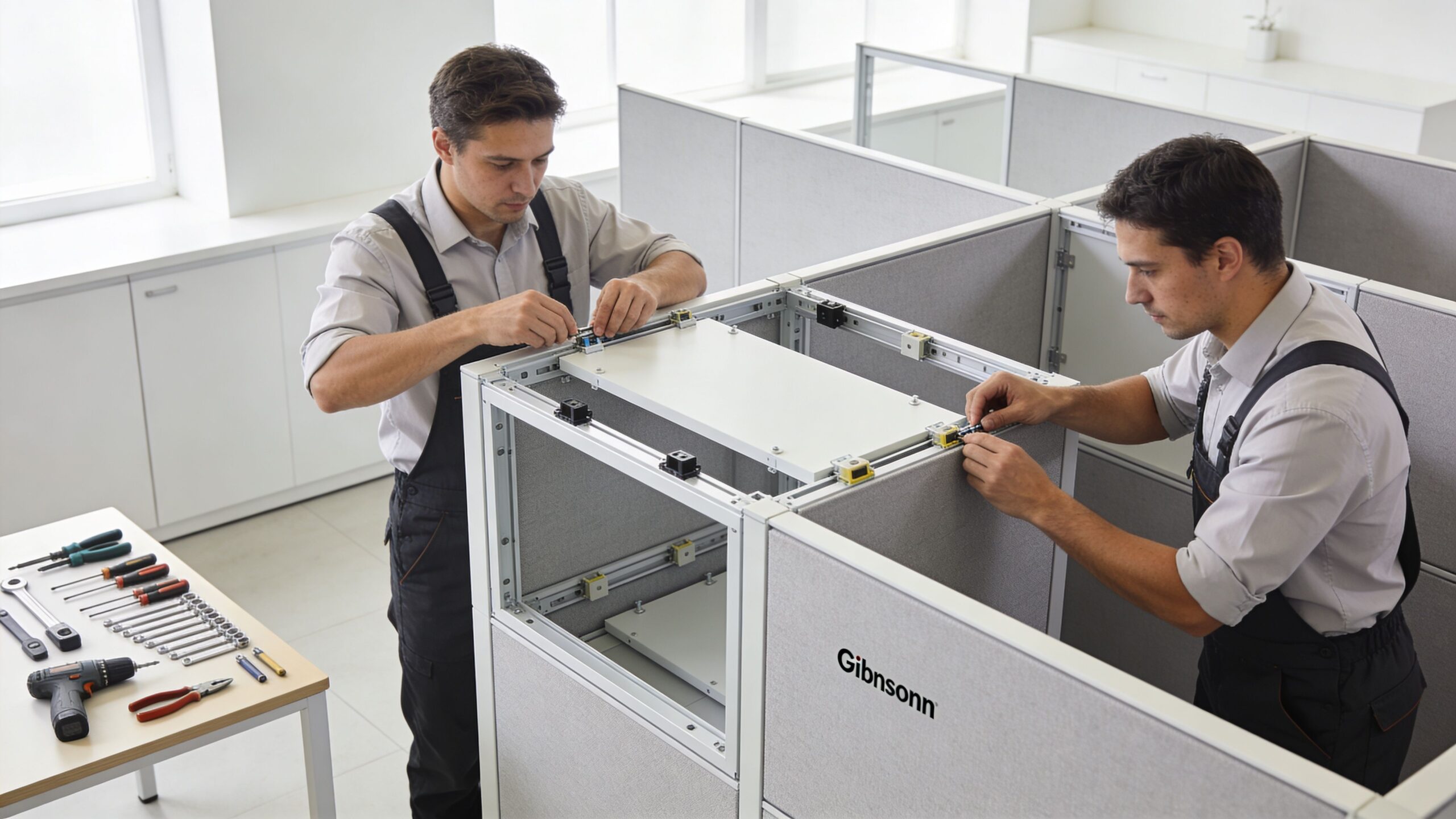
A proper plan also looks at adjacency. Pods should sit where the demand is, but not where queues or noise spillovers create a new problem. A call pod beside a quiet library zone may be a mistake. A meeting pod placed in a main circulation route may feel exposed and underused.
Step three install with minimal disruption
Most modular pod systems are well suited to phased installation. That is useful for busy London sites where weekend access, freight timing, and landlord controls can all complicate delivery. Good installation planning should protect business continuity first and aesthetics second.
A disciplined sequence usually includes:
- Pre-delivery checks: Confirm route access, storage, timings, and floor readiness.
- Protected installation windows: Coordinate with building management and avoid peak occupancy periods where possible.
- Testing before handover: Check ventilation, lighting, power, door function, and finish quality before users enter.
Good installation feels quiet. Staff arrive, the pod is there, and the office hasn't lost a week of productivity.
Step four protect performance after handover
The job isn't finished at install. Pods need user guidance, maintenance planning, and basic operational rules. Without that, even a strong product can become neglected or misused.
Aftercare should cover cleaning methods, filter or fan servicing, fault reporting, and reconfiguration options if the office changes. It should also include simple user etiquette. How long can one person occupy the pod. Whether eating is allowed. Whether calls take priority over focus work. Small rules protect the value of the investment.
The best projects feel simple to staff because someone has handled the complexity in advance.
Your Next Steps to a Quieter London Office
Monday starts with three people taking client calls in the open office, one manager hunting for a private space for a performance conversation, and a project team occupying a meeting room for work that should have happened in a smaller footprint. That is usually the point where a pod project stops being a design idea and becomes an operational requirement.
The right next step is to treat the decision like a workplace project, not a furniture purchase. Start with the pressure points that cost time or create avoidable friction. Define the use case clearly. Call privacy, short meetings, focus work, wellbeing, interview space, or overflow capacity all point to different pod types, service needs, and budget models.
Then test the commercial route as carefully as the product. Some London occupiers should buy. Others are better served by rental or subscription, especially where headcount, lease length, or floor plans may change. A good plan covers the full pod lifecycle: capital approval or monthly operating cost, compliance checks, landlord coordination, installation timing, user guidance, and aftercare.
Seeing products in person still matters. Acoustic performance, ventilation, door feel, internal comfort, and finish quality are easier to judge inside the pod than on a specification sheet. It also helps facilities teams compare what looks good in a brochure with what will stand up to daily office use.
For organisations ready to improve their workplace with premium acoustic pods, booths, and flexible rental options, Gibbsonn provides support from specification through installation and aftercare. A showroom appointment in Bishop's Stortford gives your team a practical basis for selecting the right solution for the site.