
A facilities manager approves a pod layout. The architect signs off the finishes. The workplace team loves the extra privacy for calls, focus work, and small meetings. Then building control asks a simple question. How is the ceiling void above and around those pods being compartmented for fire?
That's where many office fit-outs slow down. Acoustic pods solve noise and flexibility problems, but they also change hidden spaces in the room. New voids appear above pod roofs, around services, and beside existing partitions. If those interfaces aren't handled properly, a smart refurbishment can drift into a fire compliance headache.
This matters even more in open-plan refurbishments where the design intent is speed, minimal disruption, and a clean final look. A pod from Blocko, Framery, Kabin, Vetrospace, or an external solution from The Meeting Pod Co may fit beautifully within the floorplate, but the fire strategy still has to work around it.
Table of Contents
- The Hidden Risk in Your Open-Plan Office
- What Exactly is a Rockwool Fire Cavity Barrier
- Meeting UK Regulations with Confidence
- A Specifier's Guide to Rockwool vs Alternatives
- Integrating Fire Barriers with Acoustic Office Pods
- The Sustainable Choice for a Modern Workplace
- Frequently Asked Questions and Your Next Steps
The Hidden Risk in Your Open-Plan Office
A common office retrofit starts with a sensible brief. The business wants quiet zones without losing the openness of the floor. Pods go in. Teams get spaces for video calls, one-to-ones, and concentrated work. The project team often focuses on acoustics, power, data, and circulation first.
The hidden issue sits above eye level. Once modular structures are introduced below an existing soffit or suspended ceiling arrangement, the fire path in the void can change. The pod itself may not create the problem. The untreated cavity around it usually does.

A 2025 BRE report on fire safety in modular offices notes that 68% of facilities managers struggle with void compartmentation around relocatable structures, and identifies untested interfaces as a key risk. That finding matches what many project teams run into during open-plan upgrades, especially when the original fit-out never anticipated freestanding room-in-room products.
Where pod projects often go wrong
The problem usually appears in one of these places:
- Above the pod roof where an open void remains continuous to the surrounding ceiling space.
- At service penetrations where cables and pipework pass into or near the pod without coordinated sealing.
- At adjacent partitions where the new layout changes how concealed spaces connect, especially beside glazed systems or demountable walls such as Logika partitions.
- During late design changes when a pod gets moved after the fire stopping package has already been set.
Practical rule: If a pod changes the shape of a concealed void, the fire strategy needs to be checked again.
This is one reason many workplace teams revisit their wider open-plan office design approach before final sign-off. The pod is only one object in the room. The compliance question is how the full ceiling, partition, service, and cavity package works together.
What Exactly is a Rockwool Fire Cavity Barrier
A rockwool fire cavity barrier is a passive fire protection product used to close concealed spaces where fire and smoke could travel unseen. In practical terms, it acts like a fire-resisting seal inside the parts of the building people don't usually notice. Cavity walls, roof voids, suspended ceiling spaces, and perimeter gaps around fit-out elements all fall into that category.
The value of the product is simple. It doesn't rely on activation, software, or occupancy behaviour. Once installed correctly, it sits in place and helps stop fire and smoke from moving through hidden routes.
What it's made from
Rockwool fire cavity barriers are made from high-density stone wool with densities of 40 to 100 kg/m³ and a melting point over 1000°C. A single 50mm layer delivers 60 minutes integrity and 15 minutes insulation, tested under BS 476: Part 20 and 22:1987 according to this Rockwool fire barrier overview.
That composition matters in office retrofits because concealed spaces around pods can be awkward. They aren't always straight, square, or easy to board over neatly. A compressible stone wool barrier is often better suited to that reality than rigid-only approaches.
Why it matters in fit-out work
In fit-out terms, a cavity barrier is not the same thing as a full fire wall. It is there to stop hidden fire spread through voids that would otherwise bypass the main compartment lines. For a clear primer on wider structural fire containment for UK properties, that passive fire protection guide is useful background reading.
A pod installation creates exactly the sort of condition where concealed routes can be missed. The visible room looks tidy. The risk sits behind bulkheads, above ceilings, and around penetrations. If the cavity remains open, flames and smoke can move around the fit-out rather than through it.
A good cavity barrier does a quiet job. If no one notices it after handover, that usually means it was planned properly.
What a barrier actually does in service
A rockwool fire cavity barrier helps by:
- Closing the void so fire can't use concealed routes as a shortcut.
- Resisting heat and flame spread long enough to support the wider compartmentation strategy.
- Limiting smoke movement in the same hidden spaces.
- Adapting to irregular edges better than some rigid-only products, which helps around pod roofs and service zones.
That last point is often the deciding factor in refurbishment projects. Existing buildings rarely give perfectly clean geometry. The best system on paper still has to cope with real site conditions.
Meeting UK Regulations with Confidence
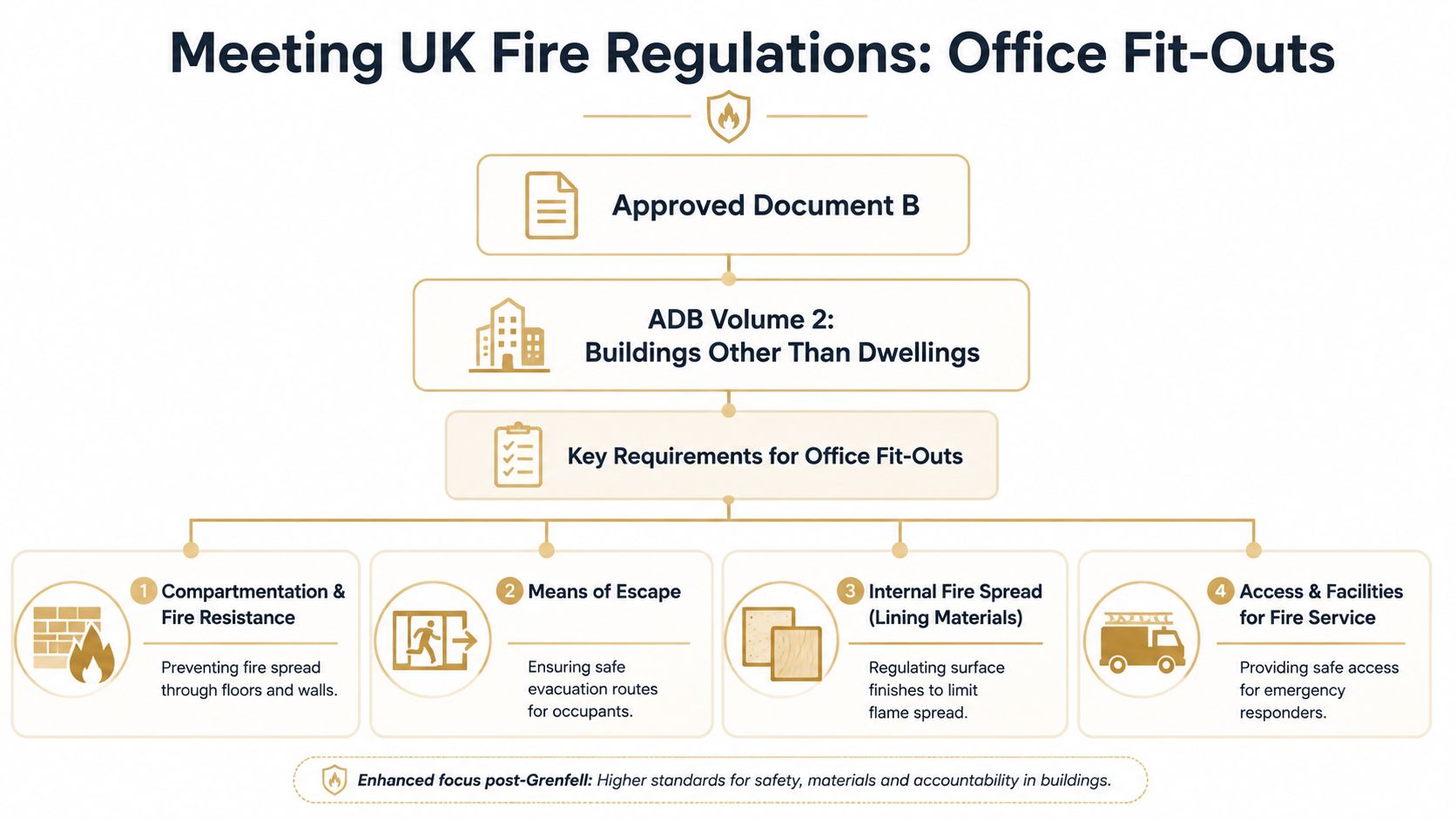
UK office fit-outs don't get judged on intent. They get judged on whether the installed solution aligns with the fire strategy and the relevant building regulations. For cavity barriers, the discussion usually comes back to Approved Document B, the tested fire performance of the product, and whether the installation matches the tested use case.
Understanding E and I ratings
Specifier conversations often get stuck in technical shorthand. The simplest way to read these ratings is this:
- E for integrity means the barrier holds back flames and hot gases.
- I for insulation means it limits heat transfer through the assembly.
So if a product is rated EI 120, it has been tested to provide both integrity and insulation for that period under the relevant test conditions.
ROCKWOOL's Fire Barrier EN achieves up to EI 120 as tested to BS EN 1364-1:2015 and BS EN 1634-1:2014+A1:2018, and the newer SCB barrier delivers E120, I45, which exceeds Approved Document B Volume 1's minimum E30, I15 requirement for dwellings, according to the Fire Barrier EN datasheet.
For office work, the key takeaway isn't to lift a dwelling requirement and apply it blindly. It's that the tested product performance sits comfortably above baseline expectations and gives specifiers a reliable starting point when assessing concealed void protection.
Why post-Grenfell choices are stricter
After Grenfell, specifiers and building owners became far more cautious about material selection in hidden spaces. Non-combustibility, traceable testing, and product suitability now receive much closer scrutiny. A1-rated stone wool products answer that concern well because the material behaviour is clear and the application history is well established.
That doesn't mean every site condition is automatically compliant just because stone wool is used. The detail still matters. The support system, fixing method, cavity size, substrate, and service penetrations must line up with the tested approach.
Compliance point: A tested product is only part of the answer. The installed detail has to reflect the tested system.
Office fit-out decisions need local and practical context
Fire regulation frameworks differ by country, and that matters if a design team works internationally. For example, teams comparing standards across regions may find it useful to review how Canadian fire door regulations are structured, even though UK projects must still be designed and signed off against UK requirements.
Within a UK office fit-out, cavity barriers often sit alongside other protection layers such as fire-retardant board systems. The strongest specifications don't treat these as competing products. They define where each belongs. Boards help form rated enclosures. Cavity barriers close concealed gaps. Mixing up those roles is where mistakes begin.
A Specifier's Guide to Rockwool vs Alternatives
A cavity barrier choice usually gets made in a crowded coordination meeting, not in a vacuum. The ceiling grid is already set out. M&E routes are fixed. The pod supplier has issued dimensions. The landlord shell may be uneven. Under those conditions, the right question is not which product sounds best on paper. It is which detail can be installed properly, inspected properly, and kept compliant once the pod is in place.
That matters more with prefabricated acoustic pods than with standard partitions. Framery, Blocko, and similar systems introduce short runs, awkward corners, service feeds, and tight roof void interfaces that do not suit every fire-stopping product equally well.
What decides the specification around pods
In pod-related voids, five checks usually separate a workable specification from one that causes trouble on site:
- Test evidence for the actual application, not just the material class.
- Installation tolerance where soffits, bulkheads, and pod tops are not perfectly straight.
- Continuity across long concealed gaps and broken interfaces.
- Coordination with adjacent fit-out elements such as glazing tracks, MF ceilings, and service supports.
- Acoustic benefit where speech privacy and reverberation control still matter.
That last point gets missed. In an office fit-out, the fire detail above a pod can affect acoustic performance below it. Where the surrounding build-up includes 15mm Soundbloc plasterboard for acoustic partition upgrades, the cavity barrier choice should support the wider wall and ceiling strategy rather than fight it.
Fire cavity barrier comparison
| Feature | Rockwool Stone Wool | Intumescent Pillows | Fire-Rated Board |
|---|---|---|---|
| Best use | Concealed voids, cavity edges, irregular interfaces | Local service openings where later access is expected | Built enclosures and rigid boxed details |
| Fit around pod geometry | Good for compression fit and uneven junctions | Poor for continuous perimeter lines | Better on straight runs than awkward interfaces |
| Fire performance approach | Based on tested cavity barrier systems | Depends heavily on the exact opening detail | Depends on the full board, framing, and joint detail |
| Installation practicalities | Suits restricted ceiling voids and inconsistent substrates | Quick in small openings, inefficient over long runs | Labour-heavy where cutting, framing, and support are needed |
| Acoustic benefit | Useful in acoustically sensitive office areas | Minimal | Can help, depending on the full build-up |
| Future adaptation | Moderate, depends on access and how the detail is formed | Easier to remove locally | Usually disruptive once complete |
Where each option works, and where it causes problems
Intumescent pillows have a place. I specify them where a service penetration needs to be reopened later and the opening is clearly defined. They are much less convincing above pods where the requirement is a continuous cavity closure over a changing line of interfaces. Small gaps between units, uneven soffits, and bracket interruptions all make continuity harder.
Fire-rated board also has a place. It suits framed enclosures and plant boxing where the geometry is stable and the support method is clear. Around pod tops, board details often become labour-heavy. Installers end up cutting narrow strips, packing out uneven spots, and trying to hold tolerances over a line that was never designed as a simple boarded head.
Stone wool cavity barriers generally cope better with that reality. They suit hidden voids where the line is irregular, where pod modules stop short of the soffit, and where the interface has to stay tight without forcing a rigid build-up into an uneven space.
The practical trade-off is straightforward. Pillows favour access. Board favours rigid construction. Rockwool-type cavity barriers favour continuity and tolerance in concealed voids.
Why rockwool is often the safer specification for modular office fit-outs
For acoustic pods, the risk usually sits in the junctions. A prefabricated unit may perform well on its own, but the fire strategy can still fail at the perimeter or above the roof zone if the cavity closure is treated as an afterthought. Stone wool barriers give specifiers more room to deal with real site conditions while still matching the fire-stopping function required for concealed spaces.
That is why they are regularly the stronger choice for pod projects tied into modern fit-out packages, especially where Gibbsonn products are being used across partitions, ceilings, and fire protection layers. The material choice is only part of the answer. The winning specification is the one the installer can fit accurately around the pod, the clerk of works can inspect, and the design team can defend at handover.
Integrating Fire Barriers with Acoustic Office Pods
A pod arrives on site late in the programme. The floor is nearly finished, the ceiling grid is in, and everyone wants the install done in a day. That is the point where fire compliance often slips, because the pod gets treated as a loose furniture item instead of a fitted element sitting inside a protected building envelope.
For acoustic pods, the risky detail is usually above and around the unit. The pod may be factory-built and well tested acoustically, but the concealed void over the roof, the perimeter junctions, and the service entries still have to match the building's fire strategy.
The detail that gets missed most often
Most office pods stop short of the soffit. Some sit below a suspended ceiling. Others stand in open ceilings with exposed services above. In each case, the visible pod shell is only part of the story. If a hidden void continues over the top, that route has to be closed correctly.
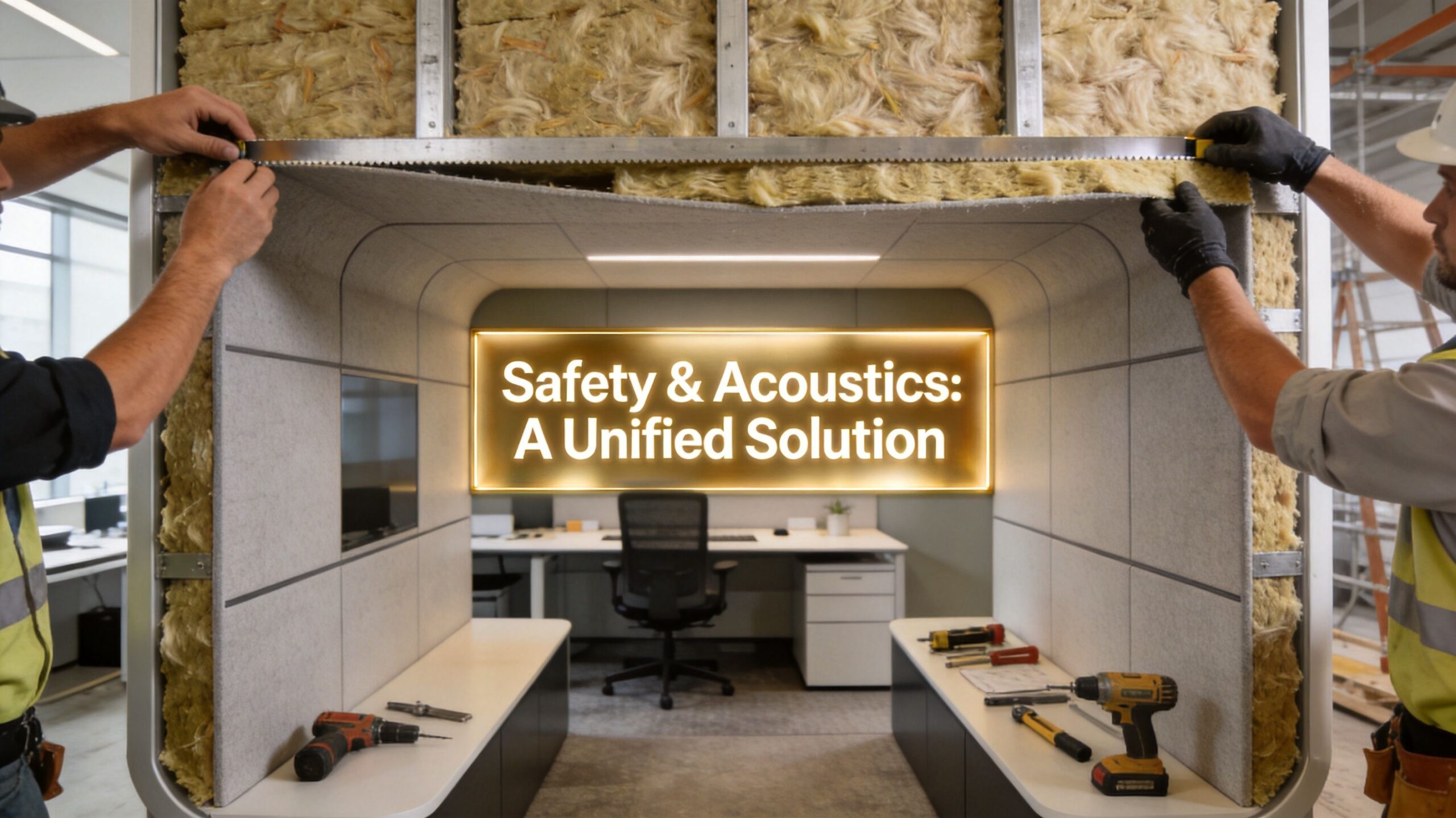
On real fit-out projects, that top detail is rarely neat. I regularly see shallow deflections in the slab, offsets in the ceiling line, sprinkler pipework cutting across the zone, and pod roofs that do not align cleanly with surrounding partitions. The barrier detail has to cope with those tolerances while staying continuous and inspectable.
That is why site measurement matters.
A practical sequence for pod installations
The cleanest pod fire-stopping jobs usually follow a disciplined order:
Review the fire strategy before the pod lands
Confirm whether the pod changes the way fire and smoke could travel through ceiling voids, partition heads, or perimeter zones.Measure the actual opening and surrounding conditions
Pod drawings help, but existing buildings often differ from the model. Check soffit levels, ceiling depths, service clashes, and access for installation.Fix service routes early
Power, data, ventilation connections, and any penetrations near the barrier line should be coordinated before materials are cut.Install the cavity barrier as a continuous system
The weak point is nearly always the break in continuity at corners, brackets, cable routes, or awkward roof profiles.Complete the surrounding build-up with compatible elements
Where the pod sits against a partition or bulkhead, products such as 15 mm Soundbloc plasterboard for surrounding wall and ceiling build-ups may support the wider acoustic and fire detail, but they do not replace the cavity barrier in the concealed void.
What changes between pod layouts
The same compliance principle applies across pod brands already noted earlier in this guide. What changes on site is the geometry.
A single-person phone booth in the middle of an open floor plate is usually straightforward. A larger meeting pod set tight to a glazed partition, under a bulkhead, or beside an existing service tray needs much tighter coordination. Roof shape, manufacturer tolerances, ventilation terminals, and door swing zones can all affect where the barrier line starts and how it is fixed.
Prefabricated pods also create a trade-off the drawings rarely show clearly. Early installation gives better access for fire stopping, but late installation often suits the fit-out programme and protects the pod from damage. If the pod is going in late, the barrier detail needs to be designed so installers can still reach and inspect the full line without relying on improvised packing or blind sealing.
Poor coordination at the pod head causes more fire-stopping failures than the barrier product itself.
Mistakes that cause problems at sign-off
Several faults come up repeatedly in office retrofits and CAT B projects:
- Leaving the void above the pod open because the unit is assumed to be self-contained
- Using acoustic infill as if it were fire stopping without a tested detail for that application
- Cutting barriers around services after the fact and accepting small gaps as tolerable
- Installing the pod before the head detail is accessible which leads to incomplete fitting and weak inspection records
- Treating the pod perimeter and the ceiling void as separate issues when both need to work as one fire strategy
The better approach is simple. Design the cavity barrier detail around the pod at drawing stage, check it against site conditions before delivery, and install it as part of the pod package rather than as a snagging exercise at the end.
The Sustainable Choice for a Modern Workplace
A strong fire strategy doesn't have to conflict with workplace flexibility. In many offices, the opposite is true. The best projects combine passive fire protection with layouts that can evolve without constant demolition and rebuild.
That is one reason pods have become such a sensible workplace investment. They add privacy, focus space, and meeting capacity without the permanence of full traditional construction. When that flexibility is paired with an effective cavity barrier approach, the office becomes easier to adapt responsibly.
Safety and circular thinking can work together
Stone wool aligns well with broader sustainability goals because it supports long-life passive protection and suits building upgrades where reuse and adaptation matter. In fit-out terms, that matters more than slogans. A product that performs well in refurbishment and can be integrated cleanly into changing layouts supports a more durable workplace strategy.
The same thinking sits behind pod hire and subscription models. Instead of overcommitting to fixed construction, some organisations prefer scalable solutions such as Framery Subscribed pod rental. That supports a more circular approach to workplace planning, particularly when headcount or team patterns may shift.
A practical sustainability view
A sustainable office fit-out usually has three traits:
- It avoids unnecessary strip-out by using adaptable elements.
- It keeps useful products in circulation rather than treating every layout change as waste.
- It supports long-term performance in acoustics, safety, and user comfort.
That broader view fits well with the workplace choices many occupiers now want. Flexible pod deployment. Smarter use of existing space. Fewer heavy rebuilds. More emphasis on durable materials and responsible procurement. For organisations weighing those factors, the wider sustainability approach at Gibbsonn gives a useful picture of how pod-led workplace design can support the circular economy in practice.
Frequently Asked Questions and Your Next Steps
Can a rockwool fire cavity barrier be cut on site
Yes, but only within the manufacturer's installation guidance and only where the final fit still matches the intended tested detail. Site cutting is common in refurbishment work because existing buildings are rarely perfectly regular. What matters is accuracy, continuity, and proper support.
Will the barrier affect pod acoustics
It can affect the surrounding acoustic environment, often positively, because stone wool has useful acoustic properties. But the pod's certified acoustic performance should never be assumed to come from the cavity barrier. They do different jobs and should be assessed separately.
How often should cavity barriers be inspected
They should be checked during installation, at handover, and whenever later works might disturb them. In offices, a significant risk often comes after the original fit-out. New cables, altered ceilings, moved pods, and added partitions can all compromise hidden details.
Are pods treated like furniture for fire compliance
That assumption causes trouble. Once a pod changes concealed voids, service routes, or escape planning, the project team needs to assess it as part of the fit-out fire strategy. The visible object may look movable. The hidden consequences often are not.
Can one solution work for every pod brand
No. The principle can remain the same, but the detail should respond to the actual pod, the host building, and the surrounding construction. Roof shape, access above the pod, nearby partitions, and service entry points all change the answer.
What is the safest approach before ordering pods
Take the proposed layout and ask for a coordinated review of fire strategy, ceilings, services, partition interfaces, and cavity treatment before procurement is finalised. That sequence avoids expensive redesign and protects programme certainty.
The cheapest moment to solve a fire cavity problem is before the pod order is placed.
A good office pod project should feel simple to the people who use it. Quiet room. Clean finish. Better focus. Behind that simplicity sits disciplined coordination. Get the hidden details right and the visible result works far better.
If a workplace team is planning pods, refurbishing an open-plan office, or reviewing whether an existing fit-out is properly protected, Gibbsonn can help with the practical side of pod selection, layout planning, and compliant integration. Teams are welcome to book an appointment and visit the showroom in Bishop's Stortford to see the pod ranges in person and discuss the right solution for the space.