

Basic office pod rental costs in the UK can start from around £149 to £150 per month for smaller units, but that headline figure rarely reflects the full investment. Once delivery, pick-up, installation conditions, and the length of hire are factored in, the full pod rental cost can look very different from the number in the advert.
A lot of facilities managers reach the same point. The office is busy, calls spill into breakout space, focus work gets pushed into corners, and meeting rooms are either overbooked or used for one-person video calls. A pod can solve that quickly, but the buying question is rarely just about the monthly fee.
The practical issue is total cost of ownership. A pod that looks affordable on paper can become less attractive if access is awkward, if the unit needs to be relocated, or if the business ends up keeping it far longer than planned. On the other hand, a flexible rental model can be the right move when a team needs speed, less upfront spend, and the option to scale up or down without committing to a permanent fit-out.
Table of Contents
- Your Guide to Office Pod Rental Costs
- Understanding Your Rental Options
- UK Pod Rental Costs A Realistic Breakdown
- What Drives Your Final Pod Rental Quote
- Rental vs Purchase Is Hiring Always Cheaper
- Smart Procurement and Planning for Your Pods
- Your Next Step to a Quieter More Productive Office
Your Guide to Office Pod Rental Costs
An open-plan office can look polished and still fail the people using it. The usual pattern is familiar. One team needs quiet for focused work, another needs a private space for calls, and meeting rooms are too large for the tasks they absorb every day.
That's where pods become useful. They aren't just pieces of furniture. They are fast, contained workplace interventions that create privacy, reduce disruption, and avoid the mess of full construction.
For budgeting, the first figure most buyers want is the monthly rate. That matters, but it's only the starting point. A useful assessment of pod rental cost has to account for logistics, placement, acoustic expectations, maintenance responsibility, and whether the pod is solving a short-term pressure or a long-term workplace need.
Practical rule: If the quote only shows a monthly charge, it isn't a complete pricing picture.
Facilities teams also need to think visually as well as financially. A pod that fits in theory can still fail in practice if circulation routes, glazing lines, or desk density haven't been tested. Using a planning tool such as the Room Sketch 3D floor planner can help teams sense-check footprint and layout options before they ask for a formal proposal.
Three questions usually sharpen the decision early:
- What problem is the pod solving: phone privacy, focus work, small meetings, or overflow space.
- How long is the need likely to last: a few months, a pilot phase, or part of a broader workplace reset.
- What will the site allow: access, power, floor loading, and installation windows all affect the final outcome.
A realistic guide to pod rental cost has to answer all three.
Understanding Your Rental Options
Not all rental models behave the same way commercially. Some are built for short-term convenience. Others are closer to structured leasing. Newer subscription models sit somewhere in between and are often more useful for workplaces that need agility.
Short-term hire
Short-term hire suits temporary demand. That could be a project team, a decant during office works, a trial installation, or a short occupancy period in a serviced office. The main attraction is speed and reduced commitment.
The downside is that short periods can make logistics feel expensive because delivery and collection are being absorbed across fewer months. A pod hired briefly can still make sense, but only if the operational need is urgent enough to justify it.
Longer-term leasing
Longer-term leasing usually works better when the business already knows the pod will remain in place for a sustained period. It can smooth expenditure and avoid a large upfront purchase, but it offers less flexibility than a subscription arrangement if requirements change.
That matters in the current workplace market. Recent UK workplace commentary notes that occupiers are prioritising more amenity-rich and flexible environments, and that subscription-style pod access is emerging to support that need for agility in ways generic cost guides often miss, as discussed by FreightWaves on evolving pod cost models.
Subscription models
A subscription approach is often the most practical fit for organisations that want pods without treating them like a fixed asset purchase. A model such as Framery Subscribed shifts the conversation from ownership to use. That can help when a workplace strategy is still moving, headcount is changing, or a client wants premium acoustic performance without tying up capital.
The finance angle matters here. Rental or subscription can support an operational expenditure mindset rather than a capital purchase. For many organisations, that makes internal approval easier and aligns better with phased workplace rollouts.
A separate consideration is product type. Some teams need a single phone booth. Others need a two to four person pod with integrated power, ventilation, lighting, and a finish that fits a premium office environment. Those broader workplace options sit alongside other acoustic office solutions such as screens, wall treatments, and zoning elements.
The right model depends less on the pod itself and more on how certain the organisation is about time, scale, and future change.
UK Pod Rental Costs A Realistic Breakdown
The simplest answer is that smaller pod or container-style rental units in the UK commonly start at about £149 to £150 per month, with delivery and pick-up often adding about £75 per trip, according to UK-oriented pod rental pricing guidance referenced here.
That figure is useful, but it doesn't behave like a complete office pod quote. Workplace buyers need to think in three layers. The monthly rental fee is only one part. Logistics come next. Then there are optional or site-specific costs that can change the actual spend quickly.
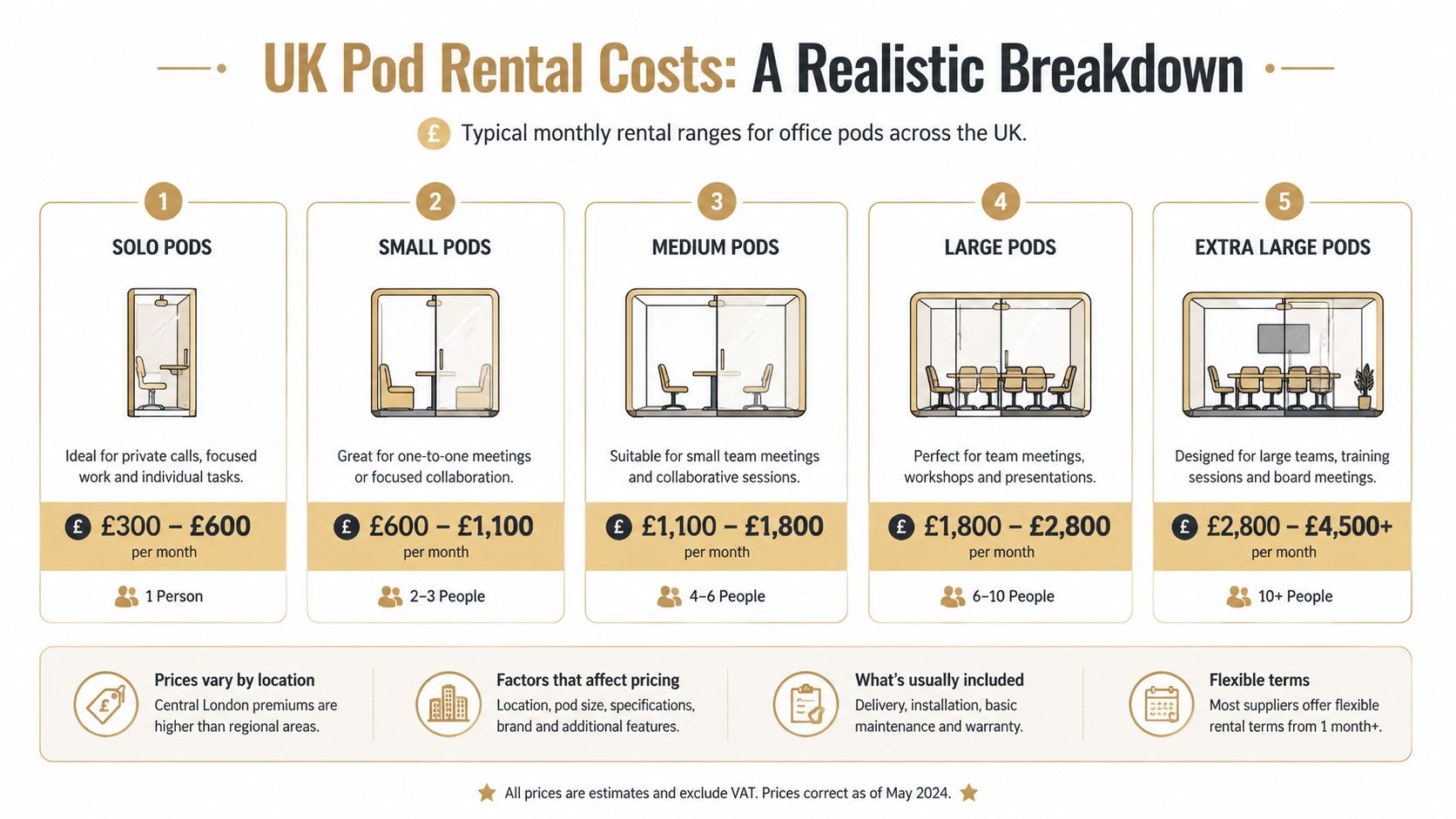
The three-part cost model
| Cost element | What it usually covers | Why it matters |
|---|---|---|
| Monthly hire | The base rental for the pod | This is the headline number most buyers see first |
| Logistics | Delivery, collection, movement, access coordination | This can change the effective monthly cost sharply on short hires |
| Operational extras | Installation complexity, maintenance scope, special access, custom finishes | These often decide whether a quote still feels good value |
For office environments, the gap between a simple public price guide and a real proposal is often caused by workplace conditions rather than the pod itself. Lift access, out-of-hours install slots, restricted loading, and floor protection all have a cost implication.
Why pod type changes the conversation
A single-person booth is a different commercial tool from a collaboration pod. The first usually solves call privacy and short bursts of focused work. The second starts to replace pressure on small meeting rooms.
In practical specification terms, product quality also affects value. Brands such as BlockO pods, Framery pods, Kabin pods and Vetrospace pods each sit in different aesthetic and performance conversations. The cheapest route isn't always the lowest real cost if the pod underdelivers acoustically or needs replacing sooner than planned.
Where public pricing helps and where it doesn't
Public market data is useful for creating a baseline. It helps teams sense-check whether a quote is broadly realistic. It does not replace a site-specific proposal.
What tends to work well is using public price ranges to frame internal approvals, then asking for a full breakdown that includes delivery, installation assumptions, collection, maintenance responsibility, and any end-of-term obligations. What doesn't work is approving a pod on a headline figure and dealing with the actual logistics cost afterwards.
What Drives Your Final Pod Rental Quote
A final pod rental quote is shaped by more than duration. Size, performance expectations, technical features, and site conditions all move the number.
Industry pricing guides show just how sensitive rental is to size and location. Standard pod or container-style rental commonly ranges from about £139 to £239 per month, while broader market snapshots show roughly £150 to £359 per month depending on size and region. Delivery and pickup are often charged separately at around £75 to £150 per trip, based on this market pricing overview from PODS.
Size and capacity
The quickest driver of cost is physical scale. A one-person phone booth uses less floor area, less material, and simpler logistics than a larger enclosed pod designed for several users.
Bigger pods also influence the workplace around them. They need clearer access routes, more careful placement, and often a stronger case for power and data planning. In dense offices, the footprint cost is part of the decision even if it never appears as a separate line item.
Acoustic performance
Not all pods create the same level of privacy. Some are suitable for general reduction of ambient noise. Others are specified for more confidential use where speech privacy matters.
A low price can become a false economy. If the pod looks good but doesn't isolate sound well enough for calls, focused work, or HR conversations, the workplace still has the original problem. Materials, seals, ventilation design, and glazing specification all influence performance. Teams that want a clearer view of specification choices often compare finishes and build-ups against guidance on the best materials for sound insulation.
Better acoustics usually cost more, but poor acoustics cost more again when the pod fails to solve the issue it was bought to fix.
Technology and fit-out
Technology can be light-touch or integrated. Some pods need little more than power. Others need task lighting, occupancy controls, monitor mounting, booking panels, data access, or a table layout that supports hybrid meetings.
The cost effect here isn't only the equipment itself. It's also the extra labour, the cable routes, and any testing or adaptation needed once the pod reaches site.
Delivery installation and site conditions
This is the cost area buyers most often underestimate. A straightforward ground-floor delivery is one thing. A city-centre office with timed loading, lift restrictions, and occupied-floor installation is another.
A good quote should spell out practical assumptions such as:
- Access method: ground floor, lift, stairs, restricted loading bay, or crane requirement.
- Installation timing: standard working hours or out-of-hours access.
- Floor protection and route prep: especially important in premium fitted offices.
- Placement constraints: tight corners, glass partitions, live work zones, and fire routes.
A pod doesn't arrive into an empty drawing. It arrives into a functioning workplace. That's why the actual pod rental cost is always tied to the site.
Rental vs Purchase Is Hiring Always Cheaper
Hiring isn't always cheaper. It's often more flexible, less disruptive to cash flow, and easier to approve quickly. Those are different advantages.
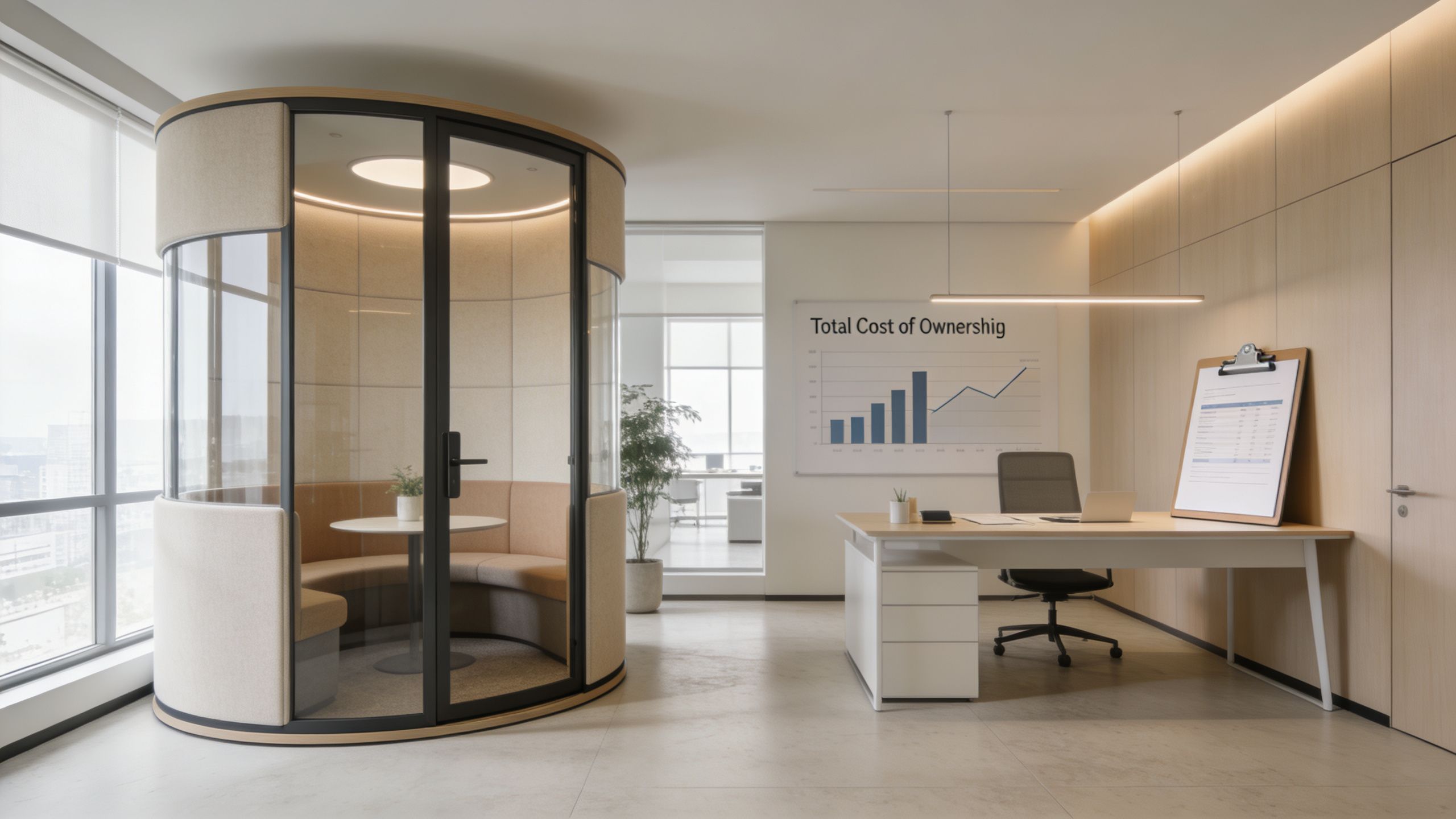
For many UK workplaces, the primary comparison is between rental, outright purchase, and more permanent interior construction. That comparison matters because office noise is still a daily issue. A UK study cited in workplace cost discussion found that 78% of workers are distracted by office noise, which is one reason demand for pods remains high, as noted in this PODS cost article discussing delivered, installed and maintained cost questions.
When rental works well
Rental tends to work best where flexibility has value in its own right.
- Pilot projects: a business can test whether a pod reduces meeting room pressure or improves call privacy before making a long commitment.
- Phased estate changes: when a workplace strategy is still evolving, rental avoids locking in the wrong quantity too early.
- Temporary occupation: decants, project floors, swing space, and short leases usually favour a rented solution.
- Cash preservation: a monthly model can be easier to align with operating budgets than a capital purchase.
There's also a workplace speed advantage. Pods are typically less disruptive than building enclosed rooms and can often be integrated with less downtime than traditional works.
When purchase starts to make more sense
Purchase becomes more attractive when the organisation knows the need is stable and long term. If a pod is likely to remain in place for years, the rental premium may eventually outweigh the flexibility benefit.
That doesn't automatically mean traditional construction is the answer. A bought pod still preserves some mobility and often creates less disruption than hard build. It can also be compared with modular alternatives such as Logika partitions when the requirement is broader zoning rather than enclosed acoustic privacy.
For buyers considering ownership routes, a practical benchmark is to review meeting pods for sale alongside rental models and ask the same question of each option. What does the solution cost once delivered, installed, maintained, and eventually moved or removed?
A short visual overview can help when assessing the broader ownership discussion:
Circular economy and lower waste
Rental also fits well with circular thinking. Instead of every organisation buying, using, and disposing of workplace products independently, a subscription or managed rental model can support refurbishment, reuse, and redeployment.
That approach aligns with the principles set out in Gibbsonn sustainability and circular economy thinking. It can reduce waste, extend product life, and make premium workplace products more accessible without assuming permanent ownership is always the smartest path.
Exterior space should also be part of the discussion where indoor footprint is constrained. In some settings, The Meeting Pod Co exterior pods may open up an additional route for private meetings or quiet working without altering the main office floorplate.
Renting is strongest when certainty is low. Buying is strongest when need is stable. Permanent construction is strongest when the space itself won't need to flex.
Smart Procurement and Planning for Your Pods
The strongest pod decisions usually come from disciplined front-end planning rather than hard negotiation at the end. A facilities team that has mapped the space, defined the use case, and challenged the quote assumptions is far less likely to be caught out later.
Space planning and compliance
The first check is physical fit. That means footprint, circulation, sightlines, power source, ventilation needs, and how the pod will sit within fire routes and daily movement patterns.
A second check is operational. Installation windows, access restrictions, and building management rules often shape the final proposal as much as the product choice does.
Questions worth asking before signing
A useful procurement conversation should get specific quickly. Generic reassurance isn't enough.
- What exactly is included: ask whether the quote includes delivery, installation, collection, maintenance, and any replacement parts.
- What assumptions has the supplier made: site access, standard hours, lift use, and floor conditions should be listed.
- How does the agreement end: understand notice periods, removal process, and what happens if the pod needs to stay longer.
- What can be changed later: some models allow relocation, finish changes, or scaling the quantity more easily than others.
- What level of acoustic privacy is realistic: a pod can reduce noise well without being suitable for every confidential use.
A clear quote is one that states what happens on day one, during the term, and at the end. If any of those stages are vague, the commercial risk usually sits with the buyer.
Negotiating the agreement
Not every cost line is fixed in practice. The most useful areas to discuss are often logistical rather than product-related.
A facilities manager may be able to negotiate contract length, grouped deliveries, waived or reduced transport charges, or preferred installation timing if multiple units are being taken. The stronger the planning detail provided up front, the easier those conversations become.
One option in this market is Gibbsonn, which supplies premium interior pod brands and UK rental access for Framery through subscription. The practical value in any supplier relationship is less about the brochure and more about whether the quote, installation plan, and aftercare terms are clear enough to support procurement with confidence.
Your Next Step to a Quieter More Productive Office
A good pod can solve real workplace problems quickly. It can create privacy without construction, support hybrid working, reduce noise pressure in open-plan space, and give facilities teams a faster route to change than a traditional fit-out.
The cost decision only becomes clear when the full picture is on the table. Monthly hire matters, but so do delivery, installation, maintenance, relocation, and the likely length of use. That's why the smartest conversations start with total cost of ownership rather than a headline monthly fee.
For organisations comparing rental, subscription, or purchase, the most useful next step is usually to test the options in person. Seeing the finishes, trying the acoustics, and checking the footprint against a real floor plan tends to answer questions much faster than a price list alone. Booking an appointment and visiting the showroom in Bishop's Stortford is a practical way to do that.
If your team is weighing pod rental cost against purchase, fit-out, or phased workplace change, Gibbsonn can help assess the actual total cost and the right pod format for your site. Book an appointment to visit the showroom in Bishop's Stortford and explore the options in person.