

The office probably looks familiar. Desks are occupied. Meeting rooms are full. Teams are back in often enough to justify the rent. Yet people still step into corridors for calls, book rooms for one-person tasks, and wear headphones just to finish basic work. That is not a furniture problem on the surface. It is a workplace performance problem.
For a UK facilities manager, modern office furniture should be judged by one question. Does it help people work properly in the space that already exists? If it doesn't improve focus, support compliant desk work, or give the office flexibility as attendance changes, it is just expensive fit-out.
That matters because the category is not standing still. The UK office furniture market was valued at about £2.75 billion in 2023 and is projected to reach roughly £3.85 billion by 2030, with growth tied to ergonomic and flexible systems that support hybrid work and refurbishment rather than new build expansion, according to Intel Market Research's review of the evolution of office furniture. The shift is clear. Buyers are moving beyond static desks and looking for systems that solve real operational problems.
Table of Contents
- Beyond the Desk The New Role of Office Furniture
- What Defines Modern Office Furniture Today
- Your Functional Requirements Checklist
- Specifying the Solution A Deep Dive into Office Pods
- Planning Your Space and Layout
- The Business Case Procurement ROI and Sustainability
- Your Next Steps From Plan to Productive Space
Beyond the Desk The New Role of Office Furniture
A typical failure point in open-plan offices is easy to spot. One team is trying to collaborate. Another needs quiet. Someone takes a confidential call at a bench desk. A manager grabs a meeting room because there is nowhere else to think. The office becomes a series of workarounds.
That is why modern office furniture now sits much closer to workplace strategy than procurement admin. It is no longer just a line item for desks, storage, and chairs. It is part of how an organisation manages concentration, privacy, circulation, wellbeing, and space efficiency.

For many facilities teams, the primary challenge is not fitting out a brand new floor. It is improving an existing one without major structural work. That is why reconfiguration matters more than replacement. Pods, acoustic booths, modular seating, movable screens, and adaptable desk systems do more for a live workplace than another bank of standard desks.
Practical rule: If people keep leaving their workstation to find privacy, the office needs better settings, not more furniture of the same type.
There is also a technology layer to this. A better workplace needs stronger physical and digital support together. If teams are moving between touchdown areas, booths, and meeting spaces, connectivity has to keep up. Facilities leaders reviewing layout changes should also understand how to IT services for London and Essex SMEs fit into day-to-day office performance, especially where hybrid working depends on stable devices, calls, and room systems.
The office in 2026 won't be judged by how polished it looks in photos. It will be judged by whether people can focus, talk, meet, and reset without friction. That is the new role of furniture. It has to perform.
What Defines Modern Office Furniture Today
Modern office furniture is often discussed as a style category. That is a mistake. For a facilities manager, the useful definition is much simpler. It is furniture that helps the workplace do more with the same footprint.

Performance matters more than style
The key question is not whether a product looks contemporary. It is whether it improves how the office functions. That matters because noise and lack of privacy are top complaints in open-plan workplaces, and the better buying question is, “When should you buy acoustic pods or booths instead of more desks?”, as highlighted in this discussion of modern workplace furniture and acoustic needs.
That should change the brief immediately. If distraction is the daily friction point, adding more desks only increases density. It does not solve the problem.
“Modern office furniture should be specified as a performance system, not a styling exercise.”
A space also fails if it looks smart but works badly online. Pods, meeting areas, and touchdown zones all rely on strong connectivity. If the workplace is being redesigned around flexible settings, facilities teams should also understand how to optimize office Wi-Fi networks so the technology experience matches the physical one.
The four pillars that actually matter
A practical definition of modern office furniture rests on four pillars.
- Ergonomics. Workstations must support safe, sustainable desk work. Adjustability matters more than finish.
- Adaptability. Layouts need to respond when teams grow, shrink, or attend on different patterns.
- Technology integration. Power, charging, and cable routing should be built into the plan, not treated as afterthoughts.
- Sustainability. Procurement should consider lifespan, reuse, refurbishment, and end-of-life recovery.
The strongest projects combine all four. A beautiful chair with poor adjustment is not modern in any meaningful sense. A sleek meeting booth with no ventilation or power planning is not modern either. Nor is a fixed layout that becomes obsolete the moment attendance patterns change.
For broader fit-out schemes, bespoke pieces can still play a role. A custom reception desk, integrated storage wall, or custom benching system may help solve site-specific issues better than off-the-shelf products. That is where bespoke office furniture fits well, especially when a standard range cannot handle awkward footprints or brand requirements.
Your Functional Requirements Checklist
A facilities manager doesn't need more inspiration boards. A workplace brief needs a checklist that prevents expensive mistakes. If a product cannot meet functional requirements, it should not make the shortlist.
Start with compliance and comfort
The first filter is ergonomics. In the UK, office furniture must support safe use, not just visual consistency. The Health and Safety Executive states that users should be able to work with forearms approximately horizontal and eyes at roughly screen-top height. That is why adjustable chairs and desks are a practical control, not an upgrade, as outlined in this summary of office-grade ergonomic requirements.
That standard should shape workstation procurement straight away. Chairs need proper adjustment. Desks need correct dimensions. Meeting furniture should not force poor posture during laptop work.
A workable checklist starts here:
- Chair adjustment. Seat height, back support, and usable adjustment range matter more than upholstery.
- Desk suitability. The desk has to support actual equipment use, not just look clean in plan view.
- Monitor positioning. Furniture selection should allow screens to be placed at an appropriate working height.
- User variety. Shared workstations must accommodate different body types without improvised fixes.
Poor ergonomics creates hidden facilities work. Teams ask for footrests, monitor risers, replacement chairs, workstation moves, and ad hoc fixes that could have been avoided at specification stage.
Then test the space, not just the product
The next filter is acoustic control. Open-plan offices need more than desks and soft seating. They need a mix of enclosed and semi-enclosed settings for calls, heads-down work, and quick conversations. Where softer zoning is enough, acoustic screens and partitions can help. When a project includes partitions, Logika is worth reviewing alongside enclosed solutions.
Then comes flexibility. Static layouts age quickly. Modular benches, movable screens, reconfigurable tables, and booths that can be repositioned are far more useful when team structures change. A rigid plan usually costs more later because every adjustment becomes a mini project.
Technology should also be treated as a baseline requirement:
- Power access. People should not hunt for sockets or trail cables across circulation routes.
- Data and device support. Meeting booths and focus areas need practical support for laptops and calls.
- Lighting quality. Settings used for video calls or concentrated work need proper internal lighting.
- Cable management. Clean routing is not cosmetic. It affects safety, maintenance, and usability.
Sustainability now belongs on the same checklist. Materials matter, but so does what happens after installation. Can products be moved, reused, reupholstered, repaired, or recycled? Circular thinking reduces waste and helps avoid unnecessary replacement cycles. That is why many teams now look beyond purchase and review suppliers' broader approach to reuse and responsible specification through pages such as sustainability at Gibbsonn.
Specifying the Solution A Deep Dive into Office Pods
Office pods are no longer niche products for design-led offices. They have become one of the most practical tools for fixing open-plan dysfunction without building new rooms. Used properly, they create privacy, improve focus, and reduce pressure on formal meeting rooms.
What pods are for
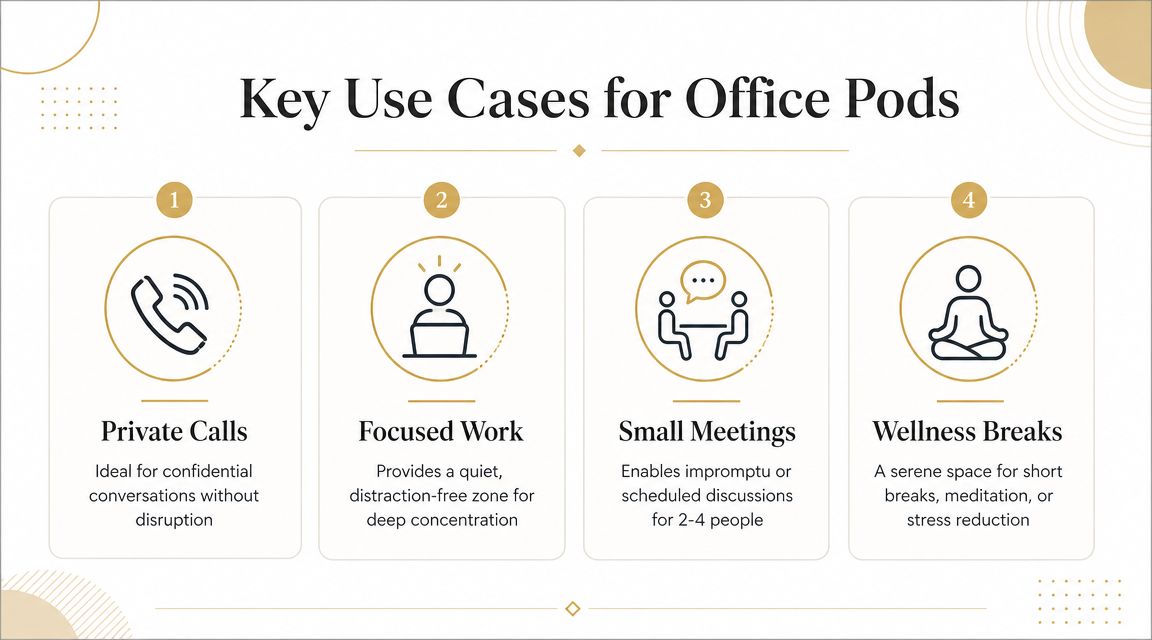
A pod should solve a specific workplace problem. The most common use cases are straightforward:
- Private calls. One-person booths stop staff taking confidential or noisy calls at open desks.
- Focused work. Enclosed settings give people short periods of quiet concentration without booking a room.
- Small meetings. Team pods absorb the overflow from formal meeting spaces.
- Touchdown tasks. Hybrid staff often need a temporary, well-equipped spot for calls and laptop work.
That mix matters because most offices do not need more of one setting. They need a better spread of settings.
How to specify a pod properly
The specification process should be technical. Pods are engineered systems, not decorative boxes. UK guidance around acoustic furniture emphasises that pods combine structure, acoustic lining, ventilation, and power, and should be selected for measurable performance such as acoustic attenuation and airflow, not just appearance, as outlined in this review of office furniture design and specification.
That means the buying checklist should include:
- Acoustic performance. The pod must reduce distraction and support the intended level of speech privacy.
- Ventilation. Airflow is essential. A pod that becomes stuffy won't be used properly.
- Lighting. Internal lighting should support calls, laptop work, and visual comfort.
- Power and connectivity. Users need practical access to charging and device use.
- Footprint efficiency. The size must justify the occupancy and fit circulation plans.
- Build quality. Frequent use demands durable finishes, stable doors, reliable seals, and serviceable components.
Specification rule: Never buy a pod because it looks quiet. Buy it because the performance data and workplace need match.
For wider planning, acoustic furniture should sit within a joined-up strategy. That can include screens, booths, wall treatments, and enclosed meeting settings. A useful starting point is to review acoustic office solutions as a whole rather than selecting pods in isolation.
Pod types worth reviewing
Different brands suit different briefs, and the choice should follow use case, finish level, and operational model.
For internal pod options, facilities teams can review BlockO pods, Framery pods, Kabin pods, and Vetrospace pods. For external settings, separate garden offices, or standalone meeting environments, The Meeting Pod Co exterior pod range gives another route.
That product mix matters because one office may need several pod types at once. A one-person booth near desking, a larger enclosed pod near collaborative areas, and an external meeting pod for overflow or specialist use can all sit within the same workplace strategy.
Planning Your Space and Layout
A good pod in the wrong place will underperform. Layout still matters. The right approach is zoning, not scattering products wherever there is floor space left.

Zone the office by task
The office should be organised around activity. Quiet work, calls, collaboration, and social use should not compete in the same zone if it can be avoided. Pods work best when they support those zones rather than interrupt them.
A practical layout usually follows a few clear rules:
- Place call booths near workstations so staff can step away quickly without crossing the whole floor.
- Keep larger meeting pods near collaboration zones where team discussions already happen.
- Protect circulation so pod doors, queues, and waiting users do not block escape routes or pinch points.
- Support booking behaviour if pods are shared heavily. A badly managed pod quickly turns into an informal private office.
For teams reviewing wider space planning principles, this guide to office space planning is a useful companion because it focuses on how different settings work together across a floorplate.
A pod should reduce friction, not create a destination trip across the office.
A visual walk-through can also help stakeholders understand how different settings fit together in a live workplace:
A practical layout example
Consider a mid-sized UK office with open benching, two meeting rooms, and constant complaints about calls and noise. The wrong response would be adding more desks to improve capacity. The better move would be to re-balance the floor.
One workable approach would be to remove a small number of underused desks, add one-person call pods near the main workstation area, place a small meeting pod beside the collaboration zone, and use modular seating to create a softer touchdown area. The result is not just a different look. It is a better behavioural map. People know where to go for the task they need to do.
That is the fundamental purpose of layout planning. The office should guide behaviour without forcing people to improvise.
The Business Case Procurement ROI and Sustainability
Most furniture decisions fail because buyers focus on purchase price. Facilities managers should focus on total cost of ownership instead. That means asking what the office costs to operate when the layout is wrong, when privacy is missing, and when products cannot adapt.
Why ownership cost matters more than purchase price
The most useful procurement question in this category is not whether pods cost more than desks. It is whether the workplace performs better with them over time. A sharper way to frame it is this: “Is modular or rented office furniture more cost-effective over 3-5 years than buying standard desks and chairs?” That question matters because flexible solutions such as pod rental and modular booths can reduce capital expenditure and support reconfiguration without major refits, as discussed in this piece on budget office furniture and long-term adaptability.
“The cheapest furniture often becomes the most expensive once the office changes.”
That is why pod hire deserves serious attention. If attendance patterns are uneven, teams are growing unpredictably, or a site may change footprint, hiring can make more sense than ownership. Framery Subscribed is one example of a pod hire model built around operational flexibility rather than a fixed capital purchase.
Circular thinking strengthens the case further. Products that can be reused, redeployed, refurbished, or recovered fit modern procurement far better than one-and-done buying. End-of-life planning should not be an afterthought, especially for larger workplace refreshes. Reviewing options for office furniture recycling helps procurement teams connect cost control with sustainability.
Procurement Models Compared Direct Purchase vs Pod Hire
| Factor | Direct Purchase | Pod Hire (Framery Subscribed) |
|---|---|---|
| Upfront cost | Higher capital outlay at the start | Lower upfront commitment |
| Flexibility | Harder to adjust if needs change | Easier to scale, swap, or reconfigure |
| Balance sheet impact | More capital tied up in assets | Better suited to organisations limiting CapEx |
| Adaptation to hybrid use | Can become mismatched to attendance patterns | Better aligned with changing occupancy |
| Lifecycle planning | Buyer manages long-term ownership and exit | More operationally flexible approach |
| Refit disruption | Changes may trigger further spend | Supports change without major refits |
The point is not that direct purchase is wrong. It suits stable environments with a settled brief. But many workplaces are not stable. They are adjusting headcount, redesigning attendance patterns, and trying to support more types of work in the same square footage. In that context, flexibility has real value.
Your Next Steps From Plan to Productive Space
Modern office furniture should earn its place. If it does not improve concentration, support compliant work, protect privacy, or make the office easier to adapt, it is not doing enough.
For most UK workplaces, the strongest move is not buying more desks. It is creating a better mix of settings. That usually means acoustic booths for calls, pods for focus and small meetings, modular furniture that can move with the business, and a procurement plan that considers lifecycle cost from day one.
A facilities team does not need a showroom full of products. It needs a clear brief, honest specification, and a layout that matches how people work. That is why a hands-on review matters. Seeing pod sizes, finishes, ventilation, internal lighting, and acoustic quality in person will answer more than a catalogue ever will.
Booking an appointment and visiting the showroom in Bishop's Stortford is a sensible next step for any team comparing pod options, rental routes, or wider workplace changes.
For customized advice on modern office furniture, office pod hire, acoustic privacy, and workplace layout planning, speak with Gibbsonn and arrange a showroom visit in Bishop's Stortford. A direct review of the space, brief, and product options will make the next decision easier.