
A facilities manager walks through the office at 10:15 on a Tuesday. One team is on a client call. Another is gathered around a screen. Someone is taking a sales call near the kitchen. A manager is trying to run a one to one in the corner because every meeting room is booked. The space looks busy and productive. It sounds exhausting.
That’s the open-plan office problem in plain terms. The layout supports visibility and collaboration, but the sound often spreads further than the work. Conversations bounce off glass, concrete, exposed soffits, and hard floors. People hear everything, even when they’re trying not to.
Ceiling sound baffles help control that problem overhead. Acoustic pods solve a different part of it by creating enclosed spaces for calls, meetings, and focused work. Used together, they form a far more practical strategy than treating either one as a complete fix on its own.
Table of Contents
- The Noise Epidemic in Your Open-Plan Office
- What Are Ceiling Sound Baffles and How Do They Compare
- Understanding Acoustic Performance Metrics
- Designing With Sound Baffle Layout and Strategy
- The Perfect Pairing Baffles and Acoustic Pods
- Materials Finishes and Sustainability
- Installation Maintenance and Budgeting
- Your Next Steps to a Quieter Workspace
The Noise Epidemic in Your Open-Plan Office
The modern office often creates two conflicting conditions at once. It asks people to collaborate more, while also expecting them to concentrate for longer. When the same floorplate has project discussions, video calls, impromptu catch ups, and focused desk work happening side by side, sound becomes the first thing that breaks down.
That breakdown usually isn’t caused by one loud event. It’s caused by constant low to moderate noise that never quite stops. Speech carries. Echo lingers. Staff start wearing headphones, searching for spare rooms, or delaying tasks that need concentration.

In the UK, noise complaints in open-plan environments rose by approximately 25% between 2015 and 2020, which helped drive more acoustic upgrades. By 2022, over 60% of new commercial office developments in regions like London and Cambridge incorporated suspended ceiling baffles according to UK acoustic market reporting on ceiling baffle adoption.
What staff usually complain about first
The first complaints rarely mention reverberation time or absorption ratings. Staff talk about everyday friction:
- Calls bleeding across desks: one person’s meeting becomes everyone’s background noise.
- Poor speech privacy: managers can’t hold sensitive conversations without being overheard.
- Mental fatigue: a space can feel draining even when nobody is shouting.
- Lack of retreat spaces: people need somewhere quieter for focus, not just more desks.
Open-plan offices don’t fail because people are talking. They fail when the space gives sound nowhere to go.
Why the ceiling matters
Most office surfaces are hard and reflective. Floors might be vinyl or polished concrete. Walls may be glass. Desks and screens add little absorption. In that setting, the ceiling becomes one of the best places to intervene without losing usable floor area.
Ceiling sound baffles won’t create total silence. That’s not their job. They reduce echo and soften the general noise build-up across the open area. Once that ambient layer comes down, it becomes much easier to decide where enclosed solutions such as pods are needed.
What Are Ceiling Sound Baffles and How Do They Compare
Ceiling sound baffles are acoustic panels hung vertically from the ceiling to absorb reflected sound. In an open office, they work like overhead soft surfaces in a room that is otherwise full of hard ones. The result is less echo, less speech build-up, and a space that feels easier to work in.
They suit offices with exposed soffits, generous ceiling heights, or services left visible for a modern fit-out. For many UK workplaces, that makes them a practical way to improve acoustics without closing in the space or sacrificing floor area that could be used for desks, circulation, or meeting settings.
Why baffles suit open-plan offices
A vertical baffle exposes two faces to the room, so sound can strike and be absorbed from both sides. That extra usable surface area is one reason baffles often perform well in open-plan desking zones, collaboration areas, atriums, and refurbished industrial offices.
Their role is different from room-to-room sound insulation. Soundproofing aims to reduce transmission between spaces. Baffles improve the acoustic quality within the space by absorbing reflections that would otherwise keep speech and general office noise circulating. If you need a plain-language overview of that distinction, this South Florida soundproofing guide explains the barrier side of the problem clearly.
How they compare with other acoustic treatments
Different products solve different parts of the noise problem. A useful way to assess them is to ask one simple question first: are you trying to calm a shared area, treat a specific reflective surface, or create privacy for a task?
| Acoustic Treatment Comparison | |||
|---|---|---|---|
| Treatment | Primary Use | Best For | Gibbsonn Solution |
| Ceiling sound baffles | Reduce reverberation across open areas | High ceilings, exposed soffits, open-plan desking | Acoustic strategy supported by pod planning |
| Wall panels | Soften reflected sound from perimeter surfaces | Meeting rooms, corridors, breakout spaces | Acoustic treatment for targeted wall areas |
| Acoustic clouds | Overhead absorption in horizontal form | Feature areas, receptions, smaller open zones | Bespoke acoustic design options |
| Acoustic pods | Create enclosed spaces for privacy and focus | Calls, private meetings, deep work | Framery, BlockO, Kabin, Vetrospace, The Meeting Pod Co |
Three practical differences matter for facilities managers:
- Baffles lower the general noise build-up across the floorplate. They help the whole room feel calmer.
- Wall panels address local reflection points. They are useful where sound is bouncing off glass, plasterboard, or other perimeter surfaces.
- Acoustic pods provide enclosure. They support calls, confidential conversations, and focused work that should not sit in the middle of an open desk area.
Practical rule: use baffles to improve the shared acoustic environment, then use pods for activities that need separation and speech privacy.
That pairing is where many modern office projects succeed or fail. Baffles can make a busy office much more comfortable, but they will not create a private place for HR conversations or video calls. Pods can solve those high-sensitivity tasks, yet one pod on its own will do little for the overall sound character of a noisy floor.
For flexible workplaces, the strongest strategy is usually a layered one. Install baffles across the open zones to reduce reverberation. Then add pods where staff need retreat space for focused work, one-to-ones, or hybrid meetings. If the layout is still evolving, pod hire can be a sensible way to test demand before committing to a permanent mix, and it often aligns better with sustainability goals because the solution can be reused, relocated, and scaled as the office changes.
Understanding Acoustic Performance Metrics
Acoustic specifications can look technical very quickly. Most facilities managers don’t need to become acousticians, but they do need to recognise which figures are important when selecting ceiling sound baffles.
The most useful one is usually NRC, or Noise Reduction Coefficient. It works like a simple performance grade for sound absorption. In broad terms, the higher the number, the more sound the product absorbs rather than reflects back into the room.
What NRC actually means
High-performance ceiling sound baffles can achieve NRC ratings between 0.80 and 1.10. A 2-inch thick baffle can deliver an NRC of 1.10, making it up to 40% more effective at reducing mid-frequency reverberation time, which is especially relevant for speech clarity under UK BB93-related acoustic guidance for baffle performance.
That matters because office noise is often dominated by the frequencies of human speech. When those reflections are reduced, conversations become clearer at close range and less intrusive at distance.
Why thickness and density matter
A thicker baffle with a denser core usually absorbs more sound, especially in the most perceptible frequency range. That doesn’t mean the thickest option is always best. It means the specification should match the room.
A large open office with exposed concrete and glass needs more help than a smaller room with carpet and soft furnishings. In one space, a lighter treatment may be enough. In another, the wrong product will leave the office sounding only slightly better after installation.
A few terms are worth keeping straight:
- NRC: a simple absorption score.
- Reverberation: the persistence of sound after the source stops.
- Speech intelligibility: how easily people can understand spoken words.
- Absorption coefficient: a frequency-specific measure showing how a material performs at different sound ranges.
For teams that want a plain-language explanation of how materials absorb sound rather than block it, this South Florida soundproofing guide gives a useful general overview of the difference.
Better office acoustics aren’t only about lowering volume. They’re about reducing the smear of reflected speech that makes every conversation harder to ignore.
When reviewing product sheets, the safest approach is to ask one basic question. Does the stated performance suit the actual problem in the room. If the issue is speech-heavy open-plan noise, absorption in the human voice range matters more than decorative appearance alone.
Designing With Sound Baffle Layout and Strategy
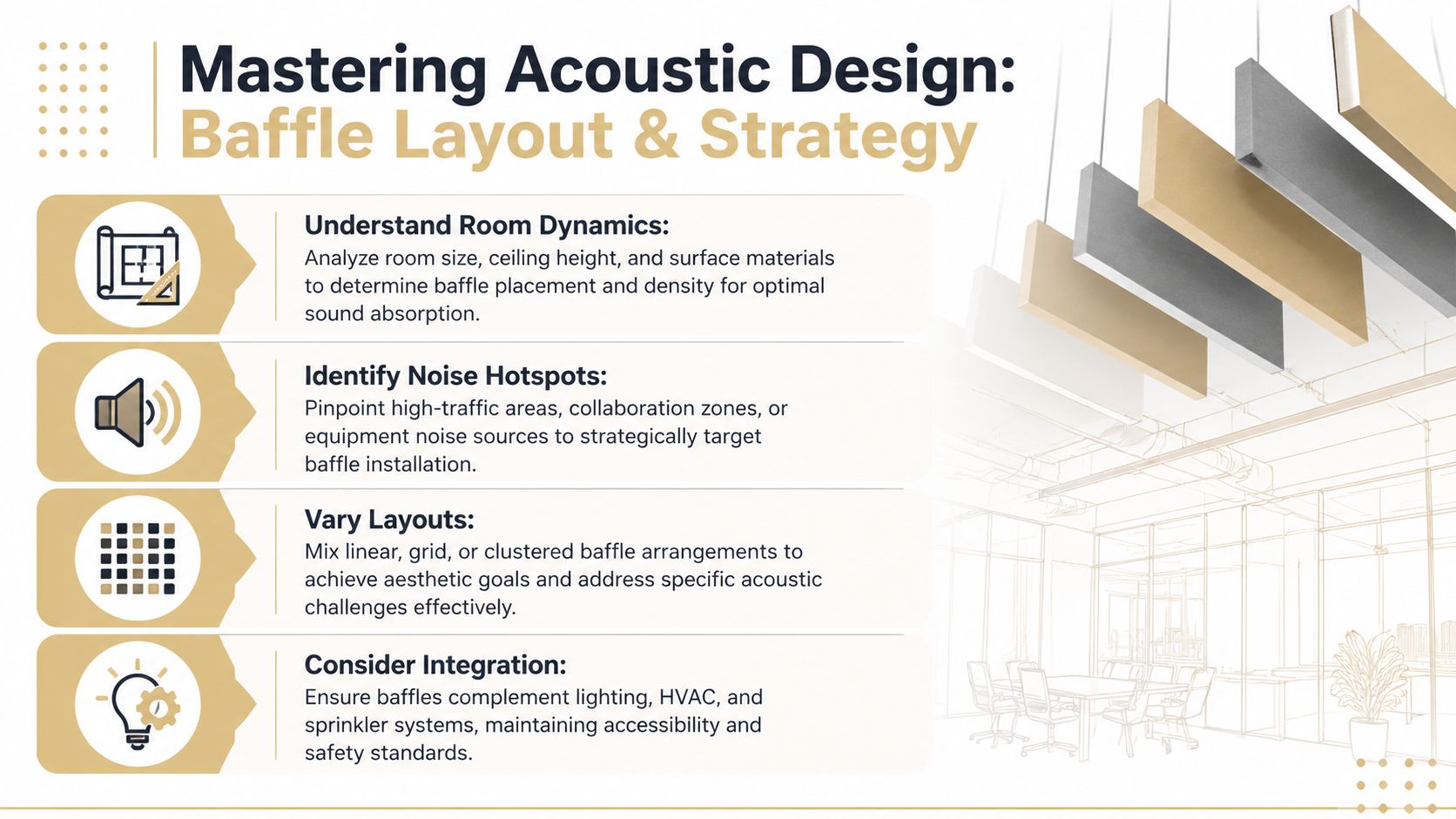
A good product can still underperform if the layout is wrong. Ceiling sound baffles work best when the design responds to the room’s shape, height, surfaces, and daily use. A neat row of panels may look organised, but appearance alone doesn’t guarantee good acoustic coverage.
Start with the room not the product
The first question isn’t which baffle looks best. It’s where the noise is building up.
In a typical office, the noisiest areas are often:
- Desking banks near collaboration zones
- Touchdown spaces beside circulation routes
- Kitchen and breakout edges
- Areas around printer points or shared equipment
- Zones close to acoustic pods where spill-out speech needs control
Older UK buildings can complicate this. Georgian and Victorian conversions often have hard plaster, irregular ceiling heights, and awkward service routes. Modern Grade A offices may have exposed concrete soffits, integrated air handling, and a strong design preference for open ceilings. In both cases, layout has to work with the building rather than against it.
Common layout choices
There isn’t one universal arrangement. The best pattern depends on the ceiling form and how the floor is used.
- Linear runs suit long desking areas and can reinforce the direction of the workspace.
- Grid layouts spread absorption more evenly across larger floorplates.
- Staggered or clustered groups help in activity zones where noise is concentrated.
- Checkerboard style arrangements can be useful when balancing acoustic coverage with lighting and services.
A facilities manager should also think about visual rhythm. Baffles are seen from across the office. If they look accidental, staff notice. If they align with the architecture, they tend to feel intentional and integrated.
Working around lights sprinklers and ventilation
Projects frequently encounter delays when dealing with the ceiling. The ceiling already contains other priorities, and acoustic treatment must not interfere with them.
A practical coordination checklist helps:
- Map the service ceiling first: identify lighting tracks, sprinklers, sensors, access panels, and HVAC routes.
- Protect airflow paths: baffles should support acoustic control without creating obvious problems for ventilation performance.
- Maintain access: facilities teams still need to reach services for inspection and maintenance.
- Avoid token coverage: a few decorative panels in dead areas won’t treat noise hotspots effectively.
A well-designed baffle layout follows the noise, not just the grid lines.
Suspension height matters too. If baffles are hung too high, they may lose some effectiveness in the occupied zone. If they are too low, they can feel intrusive or clash with lighting sightlines. The right balance often comes from coordinating acoustic intent with practical building use.
The most effective layouts usually share one habit. They treat acoustics as part of workplace planning, not as an afterthought once furniture and services are fixed.
The Perfect Pairing Baffles and Acoustic Pods
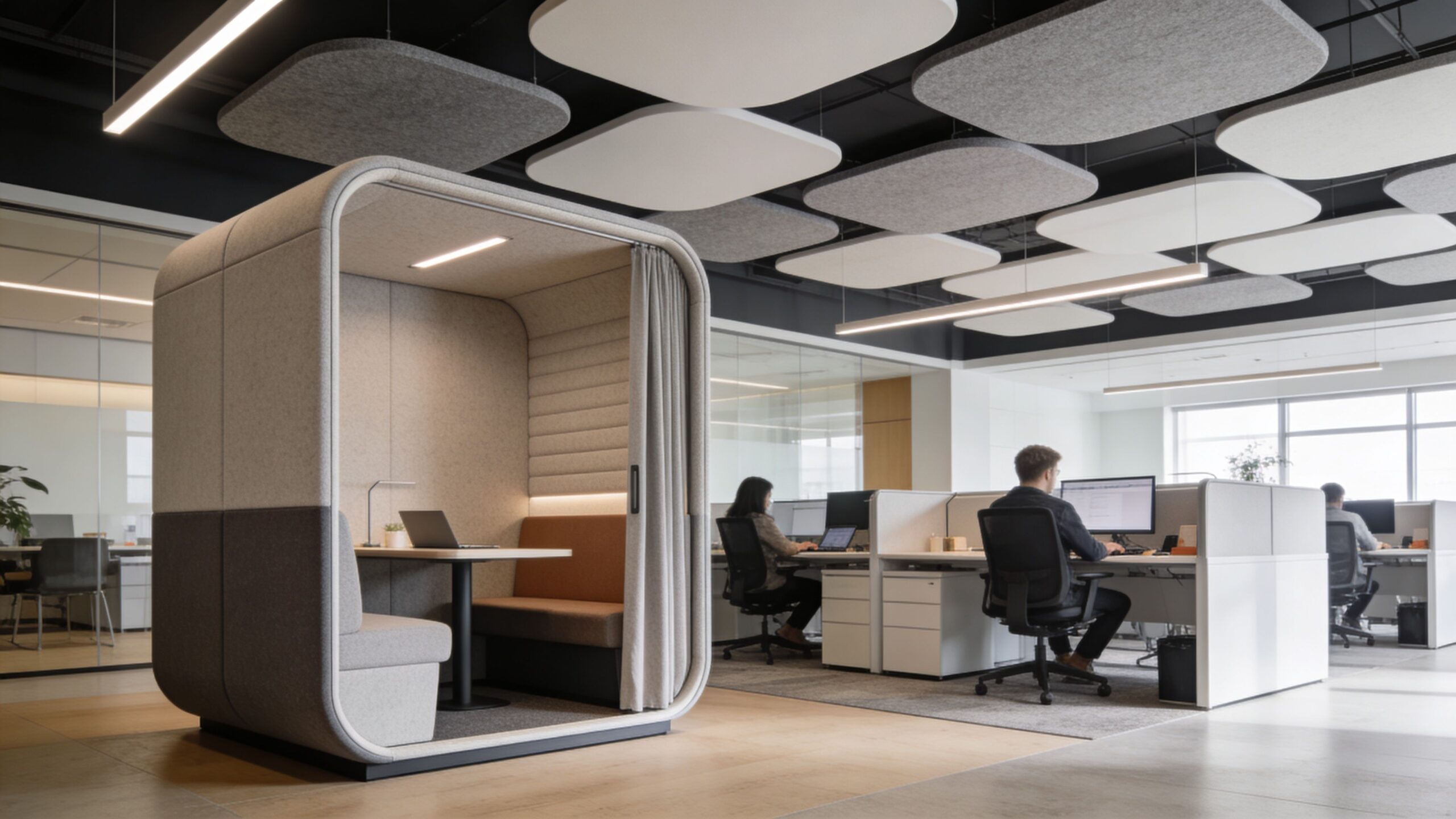
Ceiling sound baffles and acoustic pods solve different parts of the same office problem. Baffles reduce the general build-up of reflected sound across the open-plan area. Pods provide enclosed places for work that shouldn’t happen in the open.
That combination fits the way many UK workplaces now operate. Facilities managers are increasingly dealing with agile and hot-desking layouts where teams move around and space use changes frequently. A combined strategy using permanent ceiling baffles for overall reverberation control and flexible acoustic pods for on-demand private space offers a scalable answer for hybrid work according to guidance on combining baffles with flexible workplace solutions.
What each solution does best
An office that only uses baffles may feel calmer, but it still won’t give people privacy for calls, interviews, HR conversations, or concentrated solo work. An office that only uses pods may create islands of quiet while leaving the wider floor noisy and tiring.
That’s why the pairing works.
- Baffles manage the shared environment
- Pods support specific activities
- Wall and surface treatments can fine tune problem spots, including options such as acoustic office panels for targeted wall treatment
A simple way to think about it is by zone:
| Office Zone | Main Noise Issue | Best Response |
|---|---|---|
| Open desking | General speech build-up and echo | Ceiling sound baffles |
| Call activity | Poor privacy and voice spill | Single-user or small-call pod |
| Team meetings | Conversation leakage into open floor | Meeting pod |
| Transitional spaces | Mixed use and changing occupancy | Blend of baffles and movable planning |
Choosing pods for different workplace needs
Different pod brands suit different briefs. The key is matching the pod to the activity, the design intent, and the level of flexibility required.
For a polished, widely recognised workplace pod, Framery pods are often considered where teams want refined design and reliable privacy for calls and meetings.
For projects that need more individual visual expression or customisation, BlockO pods can suit organisations that want a pod to reflect brand and interior character more closely.
Where integrated technology is a major part of the brief, Kabin office pods are a strong fit for workplaces that want connectivity and optimized user experience built into the pod environment.
For organisations placing a strong emphasis on comfort and wellbeing, Vetrospace pods are often chosen for their calm, high-quality enclosed environments.
Outdoor or adjacent external space can also become useful acoustic capacity. External meeting pods from The Meeting Pod Co open up another route when indoor floor area is constrained.
A short product demonstration can help teams visualise how pods fit into the wider office environment:
Why hire can suit hybrid workplaces
Some organisations know they need enclosed spaces, but they aren’t ready to commit to a fixed long-term pod plan. Headcount changes. Teams come in on different days. Expansion or consolidation may still be under review.
In those cases, Framery Subscribed office pod hire can make more sense than immediate outright purchase. It supports a more flexible workplace strategy while still giving staff access to proper acoustic privacy.
The most resilient office layouts separate two goals. Lower the noise floor across the whole space, then provide enclosed settings for work that needs protection.
That’s the core synergy. Baffles improve the office atmosphere. Pods protect the moments that matter most.
Materials Finishes and Sustainability
Material choice sets the tone for this part of the acoustic strategy. A baffle has to absorb sound, hold up in daily use, satisfy fire requirements, and still look right above desks, circulation routes, and shared areas. In a flexible office, it also needs to support the wider plan. Lower the general noise level with overhead treatment, then reserve pods for calls, focused work, and private conversations.

Choosing between common materials
The easiest way to judge materials is to ask what problem each one solves.
PET felt is often specified where a workplace wants acoustic control with a lighter visual feel and a clearer recycled-content story. It is lightweight, easy to shape into fins or rafts, and available in a wide range of colours. That makes it useful in client-facing offices where the ceiling needs to look designed rather than purely functional.
Fibrous core baffles are often chosen where absorption is the main priority and the design language can be quieter. Decorative wrapped systems sit somewhere in between. They can soften the appearance of a space and help a scheme feel less technical.
A simple comparison helps:
- PET felt: suited to design-led schemes, lower weight, and sustainability goals.
- Fibrous core baffles: suited to projects where strong absorption is the first concern.
- Decorative wrapped systems: suited to softer interior palettes and hospitality-style office areas.
If your team is weighing baffles against other acoustic finishes, this guide to the best materials for sound insulation helps place each option in the wider specification mix.
One point often gets missed. The best-looking material is not always the best fit for the busiest zone. Breakout areas, touchdown spaces, and pod surrounds usually need finishes that can cope with cleaning, occasional knocks, and service access overhead.
Sustainability and circular thinking
Sustainability works best when it is treated as a specification question, not a marketing label. Ask what the product is made from, how long it is likely to last, whether damaged parts can be replaced, and what happens at end of life.
That matters even more if you are combining ceiling treatment with pods.
Pods can be relocated, rehired, refurbished, or reconfigured as headcount changes. Baffles are usually more fixed. So a sensible workplace strategy often pairs durable ceiling products with pod decisions that keep future change in mind. If a business is still testing attendance patterns, hiring pods can reduce the risk of buying too much enclosed capacity too early, while the baffle scheme continues to improve the whole office day after day.
For organisations trying to align acoustic upgrades with wider environmental targets, Gibbsonn’s sustainability approach and circular economy focus shows how these choices can sit within a broader specification mindset.
Partitions can also support acoustic zoning when a full enclosure isn’t required. In those cases, Logika partitions are worth reviewing as part of the overall space-planning strategy.
Sustainable acoustic design lasts, cleans well, and keeps performing after the office layout changes.
Finishes still matter. Baffles shape the ceiling plane in the same way flooring shapes the room below. Used well, colour, profile, and spacing can help an open-plan office feel calmer and more intentional, while pods handle the tasks that need a door and a higher level of privacy.
Installation Maintenance and Budgeting
A baffle scheme can look tidy on day one and still disappoint in use if the installation has been treated as a ceiling fit-out rather than an acoustic project. In practice, the difference often comes down to coordination. If the installer is forced to work around lights, sprinkler heads, sensors, and air supply grilles at the last minute, spacing changes. Once spacing changes, acoustic coverage changes too.
That matters even more in offices that also use pods.
Pods solve a different problem. They create enclosed settings for calls, video meetings, and focused work. Baffles lower the general noise load across the open-plan floor. If either element is installed without reference to the other, you can end up paying twice and still leaving gaps in the experience. A common example is adding pods after the ceiling layout is fixed, then finding doors open into the noisiest circulation route because the wider acoustic plan was never tied together.
What installation usually involves
Most ceiling sound baffles are suspended on cables or fixed to a suitable ceiling support. The right method depends on the building structure, ceiling height, access equipment, and what services already sit overhead.
A sensible process usually includes:
- Surveying the existing ceiling and structure
- Marking out the approved layout
- Checking clashes with lighting, sprinklers, detectors, and ventilation
- Installing the suspension hardware
- Hanging, levelling, and aligning the baffles
- Confirming access to services and visual consistency
Where the brief includes broader overhead treatment, it can help to review insulating ceiling panel options for office acoustic control alongside baffles so the ceiling strategy is chosen as one system rather than piecemeal.
For facilities managers, the main practical question is not just “Can these be fitted?” It is “Can these be fitted without creating maintenance headaches later?” Engineers still need access. Cleaners still need clear instructions. Fire detection and airflow still need to work as intended.
Keeping baffles performing well
Maintenance is usually simple, but simple does not mean optional. Baffles sit above eye level, so small problems are easy to miss until the ceiling starts to look uneven or marked.
Good maintenance practice usually includes:
- Routine visual checks after any work above ceiling level
- Gentle cleaning using the manufacturer’s recommended method
- Clear access rules so contractors know what can be moved and what must stay aligned
- Recording damaged units early, especially in busy areas where trolleys or ladders are used
It helps to treat baffles like carpet tiles on the ceiling. They are part of the working fabric of the office. If one section is stained, knocked out of line, or removed and not reinstated properly, the room may still function, but the finish and the acoustic result both slip.
Pods should sit in the same maintenance plan. If your workplace relies on baffles for ambient control and pods for private work, both need routine checks, cleaning schedules, and a clear ownership line. That is particularly useful in flexible workplaces where hired pods may be swapped, relocated, or returned as teams change.
Budgeting with fewer surprises
Budgeting works better when you split the cost into three parts. Product cost. Installation cost. Change cost.
Product and installation are easy to recognise on a quote. Change cost is the one that catches people out. It includes out-of-hours access, revisions after service clashes are found, extra lifts or towers for high ceilings, and rework when the office layout shifts after the acoustic package has been agreed.
The wider decision is also about where to spend fixed budget and where to keep flexibility. Baffles are usually a longer-term building improvement. Pods can be bought, but in some workplaces pod hire is the better fit while occupancy patterns are still settling. That approach can reduce upfront commitment for enclosed spaces while still improving the whole office with a permanent ceiling treatment.
A practical budgeting conversation usually covers:
- Ceiling height and access requirements
- Coordination with M&E services
- Whether installation must happen outside working hours
- Future layout risk in hybrid workplaces
- Whether pods should be purchased or hired
- Replacement strategy for damaged components
The final test is straightforward. A cheaper scheme that leaves teams taking calls in corridors, hunting for quiet space, and raising their voices across open desks is rarely the lower-cost option in day-to-day use. A better plan combines baffles for broad acoustic control with the right number of pods for privacy, then budgets for both as parts of one workplace system.
Your Next Steps to a Quieter Workspace
At 10am, the pattern is usually clear. One team is trying to focus at open desks, two people are taking calls they should have taken in private, and the room sounds busier than the headcount suggests. That is the point to stop treating noise as a single problem.
A better next step is to assess the office by activity. Start with the floorplate and ask three practical questions. Where do people need lower background noise to work comfortably. Where do they need speech privacy for calls or short meetings. Which areas are likely to change as hybrid working patterns settle.
That review helps you separate two jobs that are often mixed together. Ceiling sound baffles deal with the shared acoustic environment across open-plan space. Acoustic pods deal with specific tasks that need enclosure. It works like heating and meeting rooms. One system improves comfort across the whole office, while the other gives you the right setting for a particular use.
For a UK facilities manager, that usually leads to a clearer brief. Map the noisy circulation routes, desk clusters, collaboration points, and call-heavy teams first. Then decide where permanent ceiling treatment will give lasting value, and where pods should provide flexible quiet space. If occupancy is still changing, pod hire can be a sensible way to add privacy without locking the business into a fixed quantity too early.
Seeing products in person still matters. Drawings can show size and finish, but they cannot tell you how a pod feels during a real call or how materials sit within the wider office design. A showroom visit helps teams judge comfort, ventilation, door operation, finish quality, and whether a hired or purchased pod suits the workplace plan.
The strongest outcome is usually a joined-up one. Use baffles to calm the office as a whole. Use pods to give people somewhere appropriate to step into when work needs quiet, privacy, or concentration. That combination solves more of the problem than either product used on its own.