


Look up. Is your office ceiling a forgotten grid of stained, tired tiles? If so, you’re looking at the biggest missed opportunity to transform your workplace. An uninspired ceiling doesn’t just look drab; it actively contributes to the noise and distractions that kill productivity. It’s time to stop seeing it as a cover-up and start seeing it as your fifth wall—a powerful tool for creating a focused, sustainable, and inspiring office.
Table of Contents
- The Science of Sound: How Ceiling Tiles Create Focus
- Building a Greener Workplace From the Top Down
- Integrating Ceiling Tiles with Office Pods
- Designing a Ceiling That Inspires and Complies
- Your Next Step Towards a Better Workplace
- Frequently Asked Questions
This guide will show you how the right ceiling tiles for offices are a strategic investment. We’ll explore how they control sound, support your company’s sustainability goals, and work in harmony with flexible solutions like office pods to create an environment where your team can truly thrive.
The Science of Sound: How Ceiling Tiles Create Focus
Choosing the right ceiling tiles often feels like you need an engineering degree just to understand the specs. But what if you could cut through the jargon and get straight to what matters? Let’s break down the science of sound in a way that actually makes sense, turning that noisy open-plan space into a haven for concentration.
Think of your office like a sports hall with bare walls. Every single sound—a phone call, a keyboard tapping, a laugh from across the room—bounces off the hard surfaces, creating a relentless, distracting echo. That’s exactly what happens when you have a ceiling with poor acoustic performance. It just reflects sound, amplifying the overall office buzz.
Now, imagine laying a thick, plush carpet across that entire ceiling. Suddenly, the space feels calmer. The echoes are gone. That’s what a high-performance acoustic ceiling tile does. It doesn’t bounce sound back into the room; it soaks it up, stopping chatter from travelling and making it so much easier for everyone to focus on their work.
This simple change has a powerful ripple effect, improving not just acoustics but also productivity and even your company’s sustainability goals.
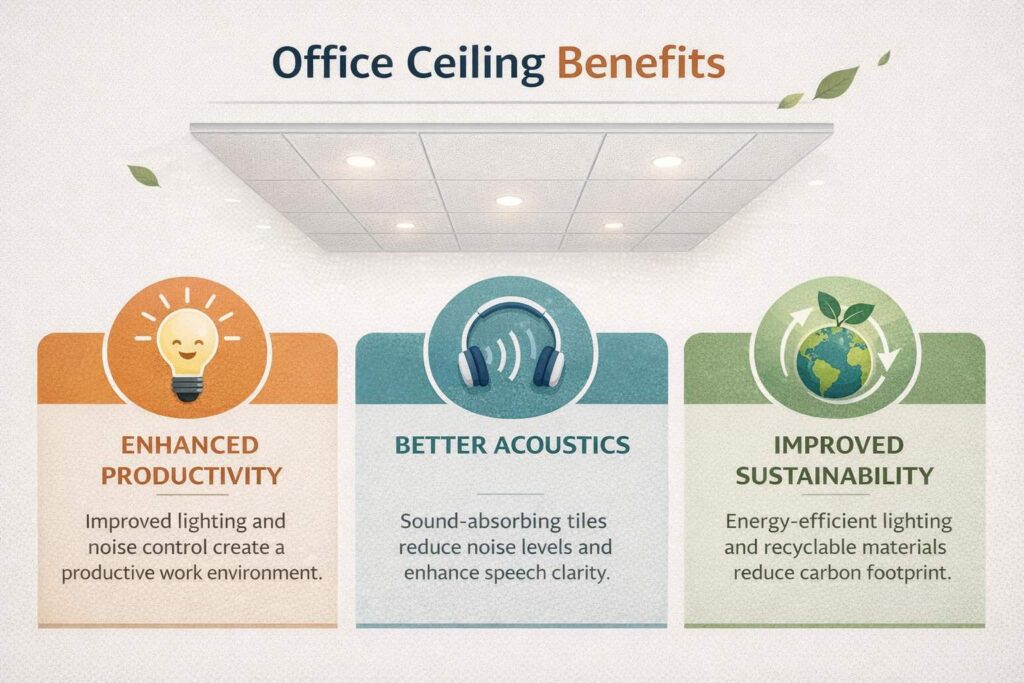
As you can see, a quieter workplace is a more effective and responsible one. These three benefits are completely intertwined.
Getting to Grips with Acoustic Ratings
When you’re looking at spec sheets, you’ll see a lot of acronyms, but two are absolutely crucial for getting acoustics right: NRC and CAC.
To make this crystal clear, here’s a quick breakdown of what they mean and what you should be looking for.
Acoustic Performance Metrics at a Glance
| Acoustic Rating | What It Measures | Good Rating for an Office |
|---|---|---|
| NRC (Noise Reduction Coefficient) | How much sound a tile absorbs inside a room. This is your defence against echo and general noise build-up. | Aim for 0.70 or higher in open-plan areas to effectively soak up sound. |
| CAC (Ceiling Attenuation Class) | How well a tile blocks sound from passing through the ceiling into an adjacent room. This is key for privacy. | Look for a CAC of 35 or more for private offices and meeting rooms. |
Understanding these two ratings is the first step to specifying a ceiling that truly performs.
The demand for quieter spaces is undeniable. In busy hubs like London, noise complaints in offices have shot up by an estimated 30% since 2020. This has sparked a real push for workplace upgrades, with modern mineral fibre tiles, some boasting NRC ratings as high as 0.90, becoming a go-to choice for commercial refits.
Of course, a brilliant acoustic strategy is about more than just one element. The best results come from a layered approach. High-performance ceiling tiles work in harmony with other solutions to create a complete system. Pairing them with wall panels, for example, can take your sound control from good to great. You can see how this works in practice in our guide on office acoustic panels, which shows how to achieve total acoustic comfort.
Building a Greener Workplace From the Top Down
The ceiling tiles you choose for your office are far more than just a finishing touch. They are a powerful, visible statement about your company’s values and your commitment to a healthier planet. This is your chance to build a better workplace by contributing to the circular economy and embracing sustainability. It’s about choosing materials that aren’t destined for landfill but can instead be reused or recycled at the end of their life. This forward-thinking approach doesn’t just benefit the environment; it speaks volumes about your brand.
When you set out to create a greener workplace, you’re also committing to higher environmental standards, from the materials you source to the quality of the air your team breathes. Understanding guidelines like the Indoor Environmental Quality Standards is a great starting point to ensure your ceiling actively supports a healthy, thriving environment.
The Rise of Eco-Conscious Materials
Sustainable materials are completely reshaping the UK ceiling tile market. With renovations making up around 60% of all commercial projects, the focus has shifted dramatically towards eco-friendly specifications.
We’re seeing a huge surge in demand for recyclable mineral fibre and low-VOC gypsum tiles. In fact, the European market is on track to exceed £2.9 billion by 2030. A major influence here is the push for BREEAM credits, where selecting tiles with over 30% recycled content can be a game-changer for your building’s rating.
But these materials do so much more than earn green credentials. Low-VOC (Volatile Organic Compound) formulas are absolutely vital for creating healthier indoor spaces. They reduce airborne pollutants and have a direct, positive impact on the wellbeing of your team. By thinking about a material’s entire lifecycle, you’re not just choosing a product; you’re investing in a healthier future. And as our guide on how insulating ceiling panels also contribute to energy efficiency shows, the benefits keep stacking up.
Adaptable and Responsible Workspaces
True sustainability is also about adaptability. The greenest office is one that can change and grow with your business, avoiding the waste and cost of constant refits. This is where smart, flexible solutions like Framery Subscribed come in. This office pod hire service allows you to adapt your workspace on demand. By pairing high-performance, reusable ceiling tiles with agile office pods, you create a responsible, future-proofed environment that can change as quickly as your business does.
Integrating Ceiling Tiles with Office Pods
So, you’ve invested in a state-of-the-art office pod. That’s a fantastic move for creating pockets of quiet in a busy open-plan space. But here’s something many people overlook: a pod on its own is only half the battle.
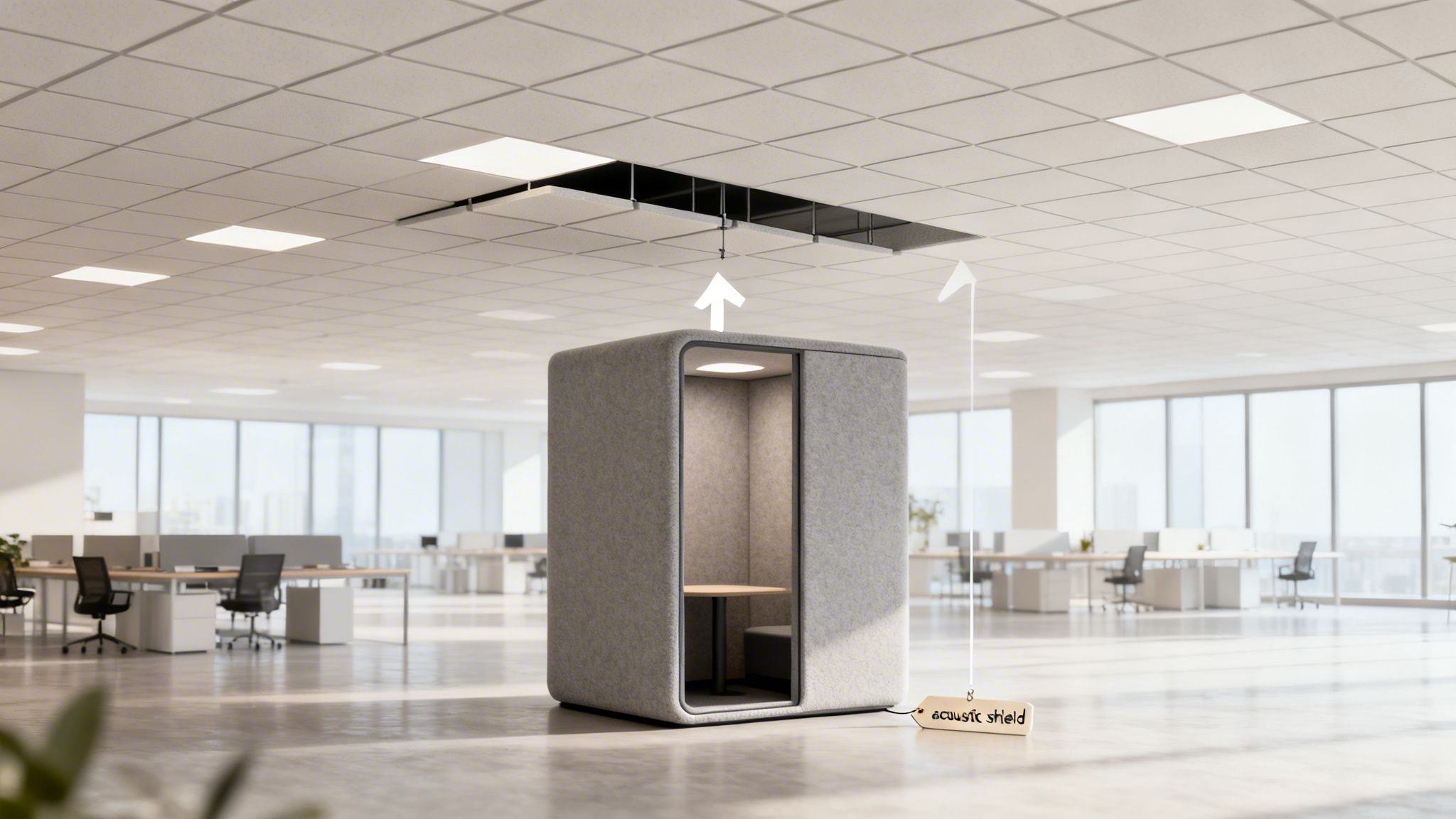
If you really want to create genuine acoustic calm, you have to look up. Without the right ceiling, sound waves will simply hop over the pod, bounce off the hard surface above, and spill right back down into the surrounding workspace. This is what acousticians call ‘sound flanking,’ and it can completely undermine the peace and quiet you’re trying to create.
This is where your choice of ceiling tiles for offices moves from a design detail to a strategic decision. The right tiles turn your ceiling into the final, crucial piece of your acoustic strategy, ensuring pods from top-tier brands like Framery, Vetrospace, and BlockO can truly deliver on their promise of focus and privacy.
From an Island of Quiet to a Protected Sanctuary
Think of your office pod as an island of tranquillity in the middle of a bustling sea of activity. Now, what if the ‘sky’ above that island was a hard, reflective surface? The noise from the surrounding sea would just echo and rain back down.
A high-performance acoustic ceiling, on the other hand, acts like a vast, sound-absorbing canopy over your entire office. It doesn’t just protect the island; it calms the whole sea.
This integrated approach, pod and ceiling working in tandem, creates a complete acoustic shield. It prevents sound from leaking over the pod, keeps conversations inside truly private, and absorbs ambient noise across the wider office. The result is a workplace where everyone, whether they’re in a pod or at a desk, can finally concentrate without distraction.
This powerful combination gives you the best of both worlds: designated quiet zones and a collaborative open-plan layout, all without having to build permanent walls. It’s a far more efficient and adaptable way to design a modern workspace. If you’re curious about the nuts and bolts, our guide on drop ceiling kits is a great place to explore how these systems are put together.
To ensure you’ve covered all your bases when bringing these two powerful elements together, use this checklist.
Ceiling and Pod Integration Checklist
| Consideration | Why It Matters | Pro Tip |
|---|---|---|
| Ceiling Height | Pods need sufficient clearance. A low ceiling can make installation impossible or create a cramped feeling. | Measure your floor-to-ceiling-grid height, not just the floor to the structural slab. Aim for at least 150-200mm of clearance. |
| Acoustic Rating (NRC/CAC) | Your ceiling’s performance must complement the pod’s. A low-rated ceiling will undo the pod’s good work. | Match the ceiling’s acoustic class to the office’s needs. For open plans with pods, Class A absorbers are ideal. |
| Fire Sprinklers & HVAC | Pods can obstruct fire suppression and airflow systems. This is a critical safety and compliance issue. | Consult with a building services engineer before finalising pod locations to ensure compliance with UK fire regulations. |
| Lighting Integration | The pod’s placement shouldn’t create dark zones or cast awkward shadows from the main office lighting. | Consider using suspended acoustic baffles or rafts, which allow light to pass through while still controlling sound. |
| Future Flexibility | Your layout might change. Is the pod and ceiling configuration easy to adapt? | A modular suspended ceiling grid and office pod hire service offer maximum flexibility for reconfiguring the space later on. |
Getting these details right from the start saves a world of headaches and ensures your investment pays off in the form of a happier, more productive workplace.
Designing a Ceiling That Inspires and Complies
It’s easy to overlook the ceiling, but it’s so much more than just a cover for pipes and wiring. Think of it as your office’s fifth wall—a huge, blank canvas that dictates the entire feel of the space. This is your chance to go beyond a purely functional grid and create something that genuinely reflects your brand and energises your team. For more on how tech is changing interiors, see this overview of AI in Interior Design.
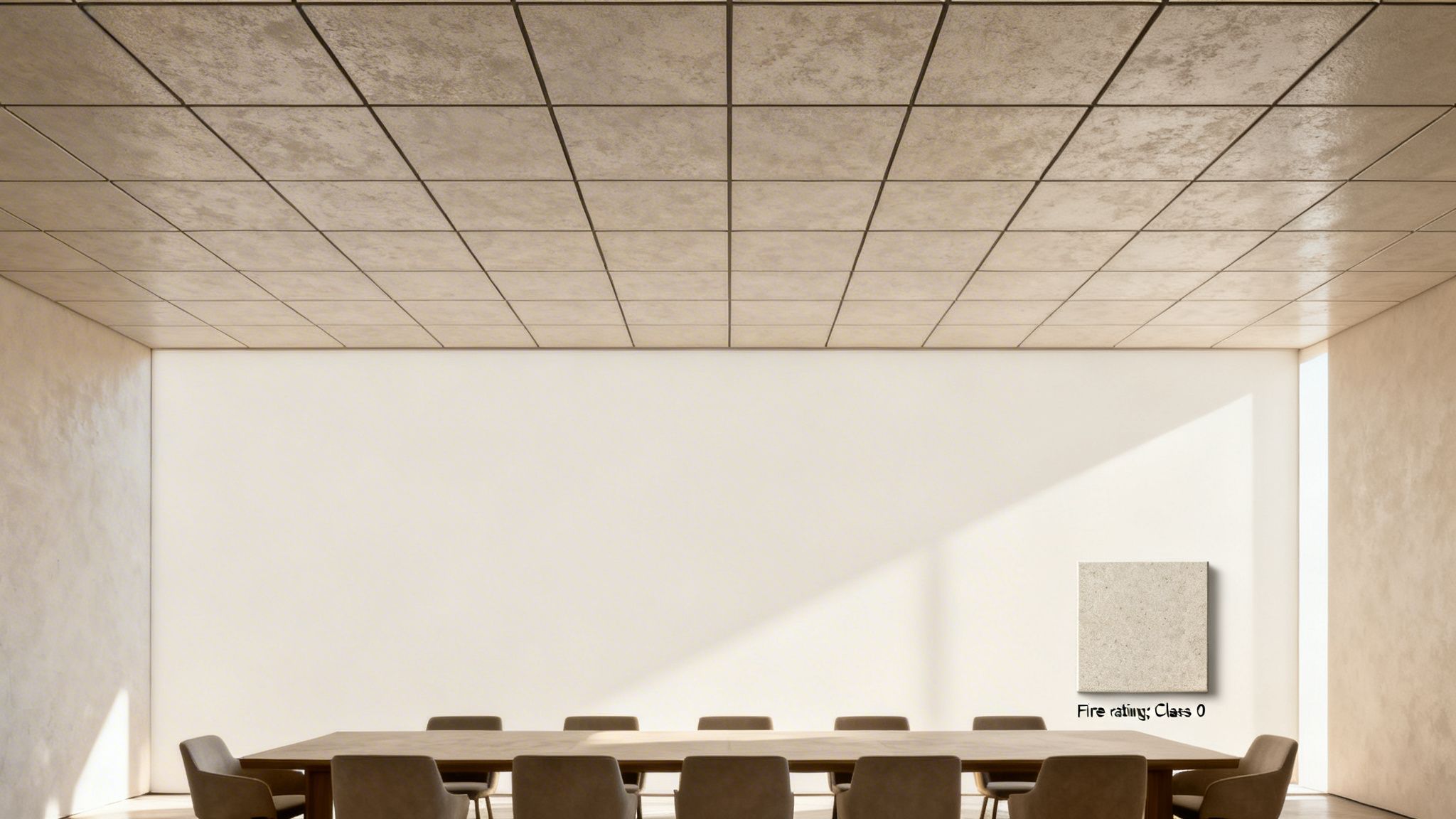
From crisp, minimalist lines to bold textures and even splashes of colour, the right tiles can turn an ordinary room into a truly impressive environment. It’s an attention to detail that doesn’t go unnoticed. A well-designed ceiling tells your employees and visitors that you care about creating a professional, thoughtful, and welcoming workplace.
Navigating UK Fire Safety Standards
Of course, a beautiful design must also be a safe one. Getting the fire safety specifications right from day one isn’t just about compliance; it’s about protecting your people and your business. The UK Building Regulations are very clear on how materials must perform in a fire, and for ceilings, two key classifications really matter.
Making a safe and compliant choice means getting to grips with these ratings:
- Class 1 Surface Spread of Flame: This is a good, solid standard for many internal finishes. It means the material has been tested to show it slows the spread of flames across its surface, buying valuable time in an emergency.
- Class 0 Surface Spread of Flame: This is the next level up. To achieve a Class 0 rating, a material must first pass the Class 1 test and then pass an even tougher fire propagation test. This second test measures how much the material contributes to a fire’s growth. For critical areas like escape routes and corridors, Class 0 is often a mandatory requirement.
The good news is that you don’t have to sacrifice aesthetics for safety. Many of the most advanced acoustic and design-focused ceiling tiles are now manufactured to meet excellent fire ratings. By working with specialists, you can find that perfect balance—a ceiling that is beautiful, functional, and fully compliant. It’s how you create a stunning space that everyone can feel safe in.
Your Next Step Towards a Better Workplace
We’ve covered a lot of ground, from the nuts and bolts of acoustic ratings to the importance of sustainability and flexible design. Hopefully, one thing is clear: choosing the right ceiling tiles for offices isn’t just a finishing touch. It’s one of the most powerful choices you can make for your workspace.
A great ceiling is the unsung hero of a productive, inspiring office. It’s your first line of defence against distracting noise and a tangible statement of your commitment to the circular economy. We’ve seen it time and again – the right ceiling system transforms an office from just a space into a place where people genuinely want to be and can do their best work.
Experience the Solutions Firsthand
Reading about NRC ratings is a great start, but nothing compares to seeing and feeling the quality for yourself. We firmly believe the best decisions are made when you can stand under a ceiling system or inside an office pod and truly understand its impact.
That’s why we encourage you to book an appointment to visit our showroom in Bishop’s Stortford. It’s a space designed for you to explore our solutions, compare different finishes, and get a real feel for how these materials can redefine your office. Our team will be on hand to discuss your specific challenges and help you find a solution that ticks every box.
Let’s start the conversation and build a better workplace together.
Frequently Asked Questions
When it comes to office acoustics, we hear a lot of the same questions. Here are some of the big ones, with straightforward answers from our team.
What Is the Most Important Acoustic Rating for an Open-Plan Office?
For an open-plan space, your focus should absolutely be on the NRC (Noise Reduction Coefficient). This number tells you how much sound a tile absorbs, which is your number one weapon against background chatter and echo.
To genuinely quieten a room, don’t settle for less. We always advise aiming for an NRC of 0.70 or higher. This is the point where the ceiling stops bouncing noise around and starts actively soaking it up, making a real, noticeable difference to concentration levels.
Can I Install New Acoustic Ceiling Tiles in My Existing Grid?
In many cases, yes. Most modern acoustic tiles are designed to pop right into the standard grid systems you already have, which are typically 24mm or 15mm wide. This makes upgrading your ceiling a much simpler job than you might think.
A word of caution though: it’s not always a straight swap. You have to be sure the new tiles are compatible and, crucially, that your existing grid can handle the weight. High-performance tiles are often heavier, so getting an expert to check first can save you a world of trouble.
How Much Do High-Performance Acoustic Ceiling Tiles Cost in the UK?
There’s a huge range here, depending on the material, the brand, and the acoustic performance. Basic mineral fibre tiles can be quite inexpensive, but for true high-performance options, you’re typically looking at a range between £15 to over £40 per square metre.