
Is your open plan office secretly sabotaging your team’s focus and wellbeing? The constant noise and lack of privacy aren’t just frustrating; they’re fuelling stress and tanking productivity. But what if you could give your team the quiet, comfortable space they desperately need without a costly, disruptive renovation?
The answer lies in a simple, powerful solution: the office pod
The Hidden Costs of an Open Office
That all-too-familiar buzz of an open office isn’t just noise; it’s a quiet drain on national productivity. For any workplace or facilities manager, this isn’t just about comfort, it’s a strategic issue that hits the bottom line. The connection between constant distraction, a sore back, and a dip in performance is impossible to ignore.
Let’s look at the numbers. Recent data from across the UK paints a pretty stark picture. An incredible 51% of office workers say their back pain is a direct result of their workstation. What’s worse, a shocking 27% have never even had the legally required workstation risk assessment, and only one in three feel their employer provides the right kit for a healthy setup.
It’s easy to dismiss this as just a few aches and pains, but there are significant side effects of bad posture that build up over time. These aren’t just minor issues; they can snowball into long-term health problems that fuel both absenteeism and ‘presenteeism’ where people are at their desks but not truly productive.
From Discomfort to Direct Business Costs
When your team is constantly shifting in their seats trying to get comfortable, their focus drifts, their creativity stalls, and their output inevitably drops. The knock-on effects are real and they are expensive.
- Increased Absenteeism: In the UK, back pain is one of the biggest reasons people call in sick, throwing project timelines and team capacity into chaos.
- Reduced Productivity: Even when they show up, people in pain are distracted and less efficient. They’re present, but not performing.
- Lower Team Morale: Nothing saps the energy out of a team faster than chronic discomfort. It can poison the atmosphere and damage collaboration.
- Higher Staff Turnover: A workplace that doesn’t look after its people’s wellbeing will always struggle to hold onto its best talent.
But here’s the inspiring part: this is a problem you can absolutely solve. The very same research found that when employers make a genuine investment in proper ergonomic equipment, a massive 89% of office workers report a real boost in their health, motivation, and productivity.
This is about more than just buying a few new chairs. It’s about building an environment where people feel supported and can truly thrive. By tackling the root cause of chair ergonomics back pain, you unlock a healthier, more focused, and more powerful workforce, turning your office into a place known for both comfort and peak performance.
Understanding How Your Chair Shapes Your Day
Think of your spine as a natural, elegant suspension bridge, designed with a gentle ‘S’ curve. This clever shape is what helps you move, bend, and carry weight without strain. But the wrong chair can completely undermine this brilliant piece of natural engineering.
A typical office chair often encourages a slumped ‘C’ shape. While it might seem comfy for a moment, sitting like this for hours puts tremendous stress on your lower back. Your spine’s natural curve flattens out, pressure starts to build, and you’ve created the perfect conditions for chronic chair ergonomics back pain.
This isn’t just about feeling a bit stiff; it’s a real mechanical problem. When your spine is pushed out of its natural alignment, your muscles have to work overtime just to hold you up, leading to exhaustion, stiffness, and eventually, pain. It’s like driving a car with poorly aligned wheels everything has to strain just to keep you moving forward.
Why Small Adjustments Make a Huge Difference
So, what separates a painful chair from a truly supportive one? It all comes down to its ability to work with your body’s natural shape, not against it. These features aren’t just fancy extras; they are well-researched tools that make a genuine difference to your wellbeing.
Take proper lumbar support, for instance. It’s far more than just a cushion stuffed into the small of your back. A good support is adjustable, allowing you to nestle it perfectly into the inward curve of your lower spine. This single feature acts like a scaffold, preventing that dreaded slump and dramatically reducing the load on your spinal discs.
This foundational support is the first line of defence against the aches and pains that plague so many office workers. It’s what really distinguishes a therapeutic chair from just another piece of furniture.
Movement and Circulation: The Overlooked Essentials
A great chair doesn’t stop at your lower back. It also needs to encourage subtle movements and support healthy circulation in your legs. This is where two key features, seat depth and a responsive tilt, come into play.
-
Seat Depth Adjustment: You should always have a small gap about two or three fingers’ width between the front edge of the seat and the back of your knees. This simple adjustment is vital. It stops the seat from cutting off circulation to your lower legs and pressing on the sciatic nerve, which is a frequent source of pain that can radiate down your leg.
-
Responsive Tilt Mechanism: Sitting still for hours on end is the real enemy. A chair with a dynamic or synchronous tilt moves with you, meaning the backrest and seat work in concert. This encourages constant ‘micro-movements’ that you barely notice, but they are crucial for boosting blood flow, feeding your spinal discs with nutrients, and stopping your muscles from seizing up.
When you bring these features together, sitting is transformed from a static, stressful activity into one that is dynamic and supportive. Of course, the chair is only one part of the puzzle. For a complete, comfortable setup, it’s worth reading our guide on finding the perfect desk height to go with your chair.
By understanding these core ideas, you’re no longer just buying a chair; you’re investing in a healthier, more comfortable, and more productive day for yourself and your team.
What to Look for in a Genuinely Ergonomic Chair
Let’s cut through the marketing noise. When you’re looking for a chair that will truly protect your back, a few key features make all the difference. It’s not about brand names or fancy aesthetics; it’s about how a chair moves with your body.
Think of it this way: your spine has a natural, healthy ‘S’ curve. But after hours in a poor chair, it slumps into a stressful ‘C’ shape, putting immense pressure on your discs and muscles. This is where the pain begins.
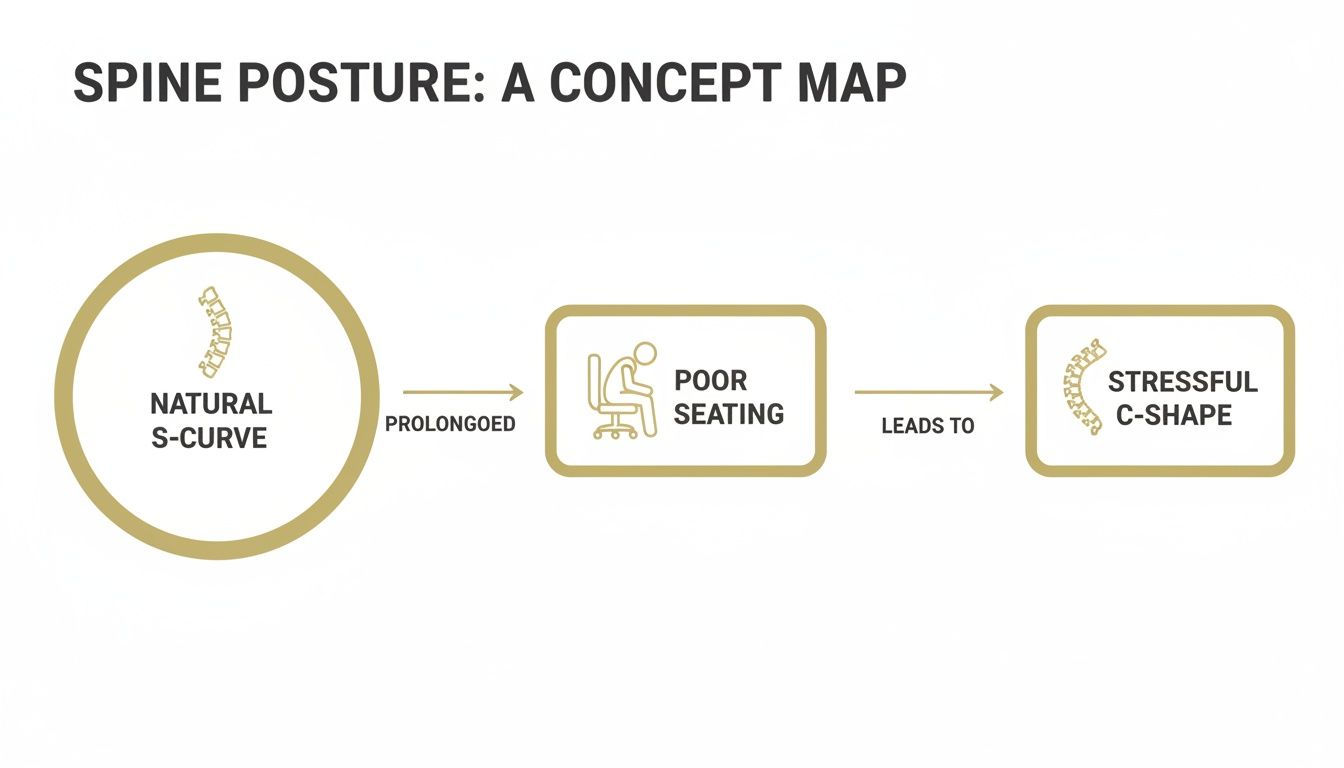
That simple visual shows you exactly what we’re fighting against. Now, let’s look at the features that stop this from happening.
To make this simple, here’s a quick-reference table. Use it to check if a chair has the essential features needed to support your body and prevent back pain.
Ergonomic Chair Feature and Benefit Checklist
| Essential Feature | What It Does | How It Prevents Back Pain |
|---|---|---|
| Adjustable Lumbar Support | Moves up/down and in/out to fit your lower back’s curve. | Maintains the natural ‘S’ shape of your spine, preventing slumping and disc pressure. |
| Adjustable Seat Depth | Slides the seat pan forward or backward. | Ensures proper thigh support without cutting off circulation behind the knees. |
| Synchronous Tilt | The backrest and seat tilt together in a set ratio as you lean back. | Encourages gentle movement, opens up the hips, and relieves spinal compression. |
| 4D Adjustable Armrests | Move up/down, in/out, forward/back, and pivot. | Supports your arms to take the strain off your neck, shoulders, and upper back. |
With this checklist in mind, you can confidently assess any chair and understand its true ergonomic value.
1. Lumbar Support: The Foundation of a Healthy Back
Your lower back the lumbar region curves naturally inwards. The problem is, most chairs are flat, forcing that curve to flatten out and pushing pressure straight onto your spinal discs. This is why adjustable lumbar support isn’t just a nice-to-have; it’s the absolute cornerstone of preventing chair ergonomics back pain.
But a simple bump in the backrest won’t do. You need support that you can tailor to your unique shape. Look for a chair that lets you adjust both the height (to position the support perfectly in the small of your back) and the depth (to control how firmly it supports you). Without that personal fit, the chair is just guessing.
2. Seat Depth and Height: Getting the Fit Just Right
Proper back support is only half the battle. If your legs aren’t positioned correctly, you can create a whole new set of problems, from restricted blood flow to nerve pain. That’s why seat adjustability is so important.
First, seat height should let you place your feet flat on the floor with your knees at a roughly 90-degree angle. Next, and often overlooked, is seat depth. You should be able to sit all the way back against the lumbar support while leaving a gap of two or three fingers between the front edge of the seat and the back of your knees. This small detail is crucial for maintaining healthy circulation.
3. Synchronous Tilt: Making Movement Your Ally
Our bodies weren’t built to sit still for eight hours a day. Static postures lead to stiff muscles and fatigue. The best chairs encourage ‘active sitting’ through a feature called a synchronous tilt mechanism.
Here’s how it works: when you lean back, the seat pan gently tilts upwards in a synchronised motion. This isn’t just about reclining; it’s a dynamic movement that opens up your posture, takes the pressure off your spine, and encourages the tiny micro-movements that keep your blood flowing and your muscles engaged. It turns sitting from a rigid state into a fluid, supportive experience. Many of the best ergonomic mesh desk chairs build this feature in for exceptional, breathable comfort.
4. Armrests: The Unsung Heroes of Posture
Armrests often get a bad rap because they’re frequently set up incorrectly. When adjusted properly, however, they are absolutely vital for taking the load off your neck and shoulders. The goal is to support your arms in a way that lets your shoulders completely relax not hunch up towards your ears.
The gold standard here is 4D armrests. The “4D” simply means you can adjust them in four different directions:
- Height: Up and down
- Width: In and out
- Depth: Forwards and backwards
- Pivot: Angling in or out
This level of customisation ensures your arms are supported right where you need them, whether you’re typing or just thinking. It completes the puzzle, creating a cocoon of support that allows your entire upper body to finally relax.
Ergonomics Beyond the Desk with Office Pods
A fantastic ergonomic chair is a brilliant start, but its power is easily lost in a distracting environment. True workplace wellbeing goes beyond how you sit, it’s about creating an environment where you can truly focus and feel supported. This is where office pods come in, extending comfort from your chair into dedicated zones built for deep, uninterrupted work.
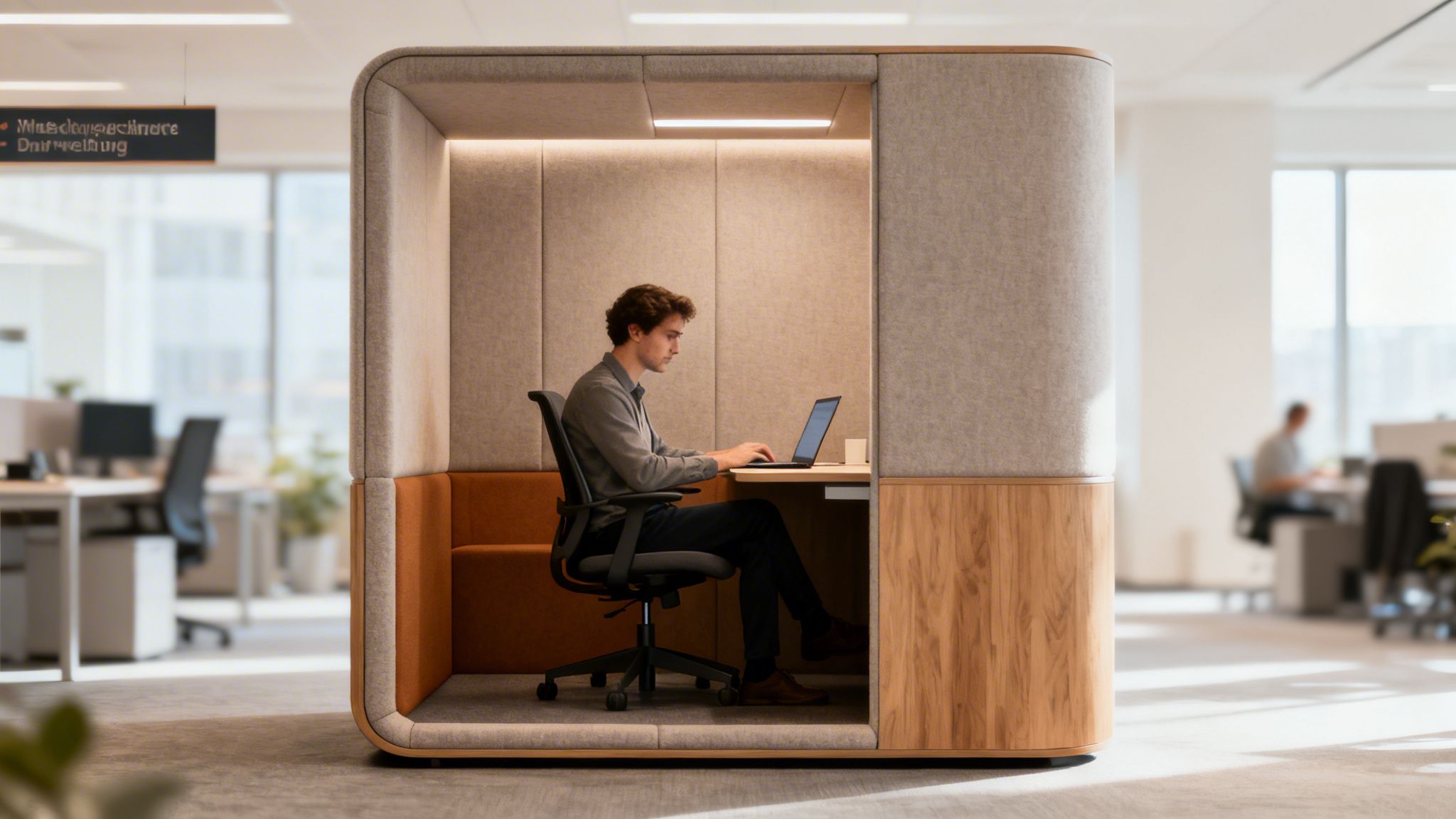
When you combine exceptional seating with an acoustic office pod, you amplify both physical comfort and mental clarity. Picture a team member needing to make a critical call. Inside a soundproofed Framery pod, they’re not just physically supported by a great chair; they’re mentally supported by a space free from the chaos of an open office. It’s this pairing that gets to the root causes of both physical strain and mental fatigue.
Creating Ecosystems of Comfort
Our philosophy is to build complete ecosystems of comfort, not just hand over isolated pieces of furniture. It’s a holistic approach that seamlessly integrates the perfect chair with the perfect space. Whether it’s a single-person booth for quiet concentration or a larger pod for team brainstorming, the principles of good ergonomics must carry through. This has become absolutely vital as focused work sessions take on greater importance in today’s hybrid world.
Recent research throws a stark light on the scale of the problem. A study of over 6,000 European workers revealed a staggering 67% experience pain from their workstation, with back pain being the number one complaint at 53%. This epidemic of discomfort is overwhelmingly caused by bad posture (55%) and uncomfortable, non-adjustable furniture (43%). For UK managers, this sounds an urgent alarm to improve focus zones like pods where people sit for long stretches. You can learn more from the research on workstation pain to grasp the full scope.
We make it our mission to ensure every pod we provide is a sanctuary of ergonomic excellence. That means pairing seating that prevents chair ergonomics back pain with spaces that shut out distractions. Our collection offers versatile choices for every need:
- Compact Focus Zones: Single-person pods like the Kabin series are perfect for individual deep work, creating a quiet, comfortable bubble for one.
- Collaborative Hubs: Larger pods from brands like Blocko can host small teams, ensuring even group sessions happen in a supportive setting.
- High-Tech Environments: For ultimate cleanliness and tech integration, our Vetrospace pods create controlled, healthy spaces for sensitive work.
Even outdoor areas can become productive extensions of your office with incredible solutions from The Meeting Pod Co. These principles also perfectly complement a thoughtful open plan office design by creating the essential quiet zones needed to balance out a busy layout.
Flexible and Accessible Ergonomics
We realise that committing to a full-scale installation is a big decision. That’s why we’ve developed innovative ways to make outstanding ergonomics more accessible to everyone.
Our Framery Subscribed service is the perfect example. This office pod hire model allows you to bring fully-equipped, acoustically brilliant, and ergonomically sound quiet zones into your office without the large capital investment. It gives you the power to trial the benefits, see the impact on your team’s wellbeing and productivity firsthand, and then scale your solution as your business evolves.
This flexible approach empowers you to respond to the growing demand for healthier work environments decisively and affordably. It’s all about building a workplace that supports your people from the ground up, one comfortable, focused space at a time.
Building a Workplace That Lasts
When we think about the smartest business decisions for 2026 and beyond, they all share two qualities: they’re sustainable and they’re adaptable. Investing in genuinely high-quality ergonomic furniture and office pods isn’t just a perk; it’s a powerful signal of your commitment to corporate responsibility and the circular economy. It’s about seeing every chair and pod as a long-term asset, not a short-term cost.
Think about it. A well-made, durable office pod is built to withstand years of use. By choosing quality from the outset, you’re actively cutting down on waste, shrinking the environmental footprint of your operations, and actually lowering your costs over time. What’s best for your people is also best for the planet. Our commitment to sustainability at Gibbsonn is central to how we help businesses grow.
The New Standard: Agile and Sustainable Spaces
The way we design offices has fundamentally changed. The old model of a rigid, five-year fit-out is gone, and for good reason. Today’s facilities managers need the freedom to create spaces that can grow, shrink, and reconfigure right alongside the business. This is where building a flexible, sustainable workplace becomes your secret weapon.
Instead of being locked into permanent walls and fixed layouts, this new approach is all about modular, adaptable components. Imagine reconfigurable partitions from specialists like Logika that can transform a floorplan overnight, or office pods that can be easily moved or expanded as your teams evolve. It’s a way of thinking that avoids disruptive, wasteful renovations and embraces a cycle of continuous improvement.
This is the very philosophy at the heart of our operations. We champion products and services that keep resources in use for longer, because we know a truly modern office is as economically sound as it is environmentally responsible.
Making a Healthier Workplace Accessible Today
So, what’s the catch? For many businesses, the biggest roadblock has always been the huge upfront investment needed to create a truly ergonomic and acoustically peaceful environment. This is the exact problem we wanted to solve with our office pod hire service.
Our Framery Subscribed model was created for the reality of modern business. It allows you to bring premium, fully-equipped acoustic pods into your workplace for one, predictable monthly fee. The barrier of a huge capital expense is simply gone, making a world-class, healthier office an immediate reality.
The benefits of this subscription approach are real and immediate:
- True Flexibility: You can scale your number of pods up or down as your team changes. You’re never stuck with an investment that no longer serves you.
- Smarter Finances: Avoid the huge upfront bill and treat your ergonomic infrastructure as a simple operational expense.
- Instant Impact: You can introduce top-tier focus and meeting spaces complete with ergonomic seating and see the positive effects on your team’s wellbeing and productivity from the very first day.
When you embrace a more flexible and sustainable path for your workplace, you’re doing so much more than just solving issues like chair ergonomics back pain. You are positioning your company as an intelligent, forward-thinking leader creating a workplace that not only attracts the best talent but is truly built to thrive for years to come.
Your Action Plan for a Pain-Free Workplace
You’ve seen the evidence. You understand how the wrong environment can be the root cause of persistent pain and distraction, and more importantly, how the right one can be the solution. Now it’s time to put that knowledge into action. This isn’t about a complete overhaul overnight, but a clear, step-by-step plan to methodically remove chair ergonomics back pain from your workplace for good.
Meaningful change doesn’t have to be daunting. It starts with a single, crucial step: paying attention. A workplace free from aches and pains isn’t just a lofty ideal; it’s a tangible goal, and the journey begins today.
Step 1: Conduct a Simple Workstation Walk-Through
You don’t need to be a certified ergonomist to spot the most obvious red flags. A simple walk around your office with a fresh pair of eyes can reveal a lot.
- Look at Postures: Do you see people hunched over their keyboards in a distinct ‘C’ shape? Are their shoulders creeping up towards their ears? These are classic signs that their chairs are failing them.
- Check the Key Connections: Notice the relationship between your people, their chairs, and their desks. Are their feet planted firmly on the floor? Is there a two-finger gap between the edge of the seat and the back of their knees? Are their elbows and forearms resting at a comfortable, near-level angle to the desk?
- Just Ask: Your team holds the most important insights. Open the door for feedback with simple questions like, “Do you feel any discomfort by the end of the day?” or “Is there anything about your setup that gets in the way of your work?” Their answers are your road map.
Step 2: Use the Feature Checklist for Smarter Procurement
With a clear picture of the need, the next move is to invest with confidence. When looking at new chairs and pods, lean on the essential ergonomic feature checklist we covered earlier. Prioritise genuine adjustability over a one-size-fits-all shape.
Think of a great chair and pod as a long-term health tool. The aim is to give your team furniture that adjusts to them, not the other way around. This approach also aligns with building a more responsible workplace and supports your sustainability commitments.
Of course, a chair is only part of the equation. It provides crucial external support, but lasting back health also requires internal strength. Encourage your team to explore core strengthening exercises for your back to build that vital internal stability.
Step 3: Weave Ergonomics into the Fabric of Your Office
Excellent ergonomic principles shouldn’t stop at the individual desk. The best workplaces extend this thinking into every corner of the office, especially in focus and collaboration zones like acoustic pods.
Whether someone is using a quiet Kabin for deep work or a team is brainstorming in a Blocko, the furniture inside should prevent strain, not cause it. If you want a flexible way to test this out, our Framery Subscribed office pod hire service is a perfect way to introduce these solutions without a huge upfront commitment.
You have the ability to truly transform your team’s daily experience at work. By taking these thoughtful steps, you can build an environment where comfort and focus aren’t just afterthoughts, they’re the foundation of everything you do.
Ready to build a healthier, more productive workplace? Reading about it is one thing, but experiencing it is another. We invite you to book an appointment at our Bishop’s Stortford showroom to see our pods and feel the difference firsthand.
Your Questions Answered
When it comes to ergonomics and office pods, it’s natural to have questions. Getting it right can feel daunting, but it doesn’t have to be. Let’s walk through some of the most common queries we hear from businesses looking to solve chair ergonomics back pain and distraction for good.
How Much Should We Budget for an Office Pod?
It’s helpful to think of a great office pod not as a cost, but as a long-term investment in your team’s wellbeing and productivity. A high-quality, fully equipped acoustic pod will have a wide price range depending on size and features, but the return on investment is clear.
The key is to compare the price to the spiralling costs of absenteeism and lost focus that stem from a noisy, uncomfortable office. A well-made pod can serve your team for a decade or more, making the annual cost incredibly small for the massive return in employee health and output.
For a more flexible approach, our Framery Subscribed service lets you hire premium pods for a simple monthly fee, removing that big upfront capital expense. This means you can get the benefits of a quiet, ergonomic space for a predictable operational cost, often starting from just a few hundred pounds per month.
Can We Use Ergonomic Chairs with Our Existing Desks?
Absolutely. In most offices, we can make new ergonomic chairs work beautifully with your current desks. The key is to create a setup where your people can sit with their feet flat on the floor, their knees at a comfortable 90-degree angle, and their forearms resting parallel to the desk.
If your desks are a fixed height and sit too high for some, a simple footrest is an incredibly effective and affordable fix. If the desks are too low, desk risers can work, or you might consider moving towards height-adjustable desks for a truly dynamic workspace. Our team can quickly assess your furniture during a consultation and map out the smartest way forward.
What Is the Single Most Important Feature for Back Pain?
That’s a great question. While a chair’s magic lies in how all its features work together, if we had to pick just one, it would be high-quality, adjustable lumbar support. Your lower back has a natural inward curve (the lordotic curve), which tends to flatten out and strain your spinal discs when you sit for hours on end.
Is a Standing Desk a Better Solution Than an Ergonomic Chair?
A standing desk is a brilliant tool, but it’s a partner to a good ergonomic chair, not a replacement. The best-in-class approach is all about encouraging natural movement, alternating between sitting and standing throughout the day. Standing all day creates its own problems, from tired legs to foot and joint strain.
The ideal setup is a height-adjustable desk paired with a supportive ergonomic chair. This gives your team the freedom to switch postures easily. The goal isn’t to stop sitting entirely; it’s to make sure that when you do sit, your body is perfectly supported to prevent discomfort and injury.
Ready to build a workplace that works for everyone? Reading about it is one thing, but feeling the difference is what truly matters. We invite you to book an appointment to visit our showroom in Bishop’s Stortford and experience our range of office pods and ergonomic solutions firsthand.