
The complaint usually arrives before the brief does. Teams can’t hear themselves think. Calls spill into shared desks. Small meetings take over breakout corners because there isn’t anywhere else to go. The office still looks fitted out, but it no longer works.
That’s where office furniture installation stops being a delivery task and starts becoming a workplace decision. A productive office isn’t created by ordering better desks or adding a few chairs. It’s created by planning how people move, focus, meet, plug in, and recover from noise across the whole floorplate. In open-plan environments, that often means giving quiet work the same priority as collaboration.
Businesses are still investing in workplace quality. In the United States, offline distribution channels, including professional on-site consultation and fitting, accounted for 61.82% of the office furniture market in 2025 according to Grand View Research on the U.S. office furniture market. When the project is complex, organisations still rely on people who can survey, plan, install, adjust, and sign off properly.
For facilities managers, the difference is obvious on day one. A rushed install leaves trailing cables, awkward walkways, chairs that don’t fit the desks, and pods that look impressive but feel disconnected from the office around them. A planned install feels calm. Staff know where to take a private call. Managers can host a quick one-to-one without hunting for a room. The floor works harder without feeling more crowded.
Table of Contents
- Introduction
- The Foundation Consultation and Space Planning
- The Pod Revolution Why Your Office Needs Quiet Spaces
- Smart Finance Office Pod Hire vs Purchase
- Seamless Execution The Installation Workflow
- Beyond Day One Handover Aftercare and Your Project Checklist
- Conclusion Build Your Future-Proof Office Today
Introduction
A noisy office rarely needs more furniture. It needs the right furniture in the right places, fitted in the right order.
That distinction matters more in 2026 because most workplaces are no longer designed around one fixed pattern of use. Teams come in on different days. Headcounts shift across the week. A space may need to support focused solo work in the morning, private video calls at midday, and quick collaboration later on. Traditional layouts struggle under that pressure, especially when acoustic privacy was never built in.
Professional office furniture installation solves that at the planning stage. It picks up the constraints that cause trouble later. Access routes. Floor boxes. Existing partitions. Fire egress. Desk depth. Pod ventilation. Monitor positioning. Whether a booth door clashes with a circulation route. Whether a meeting pod lands in the only quiet zone on the floor or creates one.
The practical value is often clearest in retrofits. Many organisations aren’t starting with an empty shell. They’re adapting a live office with staff, deadlines, and inherited layouts. That calls for staged delivery, careful sequencing, and products that do more than fill space. Acoustic pods, privacy booths, modular seating, and smart partitions now play a central role because they can reshape how the office performs without a full rebuild.
That’s why the best projects don’t begin with a product list. They begin with a clear reading of the workplace as it is now, and a sharper plan for what it needs to become.
The Foundation Consultation and Space Planning

A strong installation starts long before the first crate arrives. The consultation and survey phase decides whether the project runs cleanly or starts absorbing avoidable problems.
Why the survey matters
On paper, a layout can look tidy. On site, the same layout may run into columns, uneven walls, shallow floor boxes, low ceiling features, or a door swing that cuts straight into a circulation route. Those issues aren’t unusual. They’re normal. The mistake is discovering them after furniture has been ordered or pods have already been assembled.
A proper survey checks more than room dimensions. It looks at how furniture will travel through the building, where deliveries can be staged, and which services need to be live before installation starts. It also considers wider building condition issues. Facilities teams often find it useful to pair furniture planning with broader operational checks such as these insights from Purified Air Duct Cleaning on commercial building inspections, especially when an office refresh sits alongside HVAC, maintenance, or compliance work.
Practical rule: If access, power, and circulation haven’t been checked on site, the project isn’t ready for installation.
Planning for people not just furniture
Space planning only works when it reflects how teams use the office. That means balancing open workstations with enclosed focus space, meeting points, touchdown settings, and quiet call areas. It also means planning around ergonomics from the start, not treating them as a final tweak.
Professional installers need to set desks correctly because bad set-up gets expensive quickly. Assemblit’s guidance on installing office furniture notes that desk heights should sit between 28–30 inches for most adults and walkways should maintain at least 36 inches of clearance. Those details affect comfort, safety, and whether the office feels easy to move through.
A simple planning framework helps:
- Work mode mapping: identify where focused work, calls, short meetings, and informal collaboration will happen.
- Service alignment: place power, data, and lighting where the furniture needs them, not where it’s convenient after the fact.
- Ergonomic fit: match chair, desk, monitor, and accessory set-up to the people using them.
- Future movement: leave enough flexibility for teams to reconfigure without ripping the whole layout apart.
For larger schemes, that early thinking often sits inside a wider workplace concept. Gibbsonn’s approach to designing office space shows how layout planning, acoustic zoning, and product selection need to work as one brief rather than separate decisions.
| Planning check | What it prevents |
|---|---|
| Access route review | Delivery delays and damaged items |
| Power and data survey | Rework after furniture is in place |
| Ergonomic set-up planning | Poor comfort and costly post-fit changes |
| Walkway clearance check | Congestion and compliance issues |
The most expensive installation problems are usually predictable. They just weren’t addressed early enough.
The Pod Revolution Why Your Office Needs Quiet Spaces
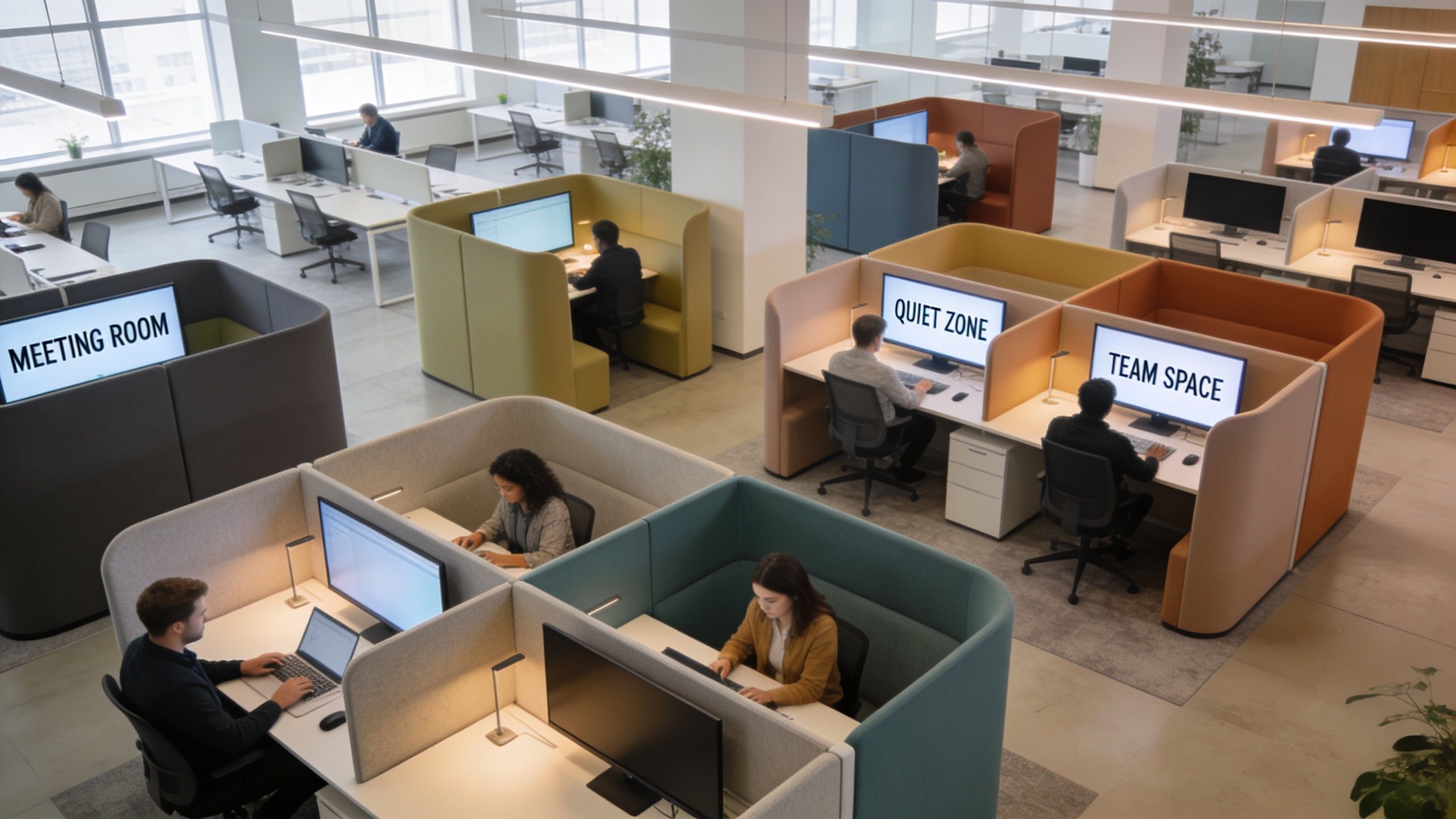
Open-plan offices still fail on the same point. They ask people to do focused, private, and collaborative work in the same acoustic environment.
Noise is the problem pods solve
In the UK, 62% of office workers report noise as their top distraction in open-plan layouts. That’s the issue acoustic pods are built to address. A well-installed pod gives the office something most layouts are short on. Immediate privacy without building a permanent room.
That changes more than sound levels. It changes behaviour. Staff stop taking sensitive calls at their desks. Managers stop borrowing circulation space for one-to-ones. Small groups stop occupying larger meeting rooms for short conversations. The office becomes easier to share because not every task competes in the same open area.
“A pod isn’t just another item of furniture. It’s a controlled environment for focus, privacy, and better use of the space around it.”
Choosing the right pod for the task
Different pod types solve different problems, and installation has to reflect that.
For modular layouts, BlockO pods suit workplaces that want flexibility in footprint and configuration. For tech-enabled work, Framery pods are often specified where ventilation, smart booking features, and refined acoustic performance matter. For a softer aesthetic in design-led interiors, Kabin pods sit comfortably in hospitality-style offices. Where hygiene, cleanability, and durable interior finishes are part of the brief, Vetrospace pods deserve attention. Outside the building, The Meeting Pod Co external pods add sheltered meeting space without relying on the internal floorplate.
A useful way to think about selection is this:
- Phone booth pod: best for quick calls, video meetings, and private check-ins.
- Focus pod: suited to concentrated solo work where background office noise breaks attention.
- Meeting pod: works for small team sessions, interviews, or confidential conversations.
- External pod: creates extra capacity when indoor space is under pressure.
The visual difference between products is easy to spot. The installation differences matter more. Some pods need tighter coordination around power entry points. Some require more precise placement for door clearance and airflow. Some are easier to relocate later. Those trade-offs should be part of specification, not an afterthought.
A short product overview helps show how pods fit modern workplaces:
Pods change behaviour as well as layout
Traditional office furniture fills space. Pods reshape it. They create an internal network of quiet zones that staff can understand immediately. One pod for private calls near the main desk area. A larger booth near the project team. A focus pod near shared touchdown desks. The office starts to support choice rather than forcing one acoustic condition on everyone.
That’s why pods should be integrated into the wider plan, not dropped into left-over corners. Poor placement causes conflict. Good placement relieves it.
A few placement principles usually hold up well:
- Keep call pods near active work areas so people don’t need to cross the whole office for a short conversation.
- Protect focus pods from high traffic routes such as printer zones, kitchens, and main entrances.
- Avoid blocking natural circulation around desks, partitions, and exits.
- Treat ventilation and services as part of the footprint because the usable pod zone is larger than the base alone.
When that planning is done well, pods don’t feel added on. They feel like the part of the office people were missing all along.
Smart Finance Office Pod Hire vs Purchase
Buying a pod is straightforward. The harder question is whether buying is still the smartest route for the way many offices now change.
When buying makes sense
Purchase tends to suit organisations with a settled layout, a clear long-term occupancy plan, and confidence that the pod will stay in place for years. It can also make sense where the pod becomes part of a wider capital project alongside desks, partitions, lighting, and joinery.
For teams comparing options, it helps to review the wider market for meeting pods for sale before deciding on format, size, and specification. The key is to separate product preference from funding model. Liking a pod doesn’t automatically mean buying it is the right commercial choice.
When pod hire is the better fit
Rental has become much more relevant because many facilities teams are managing uncertainty, not permanence. Team size can change. Project space can expand and contract. A business may want to test how many booths it really needs before committing fully.
That’s where Framery Subscribed pod hire changes the conversation. It supports a furniture-as-a-service model that gives organisations access to pods without the same upfront commitment as a purchase. The verified data available for this topic states that pod rental options like Framery Subscribed can cut capital expenditure by up to 50% for SMEs while giving more flexibility.
A simple comparison helps frame the trade-off:
| Decision factor | Hire | Purchase |
|---|---|---|
| Upfront spend | Lower initial commitment | Higher initial commitment |
| Flexibility | Easier to scale or swap | Better for fixed long-term schemes |
| Balance sheet approach | Often suits operational spending preferences | Often suits capital project budgets |
| Change tolerance | Strong for evolving teams | Strong for stable layouts |
Pod hire works well when the office brief is still moving. Purchase works well when the brief is already settled.
Circular thinking matters
The financial model also links to sustainability. Rental and reuse fit naturally with circular economy thinking because the product can stay in service longer across different users and locations instead of being treated as a one-off asset.
That matters for organisations trying to lower waste, avoid premature replacement, and make workspace decisions with a longer material life in mind. Gibbsonn outlines this more broadly in its work on sustainability and the circular economy.
The important point isn’t that one route is always better. It’s that the funding model should match the reality of the workplace. If the office is still evolving, flexibility often has more value than ownership.
Seamless Execution The Installation Workflow
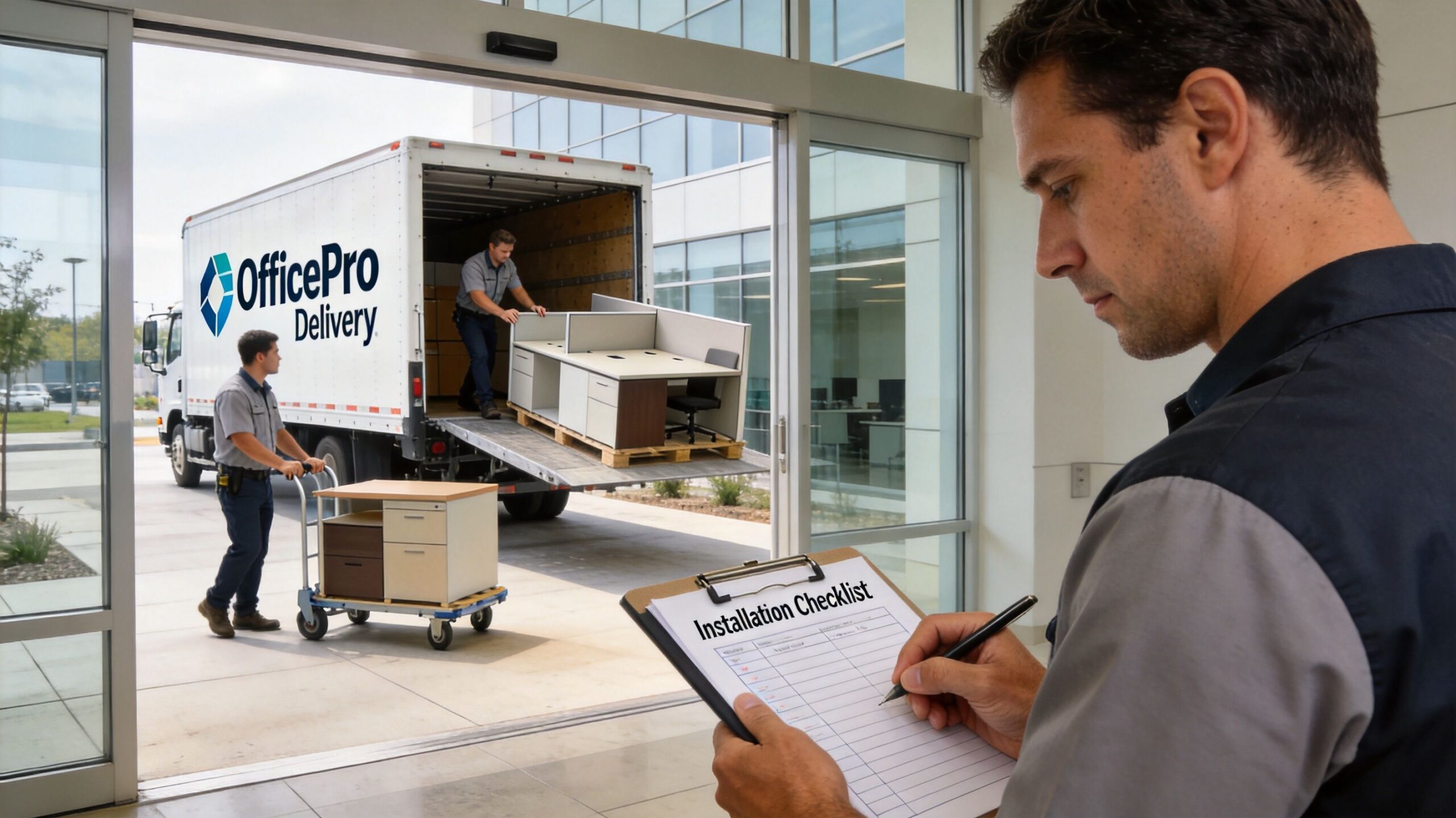
The best installation days look uneventful. That only happens when the hard decisions were made earlier and the workflow is disciplined on site.
Before delivery day
Site readiness decides the pace of everything that follows. Furniture needs a staging area. Access routes need protection. Building management needs delivery windows, lift bookings, and contractor procedures agreed in advance. If new flooring is part of the scheme, sequencing matters because pods, desks, and heavy storage shouldn’t be dragged through a half-finished surface. Facilities teams planning mixed refurbishment works often benefit from specialist advice on managing flooring projects in commercial spaces so each trade hands over a usable area to the next.
For technology-enabled pods, service coordination is not optional. American Office Installations’ office furniture installation checklist notes that power and data must be mapped and verified before assembly because fixes afterward are significantly more difficult and costly. That is especially true with enclosed booths, integrated lighting, occupancy features, and built-in cable routing.
A pre-start check usually needs to confirm:
- Delivery access: loading points, booking times, and route through the building.
- Service readiness: live power and data in the right location.
- Site protection: floors, corners, and shared areas protected before movement starts.
- Coordination with other elements: ceiling works, decorations, and any drop ceiling kits or related services complete enough not to obstruct the install.
The right installation sequence
Sequence matters because offices are layered environments. When teams install in the wrong order, the project slows and damage risk rises.
A clean workflow usually follows this pattern:
Architectural elements first
If the layout includes partitioning, those lines need to be established early. Systems such as Logika partitions are relevant in this context, because partitions and pods often need to relate to one another in both layout and circulation.Core furniture next
Desks, benches, storage, and primary workstations define the working grid of the office.Pods after the main structure is clear
Pods require careful positioning, levelling, service connection, and clearance checks. They shouldn’t be squeezed around unfinished surrounding works.Seating and accessories last
Chairs, screens, monitor arms, task lights, and loose items go in after the heavier assembly is done.
Site note: A pod may be modular, but the installation isn’t casual. Position, power entry, and final clearance all need to be right before sign-off.
Final checks before sign-off
Good installers don’t leave after assembly. They leave after verification.
That means checking pod stability, door operation, ventilation, internal lighting, and power functionality. It means making sure desks align with chairs, monitor arms sit correctly, and walkways remain open. It also means confirming that the space feels usable, not merely complete.
The practical test is simple. Can staff walk in, book or enter a booth, plug in, sit comfortably, and start work without improvising around avoidable faults? If the answer is no, the installation isn’t finished.
Beyond Day One Handover Aftercare and Your Project Checklist
The last day of installation is the first day the workplace starts proving itself. That’s why handover matters so much. It turns a fitted space into an operational one.
What a proper handover looks like
A handover shouldn’t be treated as paperwork and a wave at the door. It’s a structured walk-through where the facilities team checks what has been installed, tests key functions, and receives the documents needed to run the space properly.
That usually includes product manuals, warranty details, maintenance guidance, and user instruction for anything staff may need to adjust or operate. With pods, that can include booking tools, lighting controls, ventilation behaviour, door use, and cleaning requirements. With ergonomic workstations, it means staff need to understand how to set chairs, monitor arms, and desk positions correctly.
“A smooth handover prevents small issues from turning into daily frustrations.”
The checklist facilities teams actually use
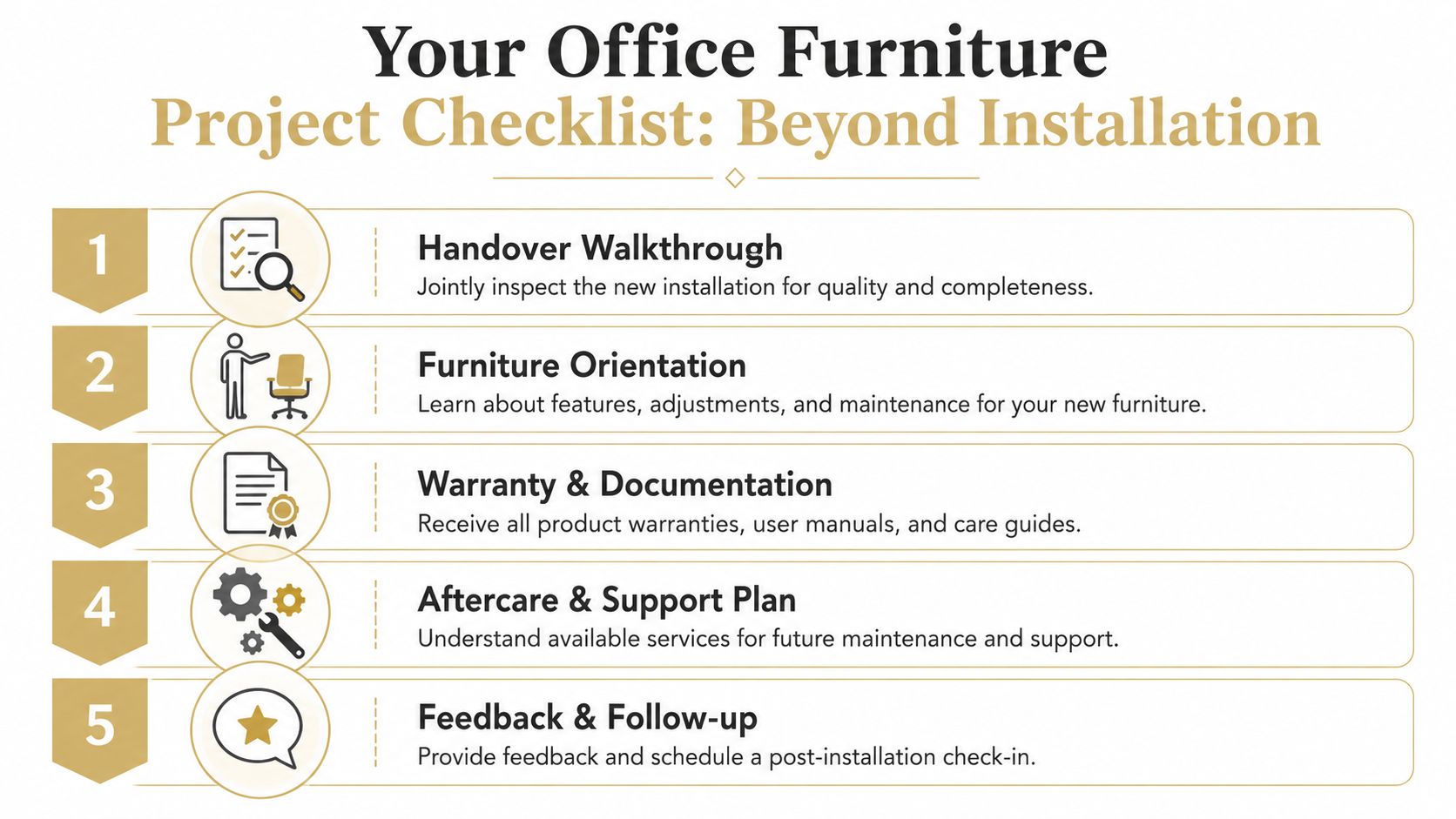
A practical checklist keeps the project grounded after the fit-out team has left. The most useful version is short enough to use and detailed enough to catch what matters.
Before sign-off
- Inspect the layout: make sure furniture and pods match the agreed plan.
- Test the essentials: doors, lighting, ventilation, sockets, and connectivity should all work as intended.
- Walk the routes: confirm circulation feels clear around desks, pods, and exits.
In the first working week
- Gather live feedback: ask teams where noise has improved and where friction remains.
- Watch utilisation: identify which booths are busy and which settings are being ignored.
- Correct early habits: if staff are using a focus pod as a meeting room, the zoning may need clearer guidance.
In the following months
- Review wear points: door seals, upholstery, flooring around pod entrances, and shared seating areas need attention.
- Update the workplace brief: note what the office now needs more of, less of, or in a different location.
- Plan support calls sensibly: small maintenance actions taken early are easier than large remedial works later.
Aftercare keeps the office working
Aftercare is often where a project shows whether it was treated as a transaction or an ongoing workplace asset. Offices change after occupation. Teams start using rooms differently. New people arrive. A pod that looked perfectly placed on plan may prove more useful elsewhere once behaviour settles.
That doesn’t mean the original plan failed. It means real workplaces evolve. The smart response is to keep a light review cycle after installation and make informed adjustments where they improve performance.
A good aftercare conversation usually covers these points:
| Aftercare area | What to review |
|---|---|
| Pod performance | privacy, comfort, ventilation, cleaning |
| Ergonomic set-up | chair adjustment, desk fit, monitor height |
| Space use | underused areas, overbooked zones, traffic pinch points |
| Maintenance | cosmetic wear, moving parts, service issues |
Facilities teams don’t need a complicated post-installation regime. They need a clear record, a usable support path, and a supplier or installer who understands that the office keeps changing after opening day.
Conclusion Build Your Future-Proof Office Today
A successful office furniture installation does more than place products in a room. It removes friction from the working day.
When the layout is planned properly, people know where to focus, where to meet, and where to step away for a private call. When pods are integrated properly, open-plan offices stop forcing every task into the same noisy setting. When installation is handled professionally, the details staff notice first are the right ones. Comfort, privacy, ease of use, and calm.
That’s the true value of a modern office fit-out. Not more furniture. Better-performing space.
For facilities managers working through a refresh, relocation, or retrofit in 2026, the strongest results usually come from asking sharper questions early. Does the office have enough quiet space. Are pods being considered at the same level as desks and meeting rooms. Is hire a better fit than purchase. Has power, data, access, and aftercare been planned before anyone books an install date.
The answers shape whether the project feels short-lived or future-proof.
A well-designed office should support focus, protect wellbeing, and adapt as the organisation changes. That’s exactly what thoughtful planning, careful product selection, and disciplined installation can deliver.
If the next project involves pods, privacy booths, or a full workplace rethink, speak with Gibbsonn. Facilities teams can also book an appointment and visit the showroom in Bishop's Stortford to see pod options in person, compare finishes, and discuss layout ideas for live projects.