
The office looks open, bright, and modern on the drawing set. Then the team moves in. Calls spill across desks, project discussions interrupt focused work, and every request for privacy turns into a compromise. That’s where a sliding room divider earns its place, not as decoration, but as a practical way to create control without locking the floorplate into a fixed layout.
For UK facilities managers, the fundamental question isn’t whether flexibility matters. It’s how to build it into a workplace without creating new acoustic, compliance, or maintenance problems. The strongest answer usually isn’t a divider on its own. It’s a layered approach that combines movable separation, acoustic thinking, and the right use of office pods.
Table of Contents
- The End of Open-Plan Why Your 2026 Office Needs Agility
- Understanding Sliding Systems and Partitions
- Choosing Your Materials Glass Timber and Fabric
- The Hybrid Solution Integrating Dividers with Office Pods
- UK Compliance and Installation Essentials
- Your Specification and Buying Checklist
- Create Your Agile Workspace Today
The End of Open-Plan Why Your 2026 Office Needs Agility
Open-plan offices still work for visibility, speed, and team energy. They don’t work when every task happens in the same acoustic condition. Focused work, confidential calls, quick huddles, and longer meetings all demand different levels of privacy, and one open room can’t deliver all of them well.
That’s why agility matters more than openness on its own. A workplace now needs to change character during the day without expensive building work every time the team shifts. A sliding room divider helps create that change quickly. It can open up an area for collaboration in the morning and close down a quieter zone later in the day.

Why fixed layouts are losing ground
Permanent walls solve one problem by creating another. They provide separation, but they also reduce adaptability, limit daylight flow, and make reconfiguration slower and more expensive. In leased space, they can also become a poor fit when occupancy patterns change.
The wider market reflects that shift. The global room divider market was valued at USD 2.42 billion in 2022 and is projected to grow at a CAGR of 5.6% through 2030. UK-specific data is limited, which is a useful reminder in itself. Many workplace teams are making decisions on layout flexibility without clear local benchmarks, so practical judgement matters.
Practical rule: If the brief includes focus work, video calls, and informal collaboration in the same neighbourhood, a static layout usually won’t stay effective for long.
Agility supports wellbeing as much as performance
Noise pressure mounts in open offices. People start taking calls in corridors, booking meeting rooms for solo work, or wearing headphones all day. That isn’t a sign of a productive space. It’s a sign that the workplace isn’t offering enough choice.
Movable spatial tools change that. A sliding room divider can reduce visual exposure and help define use zones. Pods then add a higher-performance layer where speech privacy or concentration matters most. That combination gives staff options without asking them to leave their team area entirely.
A second reason this matters is sustainability. Workplace teams are under pressure to avoid wasteful fit-outs and design spaces that can evolve rather than be stripped out. Adaptable products sit more comfortably with reuse, reconfiguration, and a circular approach to interiors. For teams thinking beyond first cost, Gibbsonn’s sustainability approach is aligned with that wider shift toward longer-life workplace assets.
What a better workplace looks like
The best agile offices don’t try to make every square metre do the same job. They create layers:
- Open areas for shared visibility and day-to-day teamwork
- Semi-enclosed zones formed by dividers for lower-distraction work
- Fully enclosed spaces such as pods for calls, meetings, and concentration
That layered model is more resilient than a pure open-plan scheme. It gives facilities teams room to respond when headcount changes, teams move, or the business needs a different balance between collaboration and privacy.
“A good workplace doesn’t force one behaviour on everyone. It gives people the right setting for the task in front of them.”
Understanding Sliding Systems and Partitions
A sliding room divider is best thought of as a wall on demand. It doesn’t replace every partition type, but it does give a workplace something fixed construction can’t. It lets one area behave like two rooms when needed, then return to a larger shared space when the divider is open.
That matters in offices where flexibility has to be built into the daily routine. A project zone may need to close off for a client discussion, then reopen for team interaction. A breakout edge may need screening during video calls, then disappear again to preserve openness.
Sliding systems compared with other partitions
The simplest mistake in specification is to treat every movable partition as the same. They aren’t. A sliding divider has a different operating pattern from a folding wall, and both behave very differently from a permanent stud wall or glazed partition.
For teams reviewing broader partition options, office partitioning walls and specialist systems from Logika are useful reference points because they sit at the more permanent end of the spectrum. The choice depends on whether the space needs daily flexibility, occasional reconfiguration, or a fixed acoustic boundary.
Top-hung systems
A top-hung sliding system carries the panel load from above. The main attraction is floor continuity. Without a full floor track, cleaning is easier and the visual line across the room stays cleaner.
This type suits offices where flooring must remain uninterrupted, or where the design team wants a lighter appearance. It does, however, depend on suitable structural support above. If the ceiling can’t take the load or the suspended grid isn’t designed for it, the specification needs more work.
Bottom-rolling systems
A bottom-rolling system carries more of the load through the floor. That can be useful for heavier panels or in spaces where the ceiling structure doesn’t support a top-hung arrangement comfortably.
The trade-off is obvious. Floor tracks and thresholds need careful planning because they affect cleaning, movement, and accessibility. In busy commercial areas, a badly considered track line quickly becomes the detail everyone regrets.
Bottom-rolling systems often solve a structural problem, but they can introduce an operational one if the floor interface hasn’t been thought through properly.
Pocket systems
A pocket system allows the panels to slide into a wall cavity. When open, the divider is largely out of sight. That makes the opening feel clean and intentional, which is why architects often like the effect.
Pocket systems demand more from the surrounding construction. They’re easier to justify when the layout is being built or heavily remodelled. In retrofit projects, they can become more disruptive than a surface-mounted sliding system.
Where sliding beats folding and where it doesn’t
Sliding systems generally give a cleaner line, a calmer look, and easier everyday use for many office settings. They’re especially effective where the workplace wants frequent zoning without the bulkier stack profile associated with some folding solutions.
But there are limits:
- For very high acoustic expectations, a standard sliding glass divider may not be enough on its own.
- For full-room closure, fixed partitions can still outperform movable systems.
- For awkward geometry, folding systems sometimes cope better with unusual openings.
That’s why the best specification starts with the behaviour of the room, not the product category. If the client needs visual division and moderate flexibility, sliding often wins. If they need strong separation with predictable high privacy, the answer may sit elsewhere or require a combined solution.
Choosing Your Materials Glass Timber and Fabric
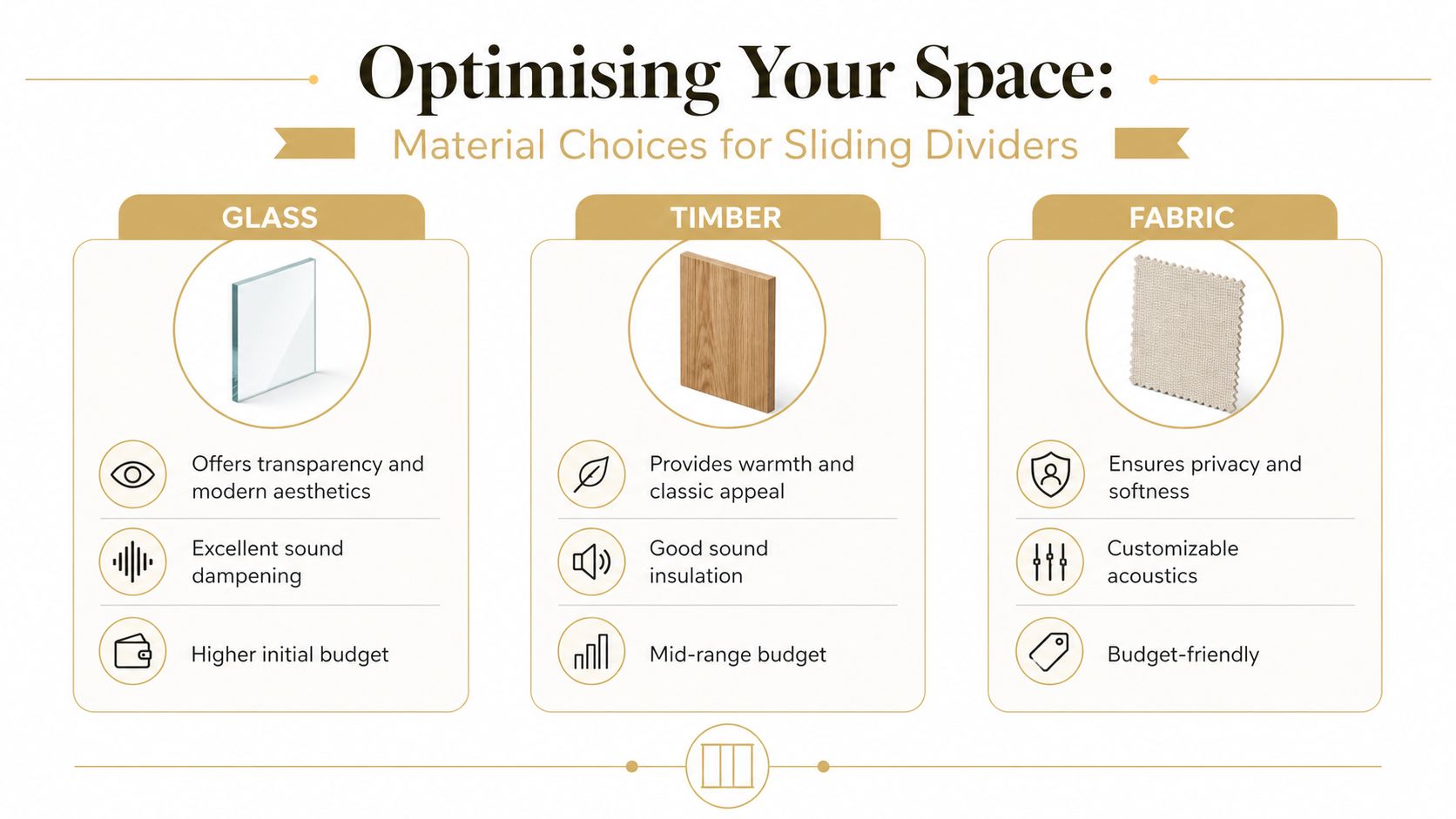
Material choice shapes almost everything about a sliding room divider. It affects how the room feels, how much light passes through, how much noise transfers, how easy the system is to maintain, and whether the divider looks more corporate, domestic, or hospitality-led.
Most commercial projects narrow quickly to glass, timber, or fabric-faced panels. Each can work well. Each also carries trade-offs that need to be understood before the order goes in.
Glass for light and visual connection
Glass remains the default choice in many office projects because it preserves openness. Teams keep daylight, sightlines, and a sense of space even when the divider is closed. That’s useful in boardrooms, touchdown zones, executive areas, and central collaboration spaces where complete visual isolation would feel too heavy.
Acoustically, glass can improve when specified properly rather than treated as a generic panel. A minimum panel overlap of 100mm can reduce noise leakage by 8-12 dB, and moving from standard 6mm glass to 10-12mm glass can improve acoustic performance by a further 5-7 dB. Those details matter more than many buyers expect.
For readers comparing glazing standards in other applications, technical discussions around ultra-clear glass and finish quality for frameless shower enclosures can also be useful for understanding how clarity, edge quality, and visual cleanliness affect the end result, even though workplace divider performance needs a different specification lens. For office acoustic planning, soundproof office partitions are the more relevant benchmark.
Timber for warmth and presence
Timber changes the mood of a workspace immediately. It softens harder commercial interiors and can make a divider feel more intentional, less technical. In hospitality-led offices, client lounges, leadership areas, and creative studios, that warmth can matter as much as raw performance.
It also gives stronger visual privacy than clear glass. Occupants feel more enclosed, which can be useful in quiet rooms or multi-purpose spaces that need to hide activity when closed. The downside is obvious too. Timber blocks light and can make smaller floorplates feel more enclosed if overused.
Fabric for absorption and softness
Fabric-faced sliding panels are often overlooked because they don’t have the visual drama of glass. In acoustic terms, though, they can be very useful. While glass is stronger for sound separation, fabric-based surfaces can help with sound absorption, which reduces echo and softens the room overall.
That makes fabric attractive in training rooms, breakout zones, libraries, education spaces, and open collaboration areas where reverberation is part of the problem. Fabric also gives more freedom with colour and finish, which helps tie zoning into brand and interior palette without adding fixed walling.
Worth remembering: Sound insulation and sound absorption are not the same thing. A divider can block transfer but still leave the room harsh and echoing if the surrounding surfaces are too hard.
Sliding Room Divider Material Comparison
| Material | Acoustic Performance (Rw) | Light Transmission | Typical Cost | Best For |
|---|---|---|---|---|
| Glass | Can be stronger when acoustic detailing is specified. Thicker panels and proper overlap improve performance. | High | Higher | Meeting spaces, executive areas, open offices needing daylight |
| Timber | Good for visual privacy and can support solid separation strategies depending on build-up | Low | Mid-range | Quiet rooms, hospitality-led offices, spaces needing warmth |
| Fabric | Better suited to softening echo and improving room feel than preserving transparency | None | Budget-friendly to mid-range | Training rooms, collaboration zones, education and breakout areas |
What works and what usually disappoints
Some specifications look attractive on a board and underperform in use. These are the common patterns:
- Glass without acoustic detailing: It looks smart but won’t deliver enough privacy where speech control matters.
- Timber in already dark interiors: It can make the area feel smaller and heavier than intended.
- Fabric in prestige front-of-house settings: It may perform well acoustically but won’t always suit the desired finish standard.
The strongest results usually come from matching the material to the behavioural need of the space. If the brief is transparency first, glass is often right. If the brief is warmth and concealment, timber has the edge. If the room sounds hard before the divider is even installed, fabric deserves serious attention.
The Hybrid Solution Integrating Dividers with Office Pods
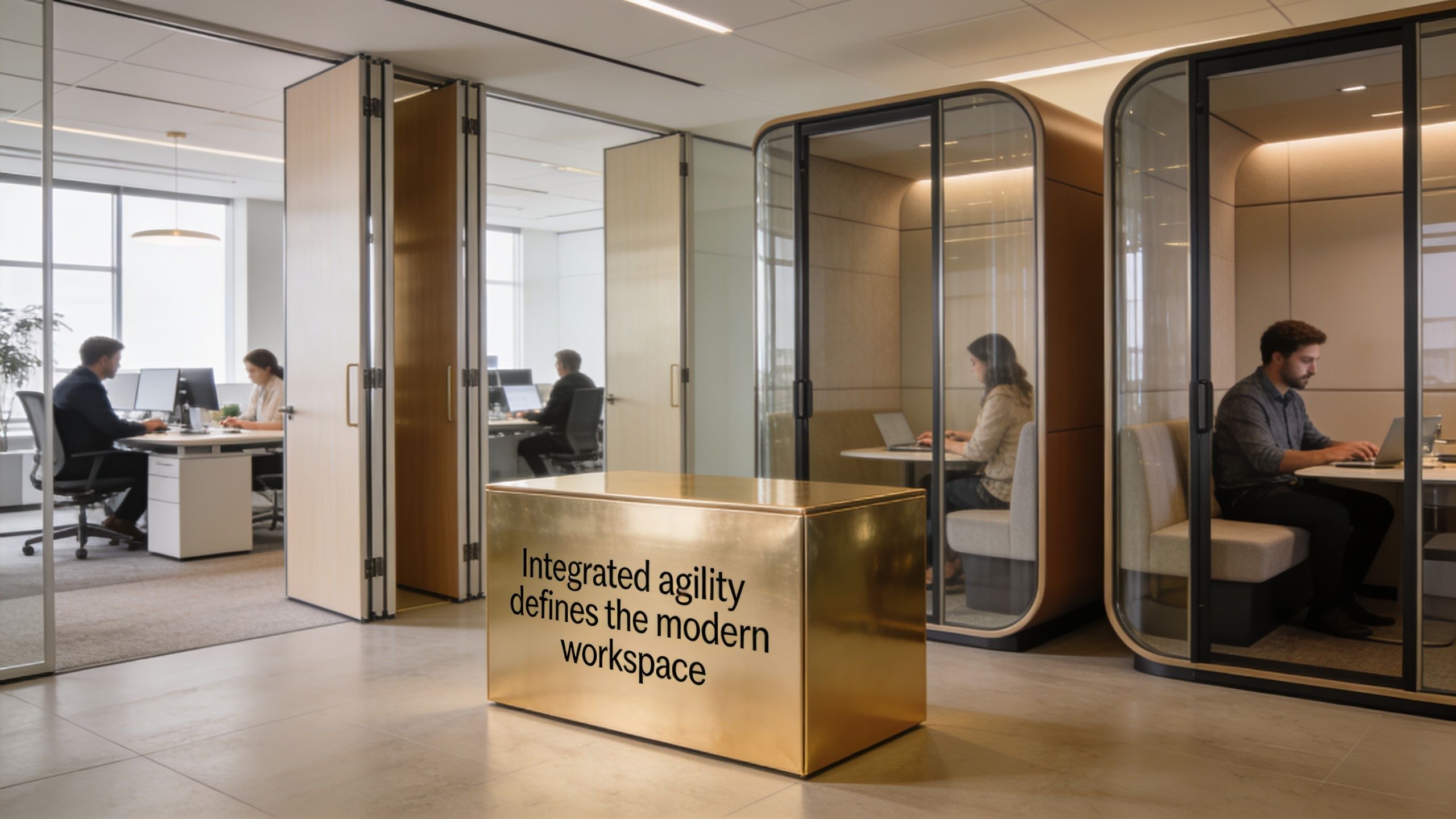
A sliding room divider shouldn’t be treated as a rival to an office pod. In a strong workplace layout, the two solve different parts of the same problem. The divider creates a zone. The pod creates a high-performance room within that zone.
That difference matters because many workplace teams expect too much from one product. A divider can define space, control movement, and improve privacy. It can’t always guarantee the level of speech protection required for confidential calls or concentrated solo work. That’s where pods come in.
Zone within a zone
A practical workplace layout often benefits from layered thresholds. A sliding divider can separate a quieter neighbourhood from the main circulation route. Inside that quieter neighbourhood, pods handle the tasks that need stronger enclosure.
That model works well in several ways:
- Focus areas: A divider screens off a calm zone, then Framery pods handle calls and concentration.
- Collaborative neighbourhoods: A divider separates team activity from the wider office, while Blocko pods or Kabin pods give teams enclosed meeting points.
- Clean visual environments: A divider creates structure without building hard rooms everywhere, and Vetrospace pods provide a more controlled enclosed setting where finish and acoustic quality matter.
A useful design reference for these layered planning decisions is designing office space, because divider placement works best when it follows movement patterns, noise sources, and the types of work happening nearby.
Why pods solve the privacy gap
A key limitation of standard glazed dividers is speech privacy. According to a 2025 RIBA report on hybrid workspaces referenced here, standard non-acoustic glass dividers underperform compared with dedicated acoustic pods like Framery at Rw 39dB in speech privacy tests. That doesn’t make dividers the wrong choice. It makes them part of a broader acoustic strategy.
This is the point many schemes miss. A divider can improve a space and still fall short if the brief includes confidential HR calls, client negotiations, or focused work beside a busy team area. Pods fill that gap cleanly because they offer a contained environment without forcing the whole office into enclosed-room logic.
A divider changes the behaviour of an area. A pod changes the behaviour of a task.
Flexible acquisition matters too
The workplace itself is more fluid now, so procurement needs to be flexible as well. That’s why pod hire is relevant in the same conversation as movable dividers. If an occupier wants adaptable zoning without committing every element as a permanent capital fit-out, Framery Subscribed gives a rental route that fits the same agile mindset.
This is especially useful in shorter leases, growth phases, and pilot spaces where the business wants to test demand before committing to a final layout. The divider creates scalable spatial control. Pod hire adds scalable enclosed capacity.
The same thinking can extend outdoors. Teams that need flexible meeting or touchdown capacity beyond the main office can look at The Meeting Pod Co for external pod solutions that support the wider estate strategy.
A short product walkthrough helps show how the pod layer complements spatial zoning:
Where this hybrid model works best
The most successful applications tend to share a few characteristics:
- Busy open-plan floors where teams need visible connection but can’t tolerate constant interruption
- Coworking environments where occupiers want shared energy and private call space at the same time
- Education, healthcare, and public sector settings where activity types change through the day and enclosed rooms are in short supply
The result is a more nuanced office. Not a sea of desks. Not a maze of rooms. A workplace with gradients of privacy.
UK Compliance and Installation Essentials
A sliding room divider can look excellent in a brochure and still fail on site. In UK projects, the risk usually sits in the practical details. Ceiling support, floor condition, threshold design, fire performance, access, and acoustic expectations all need checking before the system is ordered.
For facilities managers, that means asking harder questions earlier. It’s cheaper to challenge a specification than to correct one after installation.

Structural reality first
The most common specification error is assuming the ceiling can take the load because the divider is internal. That assumption causes trouble fast. A 2025 HSE audit found that 15% of office partition installations were non-compliant, with fines up to £20,000, and one recurring issue was exceeding the 150kg/m² ceiling load limits set out in UK Approved Document A.
That single point changes the conversation. A top-hung system is only as good as the structure above it. If the support is inadequate, the job may need steelwork, a different system type, or a rethink of location.
“Non-compliance isn’t a paperwork problem. It becomes a programme problem, a safety problem, and sometimes a £20,000 problem.”
Acoustic and fire questions need clear answers
UK projects often refer to Building Regulations Part E when acoustic separation matters. In schools and some specialist settings, BB93 may also come into play. The important point for the buyer is simple. Ask for tested performance data relevant to the actual proposed build-up, not a vague statement that the system is “acoustic”.
The same goes for fire performance. If the divider sits in a location where a fire rating is part of the wider design intent, the team needs documented evidence and a clear explanation of what the system does and does not cover. Assumptions around glazed systems and movable elements can lead to serious misunderstandings.
Accessibility and day-to-day use
A divider that looks sleek but creates awkward movement isn’t a good workplace solution. Thresholds, opening forces, clear widths, and operational ease all matter. Accessibility should be considered alongside design, not after it.
A practical review should include:
- Routes and manoeuvrability: Can users move through the area safely when the system is open and closed?
- Threshold design: Does the floor interface create a trip point or cleaning issue?
- Operation: Can staff use the divider easily without specialist handling every time?
The best divider is one people will actually use. If opening and closing it feels awkward, the space stops being flexible in real life.
The retrofit trap in older buildings
Retrofit projects in converted offices and older commercial stock often bring uneven floors, hidden structure, and tighter service coordination. Those aren’t reasons to avoid a sliding room divider. They are reasons to survey properly.
Many schemes often drift into avoidable compromise. The design intent stays elegant, but the installation conditions are messy. If the survey misses floor tolerance or support conditions, the final user ends up with poor alignment, difficult operation, or visible remedial work that undermines the whole fit-out.
A compliant installation is rarely about one dramatic mistake. It’s usually a chain of smaller oversights. Good project teams break that chain before the order is placed.
Your Specification and Buying Checklist
Buying a sliding room divider is easier when the brief is disciplined. The right questions remove half the confusion.
Start with the job the divider needs to do
- Privacy or just zoning: Decide whether the aim is visual separation, acoustic improvement, or both.
- Frequency of use: A divider used daily needs a different durability mindset from one used occasionally.
- Integration with pods: If the wider strategy includes enclosed call or meeting spaces, design the divider around that layout rather than treating it as a separate purchase.
Match performance to the building
- Structure first: Confirm that the ceiling or floor condition suits the proposed system.
- Compliance evidence: Ask for acoustic, fire, and safety documentation that matches the actual configuration.
- Maintenance reality: Tracks, seals, and operating hardware should be maintainable without disruption.
Check the installation details that often get missed
Duration’s technical guidance notes a low threshold of around 23mm to reduce trip hazards and recommends floor levelling within 2mm per metre, because uneven floors cause 30% of sliding system failures in UK buildings. That’s a specification point worth pinning down before works start, especially in older properties.
Specification note: A beautiful panel won’t compensate for a poor interface with the floor, ceiling, or adjacent wall.
Think beyond purchase price
A cheaper divider can become expensive if it needs remedial work, underperforms acoustically, or stops the space adapting later. Total value sits in lifespan, ease of reconfiguration, maintenance demands, and whether the product supports a more circular fit-out strategy instead of a disposable one.
Create Your Agile Workspace Today
A well-planned sliding room divider gives a workplace control. Combined with the right office pods, it gives the workplace choice. This marks a key shift. Not merely dividing space, but shaping different settings for different kinds of work without losing flexibility.
For teams reviewing an office upgrade, the smartest next step is to see these solutions in person, test the acoustic feel, and discuss the fit with the building itself.
Gibbsonn helps organisations create flexible workplaces with office pods, booths, and privacy solutions that work in real commercial environments. To discuss your project, contact us. Teams are also welcome to book an appointment and visit the showroom in Bishop's Stortford to explore pod and divider options firsthand.