

The noise problem usually isn’t dramatic. It’s constant. A call starts three desks away. Someone books the only meeting room for the whole afternoon. Two people try to focus with headphones on while a sales conversation spills across the floor. By midday the office still looks productive, but attention has already been broken dozens of times.
That’s why the search for sound proof room partitions has changed. Buyers no longer just want to split space. They want to protect concentration, support private calls, and create rooms for real work without locking the office into a rigid layout. Traditional partitions still have a place, but modern acoustic pods solve the actual workplace problem faster and with far more flexibility.
A quiet office isn’t a luxury fit-out choice now. It’s part of how teams think clearly, collaborate properly, and stay sane in open-plan space.
Table of Contents
- The End of Distraction Is Your Office Ready?
- Decoding Acoustic Performance What Matters Most
- The Evolution of Partitions From Fixed Walls to Flexible Pods
- Choosing Your Perfect Pod A Tour of Gibbsonn’s Solutions
- Smart Investment The Future of Office Acoustics in 2026
- From Plan to Placement Gibbsonn's End-to-End Service
- Create Your Quiet Revolution Today
The End of Distraction Is Your Office Ready?
A workplace manager doesn’t need a noise report to know when the layout has stopped working. The signs are obvious. Staff drift into corridors for private calls. Small meeting rooms become permanent Zoom booths. Teams book space they don’t need because it’s the only place they can hear themselves think.
That’s the modern version of workplace friction. It doesn’t look like a crisis. It looks like daily compromise.

Quiet space is now core infrastructure
The old response was simple. Build another room. Add a partition. Accept a bit of disruption and hope the layout still works in two years.
That approach is too blunt for today’s offices. Teams expand, contract, regroup, and work in different rhythms through the week. A floorplate needs to support focused solo work, hybrid calls, short meetings, sensitive conversations, and project bursts. Fixed construction can do that, but it usually does it slowly and permanently.
Pods handle the same challenge with far more intelligence. They create enclosed, acoustically controlled space without forcing a full rebuild. That makes them the practical evolution of sound proof room partitions rather than a niche add-on.
Practical rule: If staff are using stairwells, empty corners, or parked meeting rooms for concentration or privacy, the office doesn’t have enough acoustic space.
The real shift is from dividing space to protecting work
Visual separation alone isn’t enough. Screens and decorative dividers may tidy a plan, but they won’t stop speech from travelling. A proper acoustic solution changes behaviour. People take calls where they should. Small meetings stop spilling into shared zones. Focused work stops depending on luck.
That’s why dedicated pods have become such a strong answer for open-plan environments. They give teams the one thing most offices promise and few deliver consistently. Control.
Decoding Acoustic Performance What Matters Most
Acoustics confuse buyers because the language sounds technical and the stakes are practical. A pod either creates privacy or it doesn’t. A partition either reduces distraction or it becomes an expensive visual screen.
The useful numbers aren’t there to impress specifiers. They help buyers predict what people will hear.
STC tells buyers how much speech gets blocked
STC, or Sound Transmission Class, measures how well a partition blocks airborne sound. Higher numbers mean better soundproofing. In UK offices, acoustic partitions are recommended to achieve STC ratings of 35-50 to minimise workplace noise, and modern acoustic room dividers can reduce noise by 10-50% in open-plan spaces according to Komfort’s guide to acoustic partitioning.
A simple way to think about STC is this. It’s the difference between hearing a conversation clearly and hearing only a vague murmur. For most office buyers, that’s the decision point that matters.
| Metric | What it means in plain English | Why buyers should care |
|---|---|---|
| STC | How much airborne sound is blocked | Helps judge speech privacy |
| Rw | A UK and European sound reduction rating | Useful for comparing glazed systems and pods |
| Absorption | How much sound a surface soaks up inside a space | Helps reduce echo and harshness |
The materials inside the enclosure matter too. Buyers comparing product categories may find this guide to best materials for sound insulation useful because it explains why dense layers, glazing choices, and internal finishes all affect results.
Rw is the UK-friendly performance number to watch
Rw is another sound reduction metric used widely in UK and European specifications. It plays a similar role to STC, although it isn’t identical. For office buyers, the practical point is straightforward. If a pod or partition has a tested Rw figure, that figure helps indicate how much noise it can reduce between spaces.
Speech privacy matters more than abstract specification language. If a buyer needs a booth for confidential calls or a pod for HR conversations, tested acoustic performance should sit near the top of the shortlist criteria.
“Buyers shouldn’t ask whether a product looks private. They should ask whether its acoustic performance has been properly measured.”
Absorption and masking still matter
Blocking sound is only half the job. Offices also need to manage echo, reverberation, and the overall sound character of the floor. That’s why carpets, ceilings, wall finishes, and soft furnishings still matter. A good pod won’t fix a badly behaved open-plan office on its own, but it will give people a protected acoustic refuge within it.
In some workplaces, broader acoustic planning can include audio masking systems that help manage speech distraction across shared areas. That’s especially relevant where teams need both open collaboration and a more controlled background sound level.
The strongest buying decision is usually the simplest one. Choose solutions that combine measured sound reduction, sensible placement, and a clear use case. That’s how acoustic products stop being spec-sheet items and start solving everyday work problems.
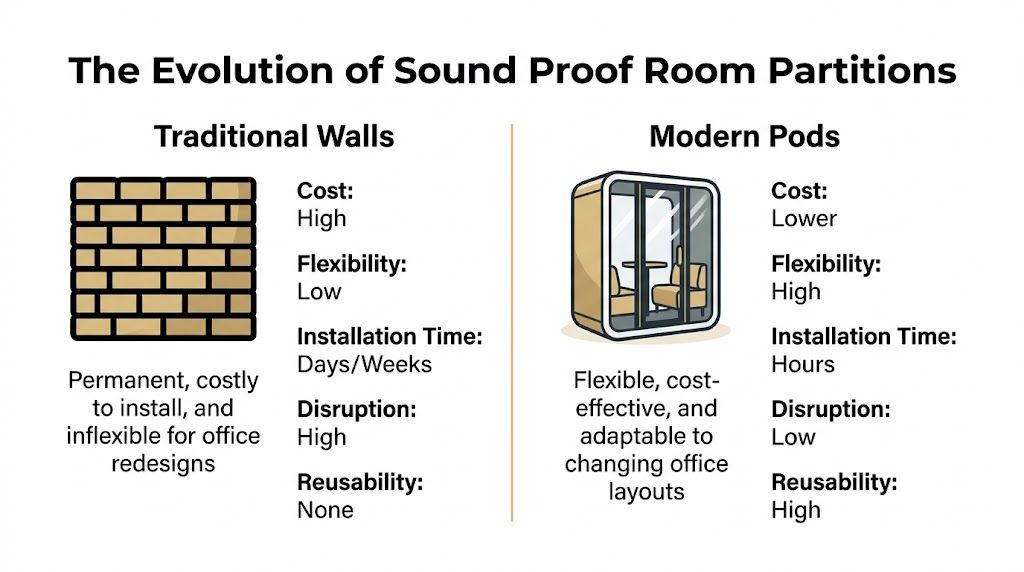
The Evolution of Partitions From Fixed Walls to Flexible Pods
The search term may still be sound proof room partitions, but the product logic has changed. Most buyers aren’t just trying to separate one zone from another. They’re trying to build a workplace that can keep changing without falling apart every time the headcount shifts or a team structure changes.
Traditional partitions still solve some problems
There’s still a case for fixed and sliding partition systems. For businesses creating permanent meeting rooms or subdividing larger spaces, solutions such as Logika partitions remain relevant. They can define space cleanly and support a more architectural finish.
For some projects, that’s absolutely the right call. A formal boardroom, a client-facing suite, or a long-term internal wall may justify a traditional partition route. The problem is that many modern offices don’t need permanence. They need adaptability.
Traditional folding partitions can achieve an STC 40 rating, but they often need significant structural integration and can have a large stack depth when retracted. A 20m-wide panel may require 4.7m of storage space, and their effectiveness can be compromised by sound leaking over the top through plenum flanking, as explained in this overview of Curtitions folding partitions.
Why pods fit modern workplaces better
That stack depth problem tells buyers everything they need to know. Traditional systems don’t just divide space. They also claim space when not in use. And because they rely on the surrounding structure, ceilings, and installation conditions, the practical outcome can disappoint.
Self-contained pods avoid that whole trap. They don’t depend on the ceiling void above them. They don’t create the same plenum flanking weakness. They arrive as complete acoustic environments with walls, glazing, ventilation, lighting, and a known footprint.
For offices that need flexibility, that changes the buying equation.
A useful comparison also appears in this guide to a temporary partition wall, especially for buyers who are still weighing fixed division against modular alternatives.
Pods aren’t replacing every partition. They’re replacing the wrong partitions. The ones built for certainty in workplaces that change every quarter.
Where each option works best
The decision becomes easier when the options are judged by workplace behaviour rather than construction category.
- Choose fixed partitions when the room position won’t change, the use is permanent, and the space is being built around long-term architecture.
- Choose folding partitions when a large room occasionally needs subdivision and the building can accept the structural and storage demands.
- Choose pods when the office needs enclosed space fast, the layout may evolve, and users need reliable acoustic control without a messy fit-out cycle.
Pods also support a wider range of everyday tasks. A single office may need one-person call booths, small team meeting pods, and larger enclosed rooms for project work. Traditional partitions can produce one answer. A pod strategy can produce several answers at once.
That is the evolution. Offices used to divide space first and then ask people to work within it. Now the better workplaces start with the work itself and add the right acoustic setting around it.
Choosing Your Perfect Pod A Tour of Gibbsonn’s Solutions
Choose the pod around behaviour, not brochure language. A call booth, a two-person pod and a larger meeting pod do different jobs, and offices that buy well treat them as a small acoustic system rather than a single catch-all product.

Framery for demanding office acoustics
Framery pods suit workplaces that need privacy to work properly every day. They fit busy headquarters, hybrid offices with constant video calls, and premium coworking environments where poor speech control quickly turns into lost focus and poor meeting quality.
Choose Framery if your office deals with:
- Frequent calls: Teams moving from one call to the next need dependable speech privacy.
- Open-plan distraction: Floors with constant voice spill need enclosed spaces people will readily use.
- Specification-led fit-outs: Architects and workplace teams often want a refined product with a polished user experience.
For buyers comparing office formats, examples of specific building solutions can help clarify where enclosed work settings support different operating models.
BlockO for design-led flexibility
BlockO pods are a smart choice where the pod needs to earn attention as well as floor area. In client-facing offices, creative studios and brand-conscious workplaces, the acoustic fix should support the interior scheme rather than sit awkwardly against it.
That makes BlockO useful when the brief includes identity, warmth and adaptability. You are not only reducing noise. You are shaping how the workplace feels to staff and visitors.
A good BlockO specification usually balances:
- acoustic control
- visual character
- flexibility in layout
That balance matters. A pod should improve performance and strengthen the space around it.
Kabin for practical everyday use
Kabin pods solve common office problems quickly. Short calls, one-to-ones, quiet solo work and informal meetings all need somewhere to happen without taking over open desks or formal meeting rooms.
They are a strong fit for:
- Straightforward acoustic upgrades: Teams that want a clear route into pod use without making the project complicated.
- Mixed daily use: A booth that can support several tasks across the week gives better value from a smaller footprint.
- Fast operational relief: Kabin can reduce pressure on meeting rooms and calm noisy floors without a long fit-out programme.
Many workplace teams get better results from several smaller enclosed settings than from one oversized intervention. Kabin suits that approach well.
Vetrospace for premium privacy and hygiene-conscious settings
Vetrospace pods fit environments where privacy, finish and cleaner shared use all matter. That includes executive offices, healthcare-adjacent settings and workplaces that want enclosed space to feel calm, light and professionally resolved.
These pods work well when the brief includes:
| Need | Why Vetrospace suits it |
|---|---|
| Private conversations | Strong enclosure supports focused discussions |
| Premium look and feel | Glass-led design keeps the workplace visually open |
| Higher-touch environments | Material choices can support cleaner shared use |
Good acoustic products should not make the office feel boxed in. They should make it feel organised and easier to work in.
A multi-brand pod offer is useful because it lets workplace teams compare different answers to the same noise problem. It also supports a more flexible procurement approach. Buy when the need is stable. Rent when headcount, lease length or attendance patterns are still shifting. That is where pods move ahead of traditional sound proof room partitions. They suit a circular workplace model better, because they can be relocated, reused and kept in service instead of being demolished and rebuilt.
This video gives a useful visual sense of how pod design and workplace flow can work together:
The Meeting Pod Co for outdoor space that works harder
The Meeting Pod Co external pods create extra meeting and focus space beyond the main floorplate. That opens up practical options for education sites, hospitality venues, airports and offices that have exhausted internal room capacity.
Outdoor pods also solve a problem fixed partitions cannot. They add usable enclosed space without tearing into the building fabric. For organisations trying to stay agile, cut waste and avoid another heavy fit-out cycle, that is a better direction.
The best pod choice is the one that matches daily work patterns, adapts with the business and stays useful when the office changes again.
Smart Investment The Future of Office Acoustics in 2026
A noisy office drains value fast. Staff lose focus, private conversations become awkward, and managers start booking meeting rooms for work that should happen anywhere on the floor. By 2026, smart acoustic investment means buying flexibility, not just buying enclosure.
A pod should be judged like any other workplace asset. Does it solve a live problem, adapt when the business changes, and stay useful long enough to justify the spend? Fixed sound proof room partitions rarely pass that test as well as modern pod systems do.

Why hire is now a serious workplace strategy
Rental has become a practical procurement choice, not a fallback. If your headcount, lease term, or office attendance is still shifting, tying every acoustic decision to capital spend is poor planning.
That is why Framery Subscribed stands out. It gives workplace teams access to high-performance pods through a model that fits change instead of resisting it. Impact Acoustic’s room divider trend overview points to two clear directions for 2026: smarter acoustic products and more flexible ways to bring them into the workplace.
Use the model that matches the risk. Buy pods when the need is stable and long term. Rent them when the business is still testing its space strategy.
“The long-term value sits in flexible acoustic assets that can move with the business instead of forcing the business to work around a fixed fit-out.”
Circular thinking beats wasteful fit-outs
Office acoustics should not create a demolition cycle. Traditional built partitions often do exactly that. A team grows, shrinks, relocates, or changes its working pattern, and yesterday’s expensive solution becomes tomorrow’s waste.
Pods are the stronger answer because they suit a circular economy model. They can be moved, refreshed, reused, and kept in service across different layouts and even different sites. That reduces waste, avoids another heavy fit-out, and protects more of the original investment.
That logic also applies to the wider acoustic strategy. In some projects, supporting materials such as 15 mm Soundbloc plasterboard for surrounding acoustic upgrades can help improve the base environment around pods, especially where teams need better separation beyond the pod itself.
Smart pods are becoming more responsive
The next shift is intelligence. Acoustic pods are no longer just enclosed booths with better finishes. The 2026 direction includes smart sensors, occupancy data, and better visibility into how space is used, as noted in the trend discussion mentioned earlier.
That matters for workplace planning. Facilities and design teams can see which pods are used properly, where noise pressure is building, and whether more focus space or more meeting space is needed. The result is a workplace that improves over time instead of freezing around one fit-out decision.
The strongest investment in 2026 is the one that stays useful when the office changes. That is why acoustic pods have moved beyond traditional sound proof room partitions. They give privacy now, flexibility later, and a far cleaner path to a lower-waste workplace.
From Plan to Placement Gibbsonn's End-to-End Service
Most acoustic projects go wrong in the gaps between decisions. The product may be good, but the placement is poor. The pod may look right, but the office circulation around it becomes awkward. The acoustic target may be ambitious, but no one has checked compliance, power, ventilation, or access properly.
The process that removes risk
A solid workplace partner handles the full chain rather than just dropping a product into a plan. That usually means:
- Space review: Looking at where noise starts, where privacy is needed, and what behaviours need to be supported.
- Product selection: Matching booth size, meeting capacity, acoustic performance, and visual finish to the actual brief.
- Installation planning: Making sure delivery, assembly, services, and placement work without chaos on site.
- Aftercare: Keeping pods in good condition so they stay useful rather than becoming neglected fit-out pieces.
This is also where adjacent acoustic elements can matter. In some schemes, supporting materials such as 15 mm Soundbloc plasterboard may play a role around the wider project, especially where pods are being introduced alongside other acoustic upgrades.
Compliance has to be designed in
Compliance isn’t a finishing touch. It needs to be part of the specification from the start. UK guidance such as Building Bulletin 93 requires specific acoustic performance in educational settings, and high-quality double-glazed pods can achieve Rw ratings of 49-54 dB, significantly outperforming standard walls and ensuring speech privacy according to Komfort’s acoustic partitioning guide.
That matters well beyond schools. Healthcare, offices, shared public buildings, and private meeting environments all benefit from the same discipline. Buyers should expect acoustic performance, usability, accessibility, and layout logic to be considered together.
Good acoustic planning doesn’t stop at the pod wall. It includes where the pod sits, what surrounds it, and how people will actually use it.
Create Your Quiet Revolution Today
The old idea of sound proof room partitions was mostly about splitting floor space. The stronger 2026 answer is different. It’s about giving people the right setting for the job in front of them. A private call. A focused hour. A quick team meeting. A confidential conversation that doesn’t spill into the office.
That’s why pods have become the more intelligent option. They’re flexible, easier to integrate, and better aligned with how modern workplaces change. They also support a smarter financial model and a more circular approach to office design.
The quickest way to make the right decision is to experience the products in person. Book an appointment and visit the showroom in Bishop’s Stortford to compare sizes, finishes, and acoustic feel properly. Seeing the difference between a decorative divider and a real acoustic pod usually makes the decision much simpler.
If the office needs quieter calls, better focus space, or a more flexible alternative to fixed construction, speak with Gibbsonn and arrange a showroom visit in Bishop’s Stortford. Teams can discuss pod hire, permanent installations, interior and exterior options, and the right fit for the space. Contact us