

The brief usually lands on a Facilities Manager’s desk in the same way. The office is busy. Teams need places for calls, focused work and private meetings. Noise is starting to affect concentration. Someone suggests building a few enclosed rooms with a stud wall frame and the idea sounds sensible because it’s familiar.
That instinct isn’t wrong. A stud wall room has been the default answer for years. But a 2026 workplace doesn’t behave like a fixed office from the past. Headcount shifts. Team structures change. Leases shorten. Technology demands move faster than fit-out cycles. In that context, the better question isn’t how to build another room. It’s whether a fixed room is the right asset at all.
Table of Contents
- The Open-Plan Problem and The Stud Wall Solution
- Stud Wall Frames Explained The Traditional Approach
- The Hidden Costs of Stud Walls in Modern Workplaces
- The Smart Alternative High-Performance Acoustic Pods
- Key Performance Criteria for Specifying Pods
- Sustainability and Flexibility The Future of Office Space
- Build Your Future-Proof Office Today
The Open-Plan Problem and The Stud Wall Solution
The pattern is easy to recognise. A team moves into a smart open-plan office with strong light, good energy and better collaboration. Then the everyday reality arrives. Sales calls overlap with project meetings. Video calls spill into shared areas. Quiet work becomes harder to protect.
The first remedy often proposed is simple. Build enclosed rooms. Use a stud wall frame, line it, insulate it, add doors and services, then hand the space back to staff as a meeting room or focus booth. For many estates teams, that feels like the practical route because it sits comfortably inside a standard fit-out process.
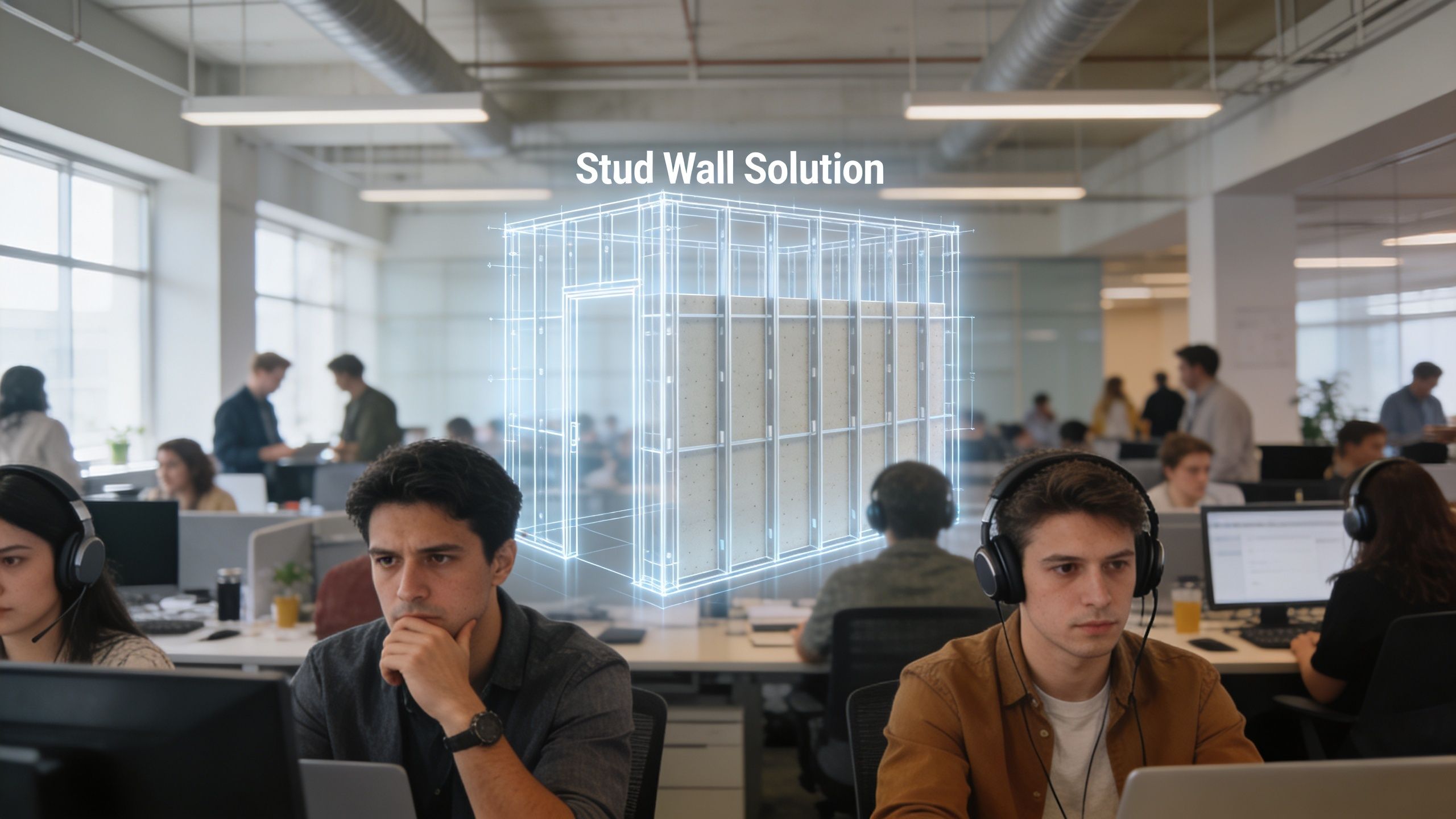
But the workplace brief has changed. The modern office needs spaces that can be deployed quickly, used immediately and adapted later without another round of contractors. That’s why so many workplace teams are now rethinking open-plan office design for 2026.
Practical rule: If the business needs privacy now and flexibility later, a fixed stud wall room should be challenged before it’s approved.
A traditional room still has its place. It can work well where the layout is settled, the use is permanent and the disruption is acceptable. The problem is that most new open-plan offices don’t meet those conditions. They need high performance without turning every change into a small construction project.
That’s where the comparison becomes useful. Not stud walls versus nothing. Stud walls versus a better long-term asset.
Stud Wall Frames Explained The Traditional Approach
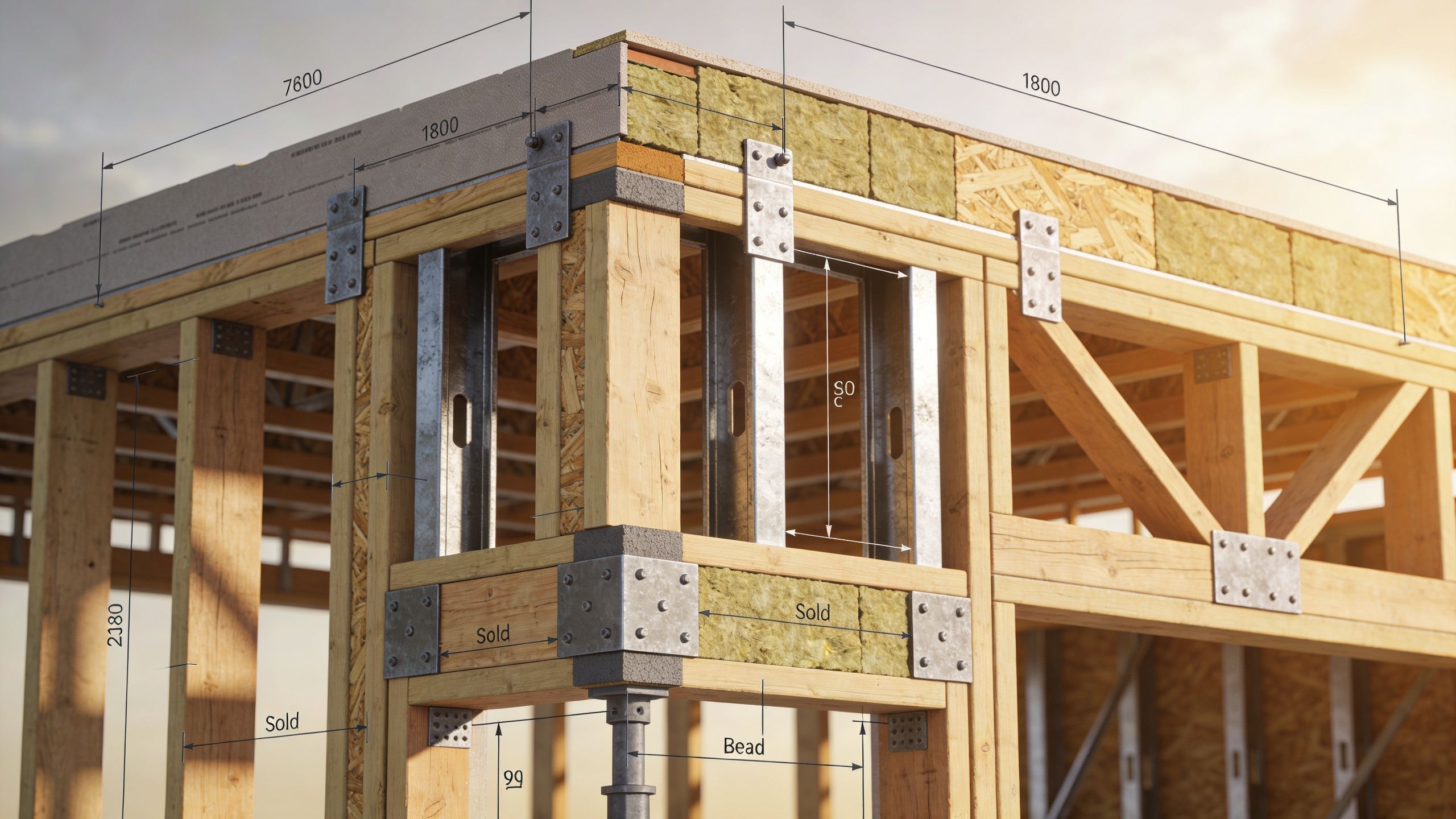
A stud wall frame is the standard skeleton used for non-load bearing internal partitions. In commercial interiors that usually means a framework of timber or light gauge steel, lined with plasterboard and filled with insulation where acoustic or thermal performance matters.
Timber stud wall frames
Timber is familiar to many contractors and straightforward to work with on site. In UK construction for non-load bearing partitions, timber studs are typically 100x50mm sections spaced at 600mm centres for walls up to 2.7m, and that wider spacing allows thicker insulation to improve acoustic and thermal performance, a principle refined further in high-performance pods, as noted by Dimensions.
A basic timber partition build usually follows this sequence:
- Set out the line: Mark floor and ceiling positions accurately.
- Form the frame: Install head and sole plates, then fix studs at centres.
- Allow for services: Reserve cavity space for power and data where needed.
- Line and finish: Add plasterboard, tape joints, decorate and complete skirtings and ironmongery.
Timber can be a sensible choice for smaller internal works. It also gives a decent cavity for insulation and services. The trade-off is that final performance depends heavily on site conditions and workmanship.
Metal stud wall frames
Steel stud partitions are common in commercial environments because they’re clean, predictable and well suited to repeatable layouts. They’re also useful where fire performance, straightness and integration with suspended ceilings matter.
A metal stud wall frame is typically made from galvanised studs and tracks, then lined with plasterboard and packed with insulation as required. It’s a system many specifiers know well because it can accommodate services neatly and supports a wide range of finishes.
This short video gives a useful visual overview of how framed partitions come together on site.
A stud wall frame is not just a wall. It’s a sequence of trades, tolerances, interfaces and finishes that all have to perform together.
Why the method still matters
Facilities teams should understand this traditional approach because it remains part of many fit-out packages. It’s also the baseline against which pods should be judged. Stud walls can create enclosed space. They can also absorb time, coordination and snagging in ways that are rarely obvious at concept stage.
That difference matters. When a workplace needs certainty, the question shifts from how a room is built to how reliably it performs once handed over.
The Hidden Costs of Stud Walls in Modern Workplaces
The headline cost of a partition rarely tells the full story. A stud wall room looks straightforward on a drawing, but on site it becomes a chain of dependencies. Surveying, setting out, framing, plasterboarding, decorating, electrical work, flooring changes, door installation and final snagging all need to line up.
That affects the business as much as the project team. Staff work around dust, noise and restricted access. Managers juggle contractors and programme slips. IT and FM teams get pulled into decisions that should have been solved before the first delivery arrived.
The issue isn’t only build cost
A conventional room built from a stud wall frame can be hard to justify in a fast-moving office because the asset is fixed from day one. If a team grows, relocates or changes the way it works, the room stays where it is. Altering it later means more labour, more downtime and more waste.
That same issue appears in demountable and glazed partition packages too. They can look cleaner, but they still belong to the wider family of fixed interior interventions. When reviewing partition systems such as those offered by Logika, the key FM question is whether permanence is really the right answer for a space that may need to flex.
Acoustic results often depend on workmanship
This is where expectations can drift away from reality. A room may be specified with insulation, layered boards and acoustic intent, yet the final result can still disappoint because site-built performance depends on execution. Weak details around junctions, doors, ceilings and services can undo good intentions very quickly.
A familiar example is the assumption that adding specialist boards solves the whole problem. Materials matter, and 15 mm SoundBloc plasterboard has a clear role in acoustic wall build-ups, but board choice alone doesn’t guarantee a quiet room. The room still has to be assembled properly, sealed properly and coordinated properly.
Site reality: The best partition specification on paper can still become an average room if small installation details are missed.
For Facilities Managers, that creates a frustrating risk. The office accepts weeks of disruption and still ends up with a room that doesn’t feel as private as expected. That’s usually the point where pods enter the conversation, not as a design trend, but as a way to avoid turning privacy into an on-site construction problem.
The Smart Alternative High-Performance Acoustic Pods
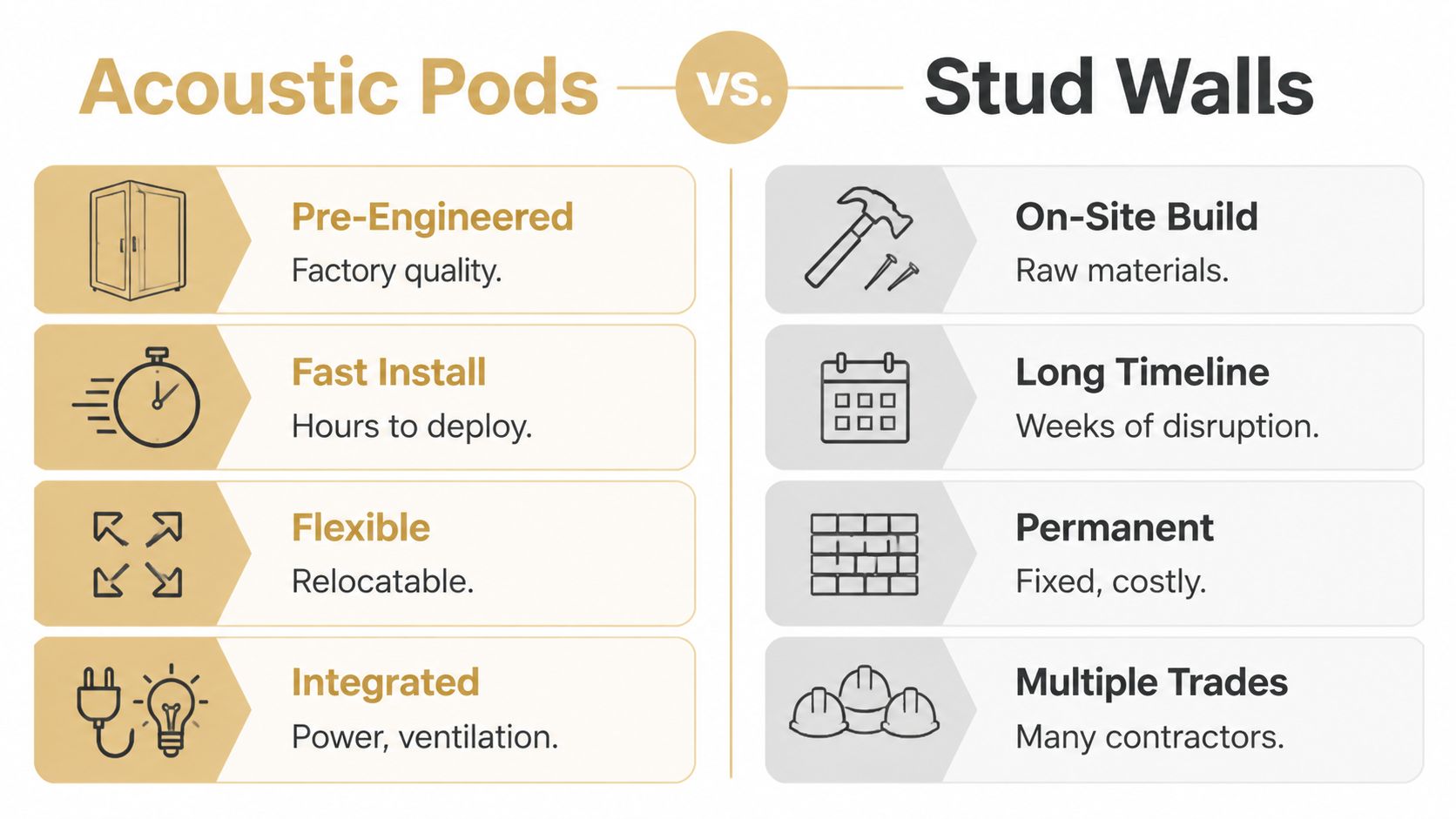
A high-performance pod is best understood as a pre-engineered room product, not a piece of occasional furniture. It solves the same need as a stud wall frame room, but it does so with factory-controlled design, integrated systems and predictable installation.
That distinction matters. One route is a project built from raw components on site. The other is a finished acoustic environment delivered as a complete system.
Product versus project
For most offices, certainty is a primary benefit of pods. A pod arrives with its acoustic build-up, ventilation, lighting and service integration already resolved. That means fewer unknowns during installation and fewer surprises after handover.
A traditional room asks the project team to assemble performance from many moving parts. A pod packages that performance from the outset.
| Comparison point | Acoustic pod | Stud wall room |
|---|---|---|
| Delivery model | Pre-engineered product | On-site build |
| Installation | Fast and contained | Multi-trade sequence |
| Future changes | Relocatable in many cases | Usually fixed |
| Services | Typically integrated | Coordinated separately |
Different pod types suit different workplace tasks
The best specification starts with use case, not style. A one-person call booth has a different job from a team meeting pod. A touchdown privacy booth serves a different purpose from an outdoor meeting space.
The current market gives specifiers strong options:
- BlockO pods work well where a business wants distinctive enclosed spaces with a strong design presence.
- Framery pods are a frequent choice when acoustic consistency, ventilation and refined workplace performance are high priorities.
- Kabin pods suit organisations that need practical privacy spaces for calls, focus and compact meetings.
- Vetrospace pods often appeal to design-led offices that want clean architectural detailing without losing functionality.
- The Meeting Pod Co exterior pods open up additional capacity outside the main office footprint, which can be especially useful when internal space is under pressure.
Why pods fit the modern office better
A pod respects the nature of a live workplace. It doesn’t require the same level of invasive build activity. It doesn’t force every acoustic need into a permanent layout decision. It also gives workplace teams a cleaner way to add privacy without redesigning the office around construction zones.
“The smartest private spaces in an open-plan office are the ones that solve today’s problem without creating tomorrow’s constraint.”
That’s the long-term investment case. A pod can support focus, confidentiality, wellbeing and hybrid work patterns in one move. The business gets a high-performing space. The FM team gets a result that’s easier to deploy and easier to manage.
Key Performance Criteria for Specifying Pods
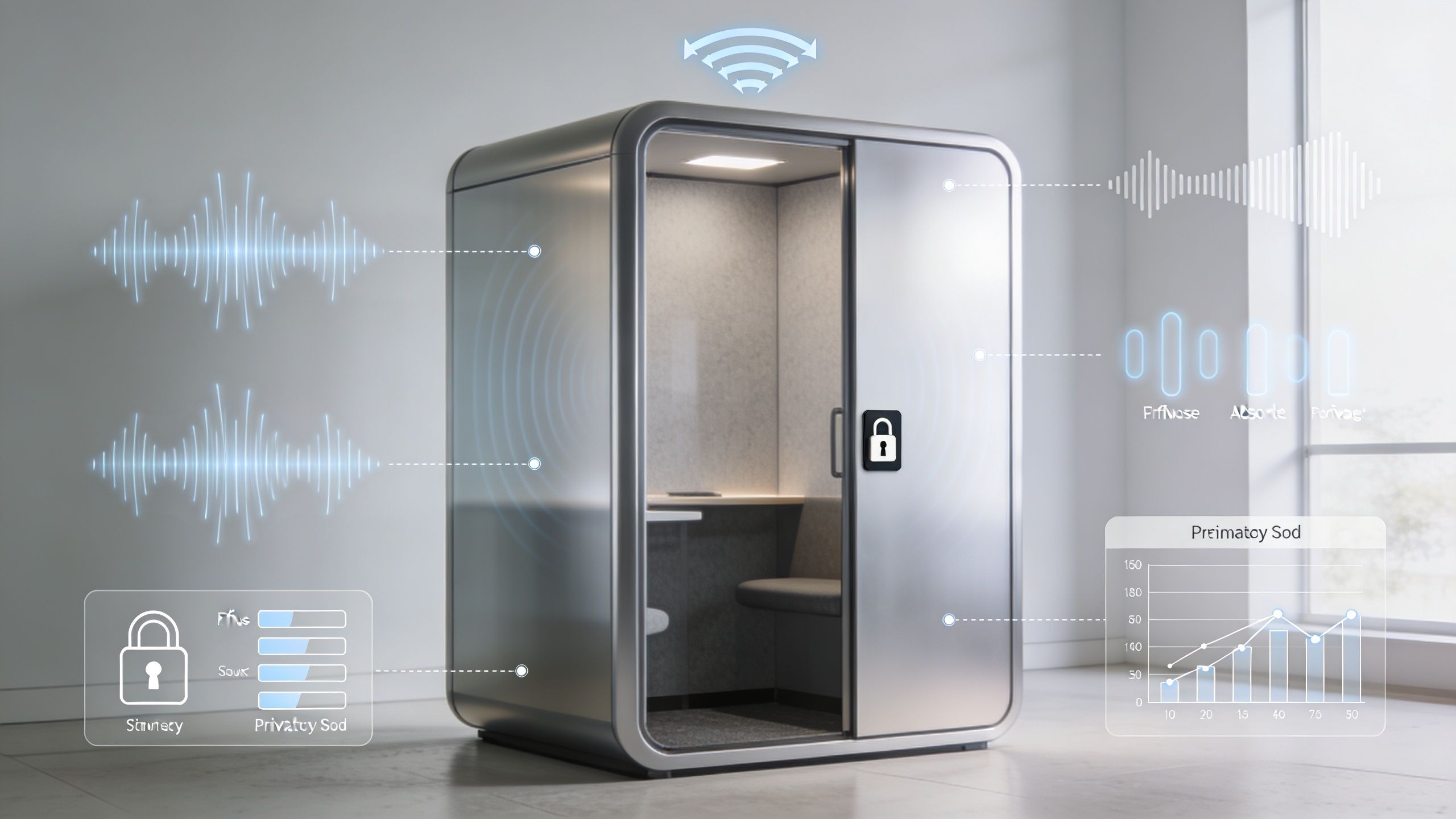
A pod should never be chosen on appearance alone. The proper decision sits on measurable workplace performance. Specifiers and Facilities Managers usually care about four things most. Acoustics, ventilation, compliance and services integration.
Acoustic integrity
Acoustic performance is not just about how much sound stays in or out. It also includes how the space feels once someone is inside it. A pod used for calls needs speech privacy. A meeting pod also needs controlled reverberation so voices remain clear rather than harsh or echoing.
Factory consistency is powerful because audits frequently find that steel stud-to-track gaps in on-site builds exceed 3mm, risking significant acoustic failures. In contrast, premium pods like those from Framery are engineered to eliminate such inconsistencies, ensuring certified acoustic performance is delivered without the risks of site-based workmanship according to research on framing tolerances and acoustic failure points.
That small detail is easy to miss at specification stage. It matters a great deal in use.
Specification check: If acoustic privacy is critical, ask how the product controls junction quality, sealing and repeatability. Don’t assume a room will perform because a drawing looks robust.
For a useful parallel outside office design, the principles behind optimizing home theatre sound show how enclosure, absorption and leakage control all shape the end result. The same thinking applies in workplace pods, even though the use case is different.
Ventilation and user comfort
A pod that sounds good but feels stuffy won’t get used properly. Ventilation should be treated as a core functional requirement, not a nice extra. Occupants need fresh air movement, stable comfort and confidence that the space supports longer use without fatigue.
Good pod design addresses this from the outset. Air movement, lighting and occupancy patterns are considered as a whole. In a site-built room, those elements are often coordinated later and can become compromised by programme pressure or ceiling constraints.
Fire, power and digital readiness
Facilities teams also need practical certainty around safety and operation. The pod has to work with the building, not sit awkwardly inside it. That means checking power access, cable management, lighting strategy and how the product supports the intended environment.
A useful benchmark when thinking about enclosure performance is to review the best materials for sound insulation, then compare how a pod combines those principles with integrated factory assembly. The strength of the pod model is that acoustic design and service readiness are resolved together rather than pieced together during fit-out.
Questions worth asking before approval
- How is acoustic performance verified: Ask for tested results and clarification on the conditions behind them.
- What ventilation is built in: Confirm the pod supports the intended duration and occupancy pattern.
- How are power and data handled: Check whether cabling is concealed, accessible and easy to maintain.
- What happens if the office layout changes: Understand whether the pod can be repositioned or redeployed.
The strongest specifications don’t chase novelty. They remove risk.
Sustainability and Flexibility The Future of Office Space
A fixed partition solves one moment in time. A pod can serve several. That difference sits at the centre of modern workplace strategy because sustainability is no longer just about materials. It’s also about avoiding needless replacement, rework and strip-out.
When an office uses stud wall rooms to solve every privacy need, the fit-out becomes harder to adapt. Teams move. Priorities shift. Leases end. The physical intervention remains, even when the original brief has changed.
Circular thinking changes the brief
Pods support a more circular approach because they can be repositioned within the office and, in many cases, moved again when the organisation relocates. That reduces the waste attached to ripping out enclosed rooms that no longer suit the plan.
For businesses that want even more flexibility, office pod hire is becoming a very practical route. Framery Subscribed gives organisations access to pod solutions without locking every requirement into a permanent capital decision. That’s useful for growing businesses, pilot spaces and organisations managing uncertain headcount.
A workplace asset is more sustainable when the business can keep using it through change rather than replacing it at every change.
ESG goals and operational common sense
This is not only an environmental argument. It’s an operational one. A relocatable pod gives the estate team a reusable asset rather than a sunk fit-out cost tied to one exact layout. That changes how workplace investment is viewed over time.
Businesses looking closely at responsible procurement should also consider the broader principles behind sustainability at Gibbsonn, especially where the circular economy, product lifespan and reduced fit-out waste matter. The right pod strategy can support ESG goals while still improving daily experience for staff.
A modern office needs privacy spaces that can move with the business. Pods do that far better than permanent stud wall rooms.
Build Your Future-Proof Office Today
The traditional stud wall frame still has a role in commercial interiors. It can create rooms. It can support insulation, linings and services. But for most open-plan offices that need speed, certainty, acoustic performance and future flexibility, it isn’t the smartest long-term answer.
Pods solve the same workplace problem with much less friction. They arrive as complete environments rather than site-built approximations. They reduce disruption. They simplify specification. They give businesses an asset that can adapt as workplace needs change.
For Facilities Managers, that’s a significant shift in thinking. Stop asking how to build more enclosed rooms. Start asking which privacy solution will still make sense after the next reorganisation, lease event or headcount change.
The strongest next step is to review the live brief properly. Identify where staff need focus, call privacy, short meetings and enclosed collaboration. Match each use case to a pod type. Then test the solution in person before signing off the investment.
A well-planned pod strategy won’t just fix noise. It will improve how the whole office works.
If the workplace needs quieter, smarter and more flexible private spaces, Gibbsonn can help shape the right solution. Teams can book an appointment and visit the showroom in Bishop's Stortford to compare pod options in person and see what works best for calls, meetings and focused work.