

The office sounds busy long before anyone notices the problem. A video call starts near the tea point. Two people swap updates across a bench desk. Someone takes a sales call on speaker. By midday, concentration has gone from difficult to fragile.
That's where the answer to what is acoustic insulation begins. It isn't just a technical layer hidden in a wall. In workplaces, it's the practical science of controlling how sound behaves so people can think, speak, meet and recover focus without fighting the room all day. In modern offices, the best use of acoustic insulation isn't always another fixed wall. Often, it's the pod.
Table of Contents
- The End of Open Plan Overload
- Insulation vs Soundproofing Unpacked
- Decoding the Numbers Rw NRC and STC
- The Building Blocks of Quiet Materials and Methods
- The Ultimate Solution Modern Acoustic Pods
- Beyond the Pod Sustainability and Flexible Ownership
- Your Blueprint for a Quieter Workspace
The End of Open Plan Overload
Open plan was meant to make work more connected. In many offices, it has done the opposite for focused tasks. Privacy disappears, calls spill into shared areas, and deep work gets pushed into the margins of the day.
That frustration isn't anecdotal. The British Council for Offices 2025 Workplace Wellbeing Report found that 68% of UK office workers report reduced productivity due to noise distractions in open-plan layouts, while only 22% of facilities managers feel confident in current acoustic solutions according to the BCO findings cited here.
Noise doesn't just distract. It fragments work
A noisy office rarely fails all at once. It fails in small, repeated moments.
- Calls become public: Staff lower their voices, repeat themselves, or leave the room to be heard.
- Meetings drift: Teams can gather, but they can't always speak candidly.
- Focus work slows down: Tasks that need concentration take longer because attention keeps resetting.
- Video quality suffers: Echo and background chatter make hybrid meetings harder than they need to be.
For teams battling call quality as well as room noise, this practical AONMeetings guide on stopping mic echo is worth reading because it shows how room acoustics and meeting technology affect each other.
Open offices don't usually need more activity. They need better control over where activity happens.
Acoustic insulation is the science behind calm
In workplace terms, acoustic insulation is what helps absorb, dampen and manage sound energy inside built spaces. It supports clearer speech, less reverberation and better separation between one activity and the next.
That matters because office noise isn't only a design issue. It's an operational one. If a workspace can't support focused calls, one-to-ones, confidential conversations or quiet thinking, the layout is working against the business.
High-performance pods answer that problem neatly. They bring acoustic control exactly where it's needed, without forcing a full rebuild of the office around every new requirement.
Insulation vs Soundproofing Unpacked
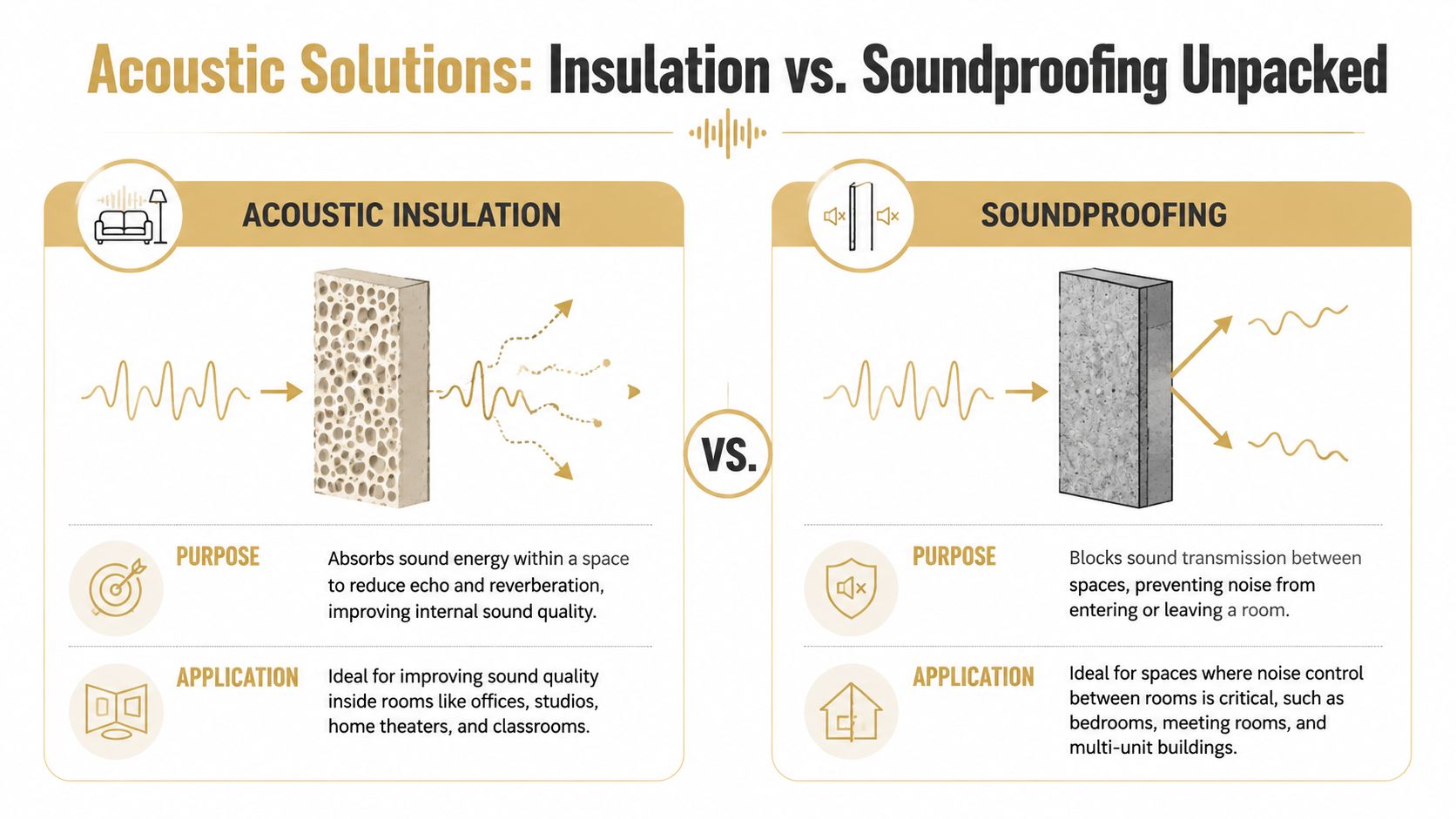
Acoustic insulation and soundproofing are often used as if they mean the same thing. They don't. That confusion leads to poor buying decisions, especially in offices where the goal is often mixed. One team wants less echo. Another wants privacy for calls. Those are related issues, but they aren't solved in exactly the same way.
Acoustic insulation absorbs sound
A simple way to think about acoustic insulation is as a sound sponge. It helps soak up sound energy inside a space or within a wall, floor or ceiling build-up. That reduces echo, softens harsh reflections and improves the quality of the sound environment.
This is why acoustic insulation matters inside office pods. If the internal surfaces and cavities don't manage sound properly, the pod may block some outside noise but still feel unpleasant during calls because the speech inside bounces around.
Soundproofing blocks sound transfer
Soundproofing is closer to a barrier. It aims to stop sound moving from one place to another. That usually depends on mass, airtightness, separation and construction detail.
A good office example is a meeting room wall. If there are gaps around the frame, lightweight materials and a rigid structure that carries vibration, conversation will leak through even if some insulation is present. Blocking sound takes more than one ingredient.
Practical rule: If the room sounds harsh inside, the issue is usually absorption. If people outside can hear too much, the issue is usually transmission.
Why offices need both
The best workplaces combine the two approaches. They absorb sound where reflection is the problem and block sound where privacy is the issue.
That's also why some quick fixes disappoint. Decorative felt panels may improve the feel of a room, but they won't create real speech privacy on their own. Equally, a dense enclosure without internal absorption can sound boxy and uncomfortable.
For most flexible offices, the strongest solution is layered:
- Absorb inside the space to reduce reverberation
- Seal edges and joints to stop weak points
- Use mass and structure wisely to reduce transmission
- Place enclosed pods strategically so noisy and quiet activities can coexist
When these principles are packaged into a purpose-built pod, the result is usually far more reliable than trying to patch an open plan layout with scattered surface treatments alone.
Decoding the Numbers Rw NRC and STC
Acoustic specifications can look technical, but they become useful once they're translated into workplace outcomes. For a facilities manager or specifier, the key question isn't what the letters stand for. It's what people will hear, or stop hearing, once the solution is installed.
What the ratings mean in daily office use
Rw is about how well an element reduces sound transmission. In pod terms, it helps indicate how much conversation is contained. A stronger Rw result usually means better privacy for calls and fewer distractions outside the pod.
NRC is about absorption. It tells you how much sound energy a material absorbs rather than reflecting back into the room. Inside a pod or meeting space, this affects how echoey or controlled the space feels.
STC is another sound isolation measure used widely in product discussions and specifications. In practice, buyers often see it used as a shorthand for how well a wall or enclosure blocks airborne sound.
Acoustic Ratings Explained
| Metric | What It Measures | Primary Use | Good Office Rating |
|---|---|---|---|
| Rw | Sound reduction through an element or enclosure | Privacy between spaces or across pod walls | Higher ratings are generally better for confidential work |
| NRC | How much sound a material absorbs | Reducing echo and reverberation inside a room or pod | Higher absorption is better for clear calls and comfort |
| STC | Airborne sound isolation in an assembly | Comparing wall and enclosure sound blocking performance | Higher ratings generally indicate stronger speech privacy |
The important point is that these metrics do different jobs. A product can have good absorption and still offer limited privacy if the enclosure leaks. It can also block sound reasonably well while sounding poor inside if the internal finishes don't absorb reflections.
Numbers only matter when they match the problem
A phone booth for quick calls needs a different balance from a multi-person meeting pod. A hush room in a coworking space has different demands from a pod beside a busy circulation route.
That's why buyers should read ratings alongside design details such as sealing, glazing, ventilation paths and installation quality. Even ceiling strategies around the pod matter in open offices, which is why broader treatments like sound insulation ceiling tiles can support the overall acoustic picture.
A strong spec isn't one impressive number. It's the right mix of blocking, absorption and installation detail for the way the space is actually used.
The Building Blocks of Quiet Materials and Methods
Good acoustic performance starts with material choice, but it doesn't end there. Quiet spaces come from the combination of what the pod or partition is made from and how the whole assembly is put together.

Why mineral wool keeps appearing in serious acoustic builds
One of the most common high-performance materials is high-density mineral wool. A key specification is 40 kg/m³ density, and 75 mm layers in double-skin pod walls can increase the sound reduction index by 12 to 15 dB for mid-frequencies, enabling focus work in 70 dB ambient noise environments according to the ROCKWOOL technical data sheet.
That works because fibrous acoustic materials disrupt sound energy as it passes through them. They don't solely “block” noise in isolation. They slow it, disperse it and reduce reflection in the cavity.
What works and what often disappoints
In practical office terms, some materials are regularly overestimated.
- Standard thermal insulation: Useful for heat, but it often underperforms acoustically compared with dedicated acoustic batts.
- Thin decorative panels: Helpful for taming surface echo, but limited when privacy is the goal.
- Poorly sealed assemblies: Even strong materials lose impact if edges, service penetrations or joints are left weak.
- Heavy construction without absorption: Dense surfaces can block some sound but create unpleasant reflections if there's no internal acoustic control.
For teams comparing products in more detail, this guide to the best materials for sound insulation helps frame what each material does well.
Construction methods matter as much as the material
A pod performs well because it uses layers and separation intelligently. Air gaps help. Double skins help. Decoupled elements help. Seals around doors, glass and panel joints are critical.
That same logic applies to larger zoning strategies in open offices. Where pods aren't the only intervention, well-designed acoustic partitions from Logika can help create quieter neighbourhoods and visual separation without turning the office into a maze of permanent walls.
Materials don't create privacy on their own. Assemblies do.
The strongest results usually come from matching the material to the frequency range that matters most in offices, especially human speech, and then protecting that performance with good detailing. That's why premium pod engineering tends to outperform improvised retrofits built from generic office fit-out products.
The Ultimate Solution Modern Acoustic Pods
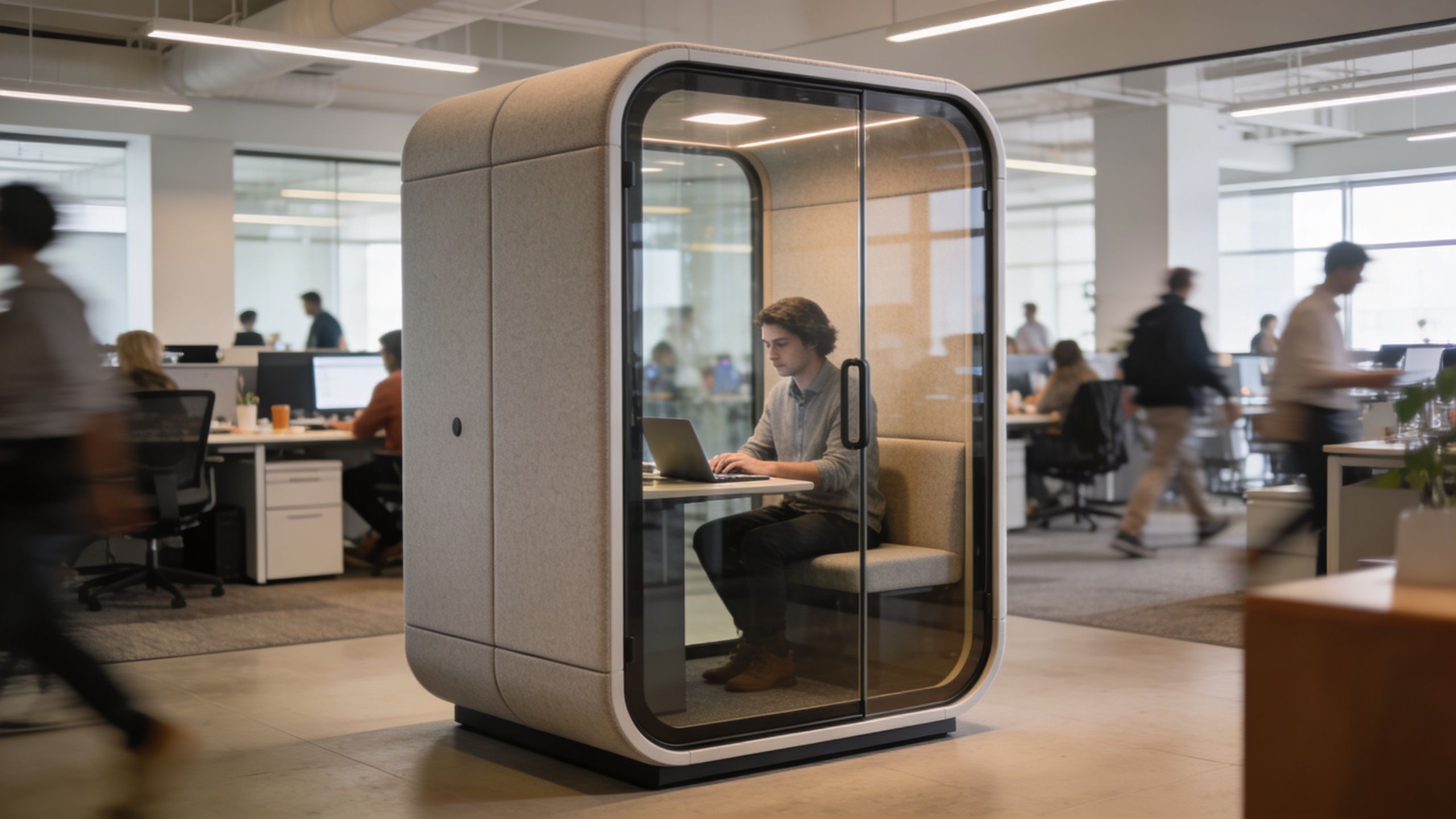
Acoustic pods solve a problem that traditional construction handles badly in flexible offices. They create a place for calls, meetings, focus work and private conversations exactly where it's needed, without forcing a landlord-level alteration every time the workplace changes.
Why pods fit modern workplaces better than fixed rooms
A good pod combines sound insulation, soundproofing principles, ventilation, lighting, power and clean interior acoustics in one modular product. That's a big shift from trying to patch open plan noise with ad hoc screens and room booking workarounds.
The business case is strong as well. Noise-related absenteeism costs UK businesses £1.2bn annually, and acoustic pods deliver 25 to 35% productivity gains, with BlockO and Kabin installations achieving Rw 42 to 52 dB reduction at 20 to 30% lower lifecycle cost than full-room retrofits according to this workplace acoustics summary.
Different pod types solve different noise problems
Not every office needs the same acoustic response.
- Phone booths suit short calls and video meetings where speech privacy matters.
- Single-person focus pods support concentrated work when bench desking is too exposed.
- Meeting pods create enclosed collaboration zones without permanent construction.
- External pods extend capacity beyond the main floorplate and can support overflow meetings, visitor functions or campus-style environments.
Product range matters. Options such as BlockO pods, Framery pods, Kabin pods, Vetrospace pods and The Meeting Pod Co external pods allow organisations to match the pod to the use case instead of forcing one format everywhere.
For broader zoning around these spaces, soundproof office partitions can support the overall layout where a combination of enclosed and semi-open areas is needed.
A closer look at pod design helps show why they've become such a practical workplace tool:
What pods do better than makeshift fixes
A freestanding booth isn't just a box in the office when it's specified properly. It's a controlled acoustic system. That means:
- Predictable privacy: Better containment of speech than open-backed call corners or soft seating booths
- Speed of deployment: Minimal disruption compared with constructing new enclosed rooms
- Flexibility: Pods can move with the workplace as teams grow or layouts change
- Better user behaviour: People use enclosed spaces for calls when those spaces are close, available and comfortable
That last point matters more than many specifications acknowledge. Acoustic strategy only works when people use the quiet space provided. High-performance pods remove friction. That's why they've become the most effective modern application of acoustic insulation in agile offices.
Beyond the Pod Sustainability and Flexible Ownership
A workplace solution has to perform acoustically, but that's no longer enough on its own. Buyers also want a sensible lifecycle, lower waste and procurement options that don't trap the business in rigid decisions.
Better acoustics can support better environmental choices
High-quality pods align well with a circular approach because they are modular, repairable and easier to relocate than fixed construction. When a business moves floor, reshapes teams or refits a site, a pod can often move with it. A plasterboard room usually can't.
That thinking sits comfortably with current regulation and retrofit pressure. National retrofit programmes and building regulations such as Approved Document E are driving the use of high-performance insulation, and modern pods are designed to meet or exceed these standards for acoustic and thermal efficiency while supporting sustainability goals, as noted in this UK acoustic insulation market overview.
Flexible ownership now matters as much as flexible layout
A growing number of organisations want performance without committing too early to a permanent fit-out decision. That's one reason subscription and rental models are gaining traction.
Instead of buying every pod outright, some teams prefer a more agile route through Framery Subscribed pod rental. It suits businesses that are scaling, testing attendance patterns or managing capital carefully.
There's also a wider sustainability story around specifying products that remain useful for longer and stay in circulation. That's why circular thinking belongs in the acoustic conversation, not on a separate page. It affects what gets bought, how long it stays valuable and whether today's solution becomes tomorrow's waste.
The best acoustic investment isn't always the most permanent one
That can feel counterintuitive in commercial interiors, where permanence is often mistaken for quality. In reality, a relocatable pod with strong acoustic performance may be the more responsible choice if the workplace is likely to evolve.
For organisations weighing performance and values together, Gibbsonn's sustainability approach shows how circular economy thinking can sit alongside workplace flexibility and long-term acoustic planning.
Quiet space is valuable. Quiet space that can adapt, move and stay in use is even more valuable.
Your Blueprint for a Quieter Workspace
The best acoustic strategy starts with a simple question. What kind of work is being forced into the wrong setting?
If calls are spilling into open areas, staff need enclosed call space close to their desks. If meeting rooms are overbooked, teams need more small enclosed rooms without the cost and delay of construction. If the office feels loud everywhere, the answer is usually a combination of zoning, absorption and properly specified pods rather than another generic fit-out layer.
A practical way to assess the space
- Map the noise hotspots: Reception, circulation routes, breakout areas and bench desks create different sound patterns.
- Separate tasks by acoustic need: Focus work, private calls and group discussion shouldn't all compete in the same sound environment.
- Check the details: In higher-demand settings such as airports and healthcare, airtight installation can reduce flanking transmission by 15 dB, which is critical for sustained performance according to the 3M technical data referenced here.
- Look beyond walls: Ventilation noise and comfort issues can undermine a quiet room, so even practical fit-out choices matter. For example, quiet airflow solutions such as these ceiling fans for every room can help reduce reliance on noisier comfort measures in some spaces.
What good looks like
A quieter workspace doesn't need to feel closed off. It should feel intentional. Staff should know where to go for a call, where to work in peace, and where conversation is welcome.
That's why acoustic pods have become the clearest modern answer to what is acoustic insulation in practice. They take the science of sound control and turn it into something flexible, usable and visible in everyday working life.
For organisations ready to create a calmer, more productive workplace, Gibbsonn can help identify the right pod, booth and acoustic layout for the space. Book an appointment, visit the showroom in Bishop's Stortford and experience the options in person.