
A facilities manager usually notices the problem before anyone writes it into a brief. A sales call spills into the desk bank behind it. Two project teams start talking at once. Someone walks to the corridor just to find a private spot for a sensitive conversation. The office still looks smart, but it doesn't support the work happening inside it.
That's where acoustic office solutions stop being a finishing touch and become an operational decision. Panels, baffles and partitions all have a role, but when a team needs real privacy, reliable focus space and a flexible layout, office pods are often the clearest answer. They create rooms inside the room without a major build, and they give people somewhere to work properly.
Table of Contents
- Is Your Open-Plan Office Killing Concentration?
- Why Noise and Acoustics Matter for Your Business
- A Guide to Modern Acoustic Solutions
- Deep Dive The Ultimate Guide to Office Pods
- Decoding Acoustic Performance Metrics
- How to Plan and Procure Your Office Pods
- Create Your Quiet Revolution Today
Is Your Open-Plan Office Killing Concentration?
The pattern is familiar. The office was designed to feel open, social and efficient. In practice, it often means one person's necessary call becomes everyone else's interruption. Confidential conversations drift across desks. Staff who need deep focus start hunting for corners, empty meeting rooms or a quieter day at home.
That's usually the moment pods move from nice idea to serious workplace option. A well-specified pod gives people a place to take calls, join video meetings, work through detail-heavy tasks or have private conversations without disturbing the wider floor. It isn't just another product on the furniture schedule. It's a tool for fixing a layout problem.
What the disruption looks like day to day
A noisy office rarely fails all at once. It fails in small ways that add up.
- Calls become public: Staff lower their voices, but everyone nearby still hears enough to lose focus.
- Meeting rooms get misused: A four-person room gets booked for one person who needs quiet.
- Hybrid work gets harder: Video calls demand speech privacy and background noise control that open desks rarely provide.
For many teams, the issue isn't whether the office has enough seats. It's whether it has the right mix of settings.
“Open-plan space works best when it includes enclosed settings for the work that shouldn’t happen in the open.”
A broader rethink often starts with the floorplate itself. The strongest schemes usually combine zoning, circulation planning and enclosed quiet settings rather than relying on etiquette alone. Such approaches make rethinking open-plan office design useful, because acoustics are tied directly to layout decisions.
Why pods change the conversation
Panels can soften a space. Behavioural rules can help a little. Headphones can mask the symptoms. Pods do something more practical. They contain the activity causing the disruption and give the wider office room to breathe.
That makes them one of the most effective acoustic office solutions for organisations that want collaboration without constant interruption.
Why Noise and Acoustics Matter for Your Business
Noise is often discussed as an annoyance. In workplace performance terms, that's too soft a description. It affects concentration, privacy, stress levels and whether staff feel the office helps or hinders their work.
Research cited by Flokk on office acoustics states that noisy open offices can reduce productivity by as much as 66 percent, and the Leesman Index describes noise levels as "statistically the strongest" predictor of poor workplace performance.
The business case is wider than noise complaints
When staff say an office is noisy, they're usually describing several operational problems at once. They may mean they can't focus, can't hold a private conversation, can't hear clearly on calls, or can't recover from constant low-level interruption. That affects output and it also shapes how people feel about being in the office.
The same Flokk workplace acoustics article notes that between 25% and 30% of employees are dissatisfied with workplace acoustics, and 70% of those in open-plan spaces report acoustic concerns. It also states that poor acoustics are linked with decreased concentration, increased stress, fatigue, headaches and increased blood pressure.
“An employee who is dissatisfied with noise levels is almost certainly going to be an employee who is not able to report that their workplace enables them to work productively”
That line matters because it shifts acoustics out of the maintenance bucket and into workplace strategy.
Where facilities managers usually feel the pressure
The pressure usually shows up in three places first:
| Pressure point | What happens in practice |
|---|---|
| Focus work | Staff leave the main floor to complete concentrated tasks |
| Confidentiality | Sensitive calls and HR conversations have nowhere suitable to go |
| Space efficiency | Large meeting rooms get occupied by solo users seeking quiet |
There's also an overlap with other parts of workplace risk management. Teams reviewing office layouts often consider visitor control, room access and adjacent secure areas at the same time. For organisations balancing open space with protected zones, this guide to enterprise security systems is a useful companion read because acoustic privacy and physical security often need to work together.
Acoustic office solutions aren't about making an office silent. They're about making it usable.
A Guide to Modern Acoustic Solutions
Not every acoustic problem needs a pod. That's the first practical point to get right. Some offices suffer mainly from echo and hard-surface reverberation. Others have a privacy problem. Others have both.
The global office acoustic panels market projection reflects how seriously organisations are taking this issue. It was valued at USD 1.5 billion in 2024 and is projected to reach USD 2.8 billion by 2032, with a CAGR of 8.1%. That growth is tied to the need to regulate sound and improve productivity in open-plan offices.
What each solution actually does
Different acoustic office solutions solve different parts of the problem.
- Wall panels and ceiling treatments: These absorb reflected sound and reduce the sense of harshness in a space.
- Screens and partitions: These interrupt sight lines and can help with local separation, especially when paired with smart zoning. For partitioned settings, Logika partitions are relevant where teams need more structured division within a workplace.
- Baffles and suspended elements: These help when noise is building up in larger open areas with reflective surfaces overhead. Ceiling treatment often matters more than teams expect, especially in exposed-soffit schemes. This guide to ceiling sound baffles shows where overhead absorption fits.
Where pods outperform partial fixes
The trade-off is simple. Panels and baffles improve the background condition of a space. They don't create a private room. A phone call still happens in the open. A sensitive conversation can still be overheard. A video meeting still leaks into the desk area.
That's why pods sit in a different category. They don't just reduce noise. They create a contained setting for a specific task.
Practical rule: Use panels and baffles to improve the floor. Use pods when the task needs enclosure, privacy or dependable focus.
Facilities managers usually get the best result when they stop treating every acoustic intervention as interchangeable. If the problem is reverberation, absorb it. If the problem is speech privacy, contain it.
Deep Dive The Ultimate Guide to Office Pods
Pods work well because they match real workplace behaviours. People need a place for solo calls, focused individual work, small group sessions and confidential meetings. A single meeting room type can't do all of that efficiently.
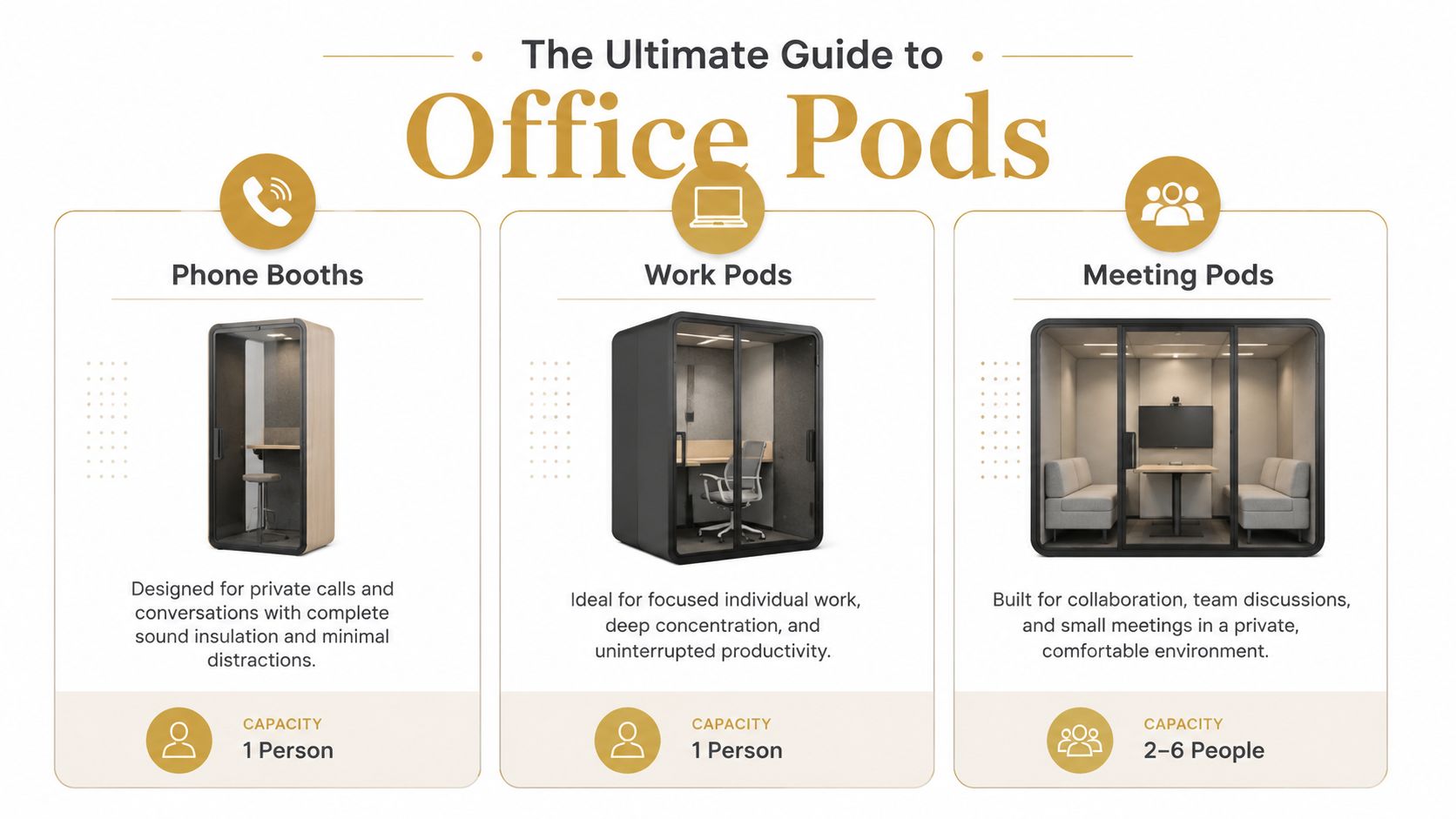
Phone booths for private calls
These are the fastest way to remove call noise from the open floor. They suit sales teams, managers, recruiters and anyone on frequent video calls. A good phone booth should feel easy to enter and use, not like a backup cupboard with a laptop shelf.
For this use case, the choice usually comes down to footprint, ventilation, lighting and the quality of speech privacy. Framery pods are widely specified for call and video settings where a refined user experience matters. Kabin pods are also relevant where a cleaner design language is part of the brief.
Work pods for focused tasks
A work pod gives one person a place to concentrate without booking a larger room. This is useful in hybrid offices where desk areas are active and not every task suits communal work benches.
These pods often support:
- Detailed project work
- Quiet admin
- Video meetings
- Short bursts of deep focus between collaborative sessions
The key trade-off is duration. If staff will use the pod for quick tasks, a compact booth can work. If they need longer spells of concentration, internal comfort becomes more important. That includes airflow, posture support and how enclosed the space feels over time.
Meeting pods for small teams
Small enclosed pods solve one of the most common layout inefficiencies in modern offices. They stop four-person conversations from taking over open collaboration zones, and they stop one-to-one meetings from consuming larger boardrooms.
BlockO pods suit schemes where configuration flexibility matters. Vetrospace pods fit projects where acoustic performance and user comfort are central selection criteria.
"The right meeting pod doesn't replace every meeting room. It protects the larger rooms by taking the pressure off them."
External pods for sites beyond the main floorplate
Some projects need quiet space outside the core office footprint. That might mean a breakout terrace, hospitality setting, airport environment or a campus-style workplace where teams need enclosed space in separate zones. In those cases, The Meeting Pod Co external pods open up options that a standard internal fit-out won't cover.
How to match pod type to actual demand
A simple way to assess need is to track what people are currently doing in the wrong place.
- Private calls at desks usually point to phone booths.
- Solo laptop work in large meeting rooms usually points to work pods.
- Informal team discussions in circulation areas usually point to meeting pods.
This is also where one factual mention matters. Gibbsonn supplies interior and exterior pod ranges including Framery, BlockO, Kabin, Vetrospace and The Meeting Pod Co, alongside planning, installation and aftercare. For a facilities manager, that matters less as a brand statement and more as a project reality. Pod selection, layout, delivery and maintenance need to be joined up.
Decoding Acoustic Performance Metrics
Most pod conversations eventually hit two terms. STC and NRC. They sound technical, but the practical questions behind them are simple. Will speech escape? Will the space sound echoey? Will people inside hear the office outside?
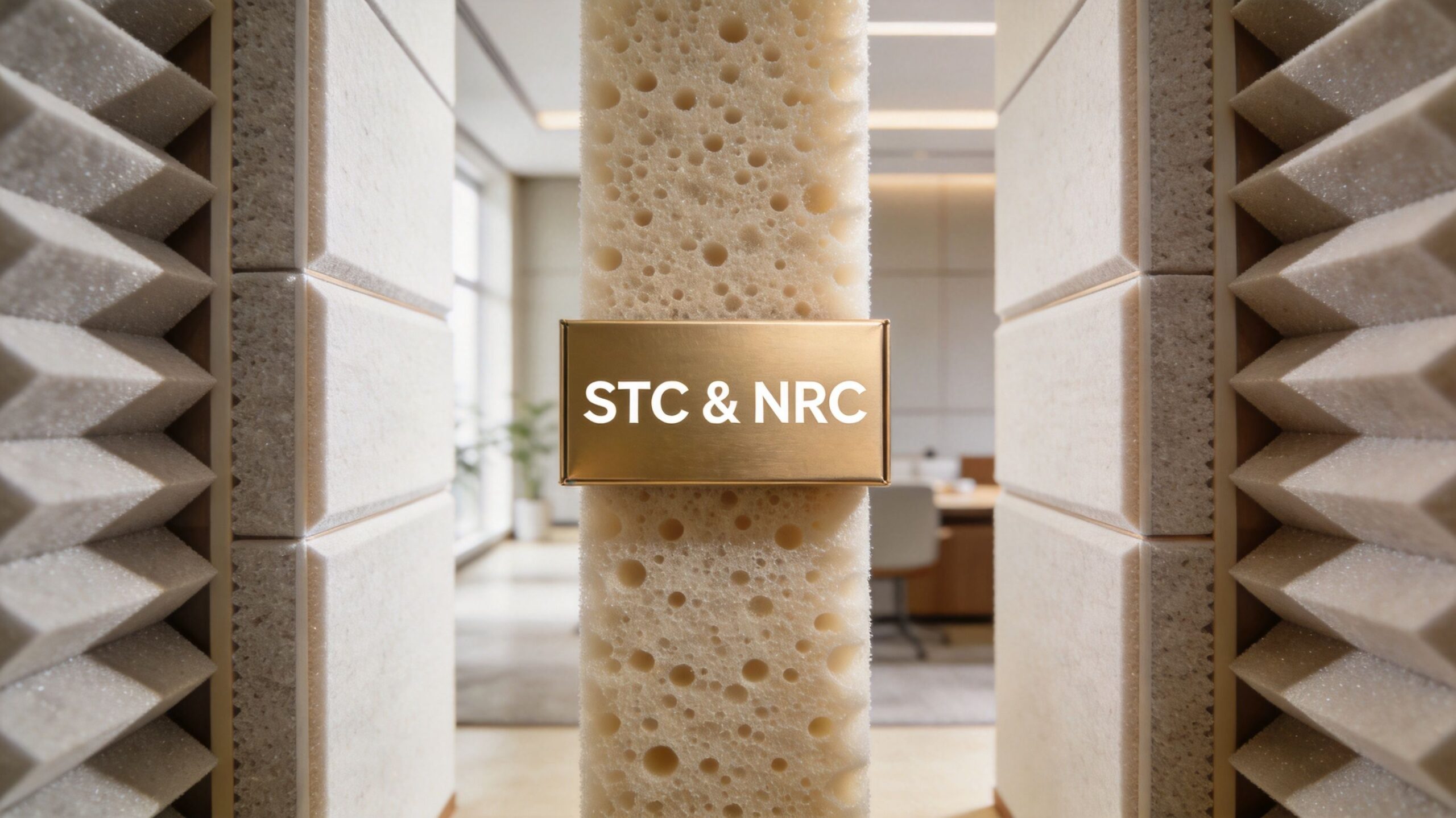
The BCO Guide 2022 and acoustic guidance referenced in MarinoWARE recommend NRC ≥0.75 for ceiling tiles and STC ≥45 for partitions to comply with workplace wellbeing standards. The same guidance notes these levels are important because they can halve reverberation time and reduce speech transmission, which affects 62% of UK office workers.
What STC means in practice
Sound Transmission Class, or STC, is about how well a construction element blocks airborne sound. In plain terms, it helps answer whether conversations will travel through the wall or pod shell.
For a facilities manager, STC matters most when privacy is part of the brief. If a pod is intended for HR meetings, commercial calls or sensitive video discussions, this rating shouldn't be treated as a side note.
What to ask suppliers: What will someone outside the pod actually hear during normal speech, not just what rating appears on the data sheet?
What NRC tells you
Noise Reduction Coefficient, or NRC, relates to absorption. It doesn't mean a product blocks sound from passing through it. It means the material absorbs sound energy rather than reflecting it back into the space.
That's why NRC often matters for the surrounding office as much as the pod itself. A loud, reflective floorplate can still feel disruptive even if several enclosed booths are installed. This explainer on the best materials for sound insulation is helpful when balancing blocking performance with absorption.
A practical reading of the numbers
Use the metrics this way:
| Metric | Main question | Why it matters |
|---|---|---|
| STC | Will speech pass through? | Important for privacy and confidential use |
| NRC | Will sound bounce around? | Important for echo control and comfort |
A good acoustic strategy usually needs both. High-performing pods solve the enclosed-room problem. Absorptive finishes around them stop the wider office from staying noisy and fatiguing.
How to Plan and Procure Your Office Pods
Pod projects usually succeed or fail before the order is placed. The product matters, but so do circulation, power, ventilation, booking behaviour and the simple question of whether the pod is solving a proven need.
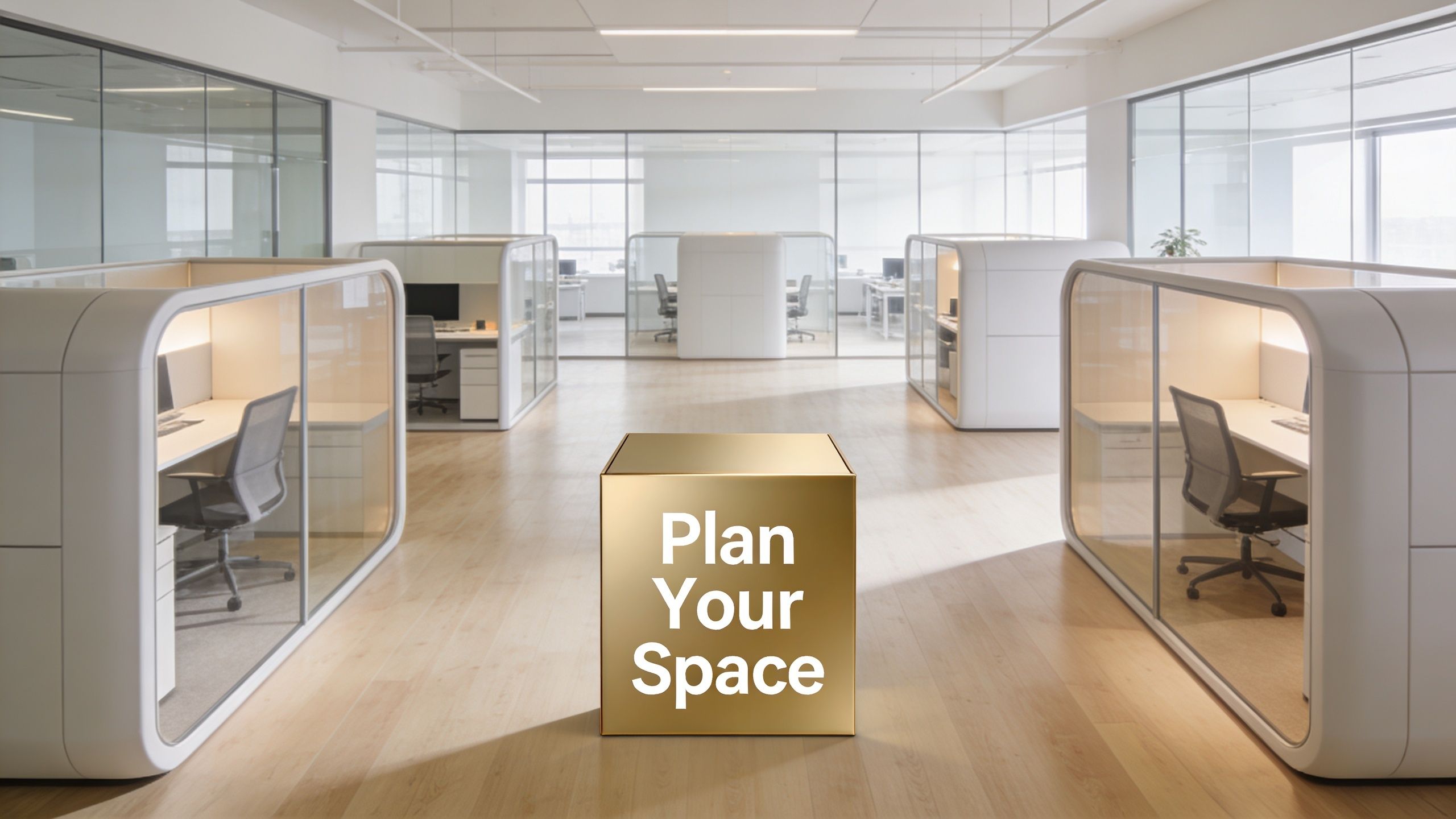
A useful starting point is to map where noise-related friction already happens. Look for repeated signs. Calls at desks. Small meetings in walkways. One-person meeting room bookings. Staff moving around the office to find privacy. Those behaviours usually tell the truth more clearly than a generic wish list.
Start with use patterns, not brochure categories
Pods should be planned around task demand.
- High call volume teams need easy-access phone booths near their working zone.
- Managers and recruiters often need enclosed settings for sensitive conversations.
- Project teams may need small meeting pods that can be used without formal booking friction.
The placement matters as much as the pod type. A quiet booth dropped into the busiest circulation route will underperform, even if the product itself is strong.
Check the practical details early
Facilities teams should review:
- Power and data: how the pod connects and whether floor or wall feeds are needed
- Ventilation: whether the unit is comfortable during repeated use
- Access and delivery: whether the route into the building is workable
- Compliance and layout fit: whether the wider office strategy aligns with standards such as ISO 22955 for open-plan acoustic quality
A product demo helps, but operational planning matters more. A pod scheme becomes a workplace project rather than a furniture purchase during this stage.
A short video can help teams visualise how pods fit into a real office environment:
Buying versus renting
For many organisations, the old barrier was upfront capital cost. That's shifting. According to the Acoustical Surfaces article on open office treatments, a 2024 CIPD survey found that office pods can deliver a 25-30% increase in focus time, with a potential payback period of 12-18 months. The same source says flexible rental models such as Framery Subscribed, starting from around £500 per month, can remove much of the initial capex pressure.
That changes the procurement conversation. Instead of asking whether the business can justify a permanent purchase immediately, teams can ask whether a rental model gives them enough flexibility to solve the problem now and review later. For organisations exploring that route, Framery Subscribed pod rental is directly relevant.
Why sustainability belongs in the procurement brief
Pods also fit well with a circular economy mindset because they are modular, movable and less tied to one fixed fit-out cycle than built construction. That matters for occupiers managing churn, lease events or changing team structures. A workplace strategy that values reuse and adaptability should treat pods as part of a broader environmental decision, not just an acoustic one. This is reflected in Gibbsonn's sustainability approach, where circular thinking forms part of the wider workplace model.
Create Your Quiet Revolution Today
The office doesn't need to become silent. It needs to become usable for the full range of work people do. That means a place for private calls, concentrated tasks, quick team discussions and sensitive conversations, without every one of those activities spilling into the wider floor.
That's why pods deserve serious attention in any acoustic office solutions strategy. Panels, ceilings and partitions improve the background condition of the workplace. Pods create the enclosed settings that open-plan layouts often lack. For many organisations, that's the difference between an office that looks collaborative and one that supports collaboration, privacy and focus at the same time.
The most effective next step is simple. Review where the office is failing today, match those pain points to the right pod type, and test procurement options that fit the budget and the lifecycle of the space. Seeing the products in person usually speeds up better decisions because teams can judge comfort, size, finish and acoustic feel properly.
Booking an appointment and visiting the showroom in Bishop's Stortford gives facilities managers, designers and workplace leaders the chance to compare options directly and plan with more confidence.
If the workplace needs better privacy, stronger focus space and a more practical open-plan layout, speak with Gibbsonn and book a showroom appointment in Bishop's Stortford to see the pod ranges first hand. The next step is straightforward.