

The client call starts on time. The agenda is tight. The team is prepared. Then the drilling starts.
That's the reality for a lot of facilities managers. Construction noise doesn't just irritate people. It wrecks concentration, breaks confidential conversations, and turns ordinary meetings into a struggle. In an open-plan office, one burst of impact noise can throw off an entire floor.
Complaining rarely fixes it. Waiting it out is worse. The practical answer is to reduce what can be controlled at the site, then protect the workplace so critical work can continue. That's how to reduce construction noise in a way that supports business continuity.
Table of Contents
- When the Drill Becomes Your Loudest Colleague
- Your First Line of Defence Assessing and Mitigating at the Source
- Shifting Focus From the Site to Your Workspace
- Acoustic Pods The Ultimate Tool for Business Continuity
- Smart Procurement Pods for a Flexible and Sustainable Future
- Take Control of Your Acoustic Environment Today
When the Drill Becomes Your Loudest Colleague
A facilities manager usually knows the signs. Staff start moving around with laptops looking for a quieter corner. Video calls get abandoned halfway through. Meeting rooms fill up, not because teams need collaboration space, but because they're hiding from the noise outside.
The problem isn't just loudness. It's disruption. Construction noise arrives without warning, cuts across speech, and makes people repeat themselves. That hits productivity first, then morale, then confidence in the workplace itself. For teams handling sensitive calls, HR conversations, finance reviews, or client work, it also creates a confidentiality risk.
This isn't a fringe issue. Construction is one of the noisiest working environments around. The CDC construction noise surveillance page reports that about 37% of construction workers were exposed to hazardous noise in the last year. That matters for nearby offices because the same activities creating hazardous exposure on site can easily disturb occupied buildings next door.
Reality check: if the site is active and the building is occupied, noise control has to be treated as a workplace continuity issue, not a minor annoyance.
That changes the response. A reactive approach usually looks like ad hoc complaints, temporary room swaps, and frustrated teams. A strategic approach looks very different:
- Protect key work first by identifying which activities can't tolerate interruption.
- Reduce exposure at the source where possible through site coordination.
- Create dependable quiet spaces inside the workplace for calls, focused work, and private conversations.
- Plan for disruption instead of hoping the noisy phase ends quickly.
Facilities teams that get ahead of this don't aim for perfect silence. They aim for operational resilience. That's the right standard. A workplace doesn't need to be acoustically perfect to function well, but it does need dependable places where people can still think, meet, and speak clearly.
Your First Line of Defence Assessing and Mitigating at the Source
The first move is simple. Find out exactly what's making the noise, when it happens, and whether the source can be managed before it reaches the office.
UK noise control has a clear legal backbone. The Control of Noise at Work Regulations guidance states that employers must take action when daily or weekly noise exposure reaches 80 dB(A), must provide hearing protection and hearing checks at 85 dB(A), and the legal exposure limit is 87 dB(A) after accounting for hearing protection. The same guidance also notes that a 3 dB reduction halves sound energy. That's why small reductions at source matter.
Start with facts not frustration
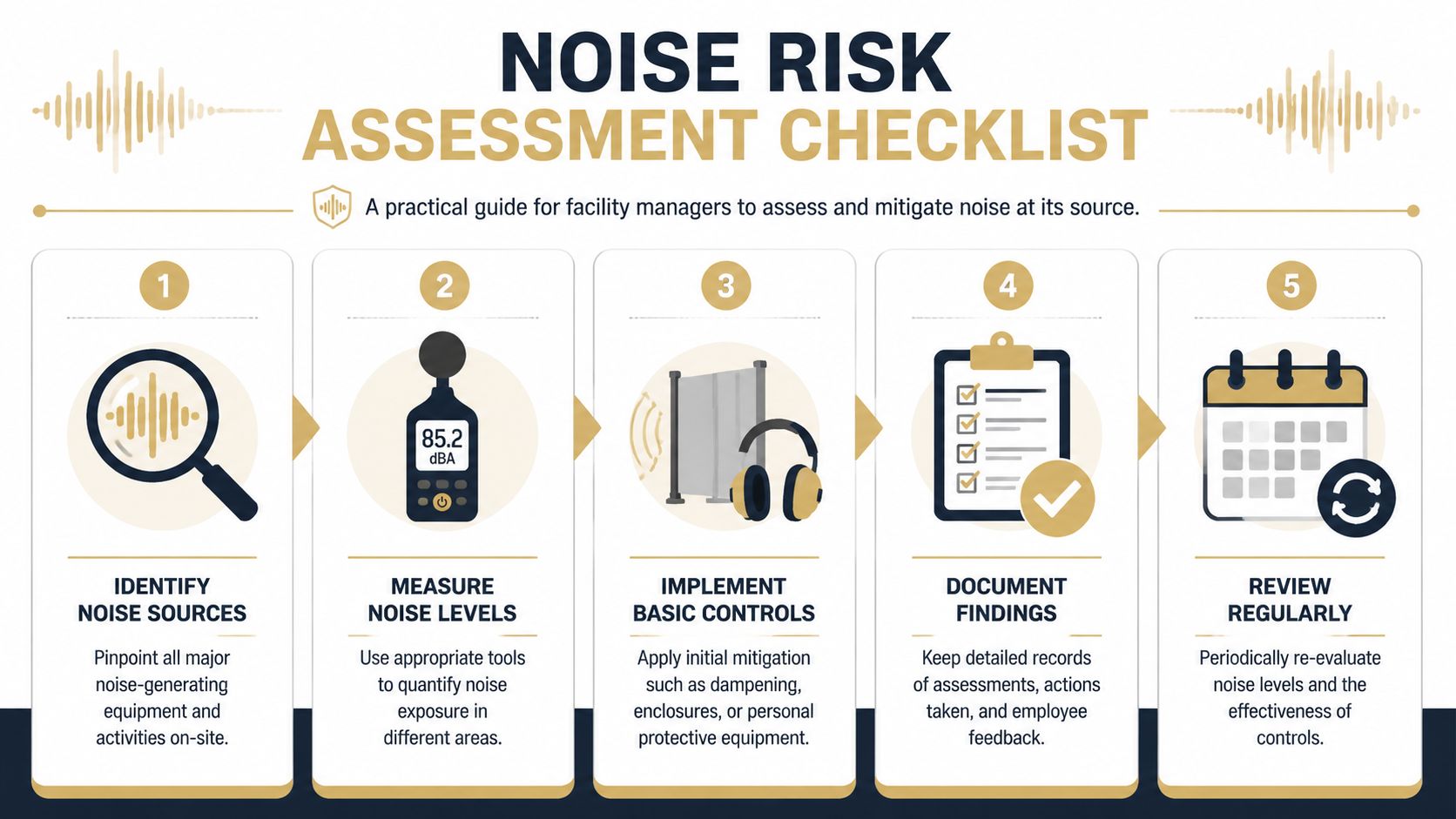
A useful site conversation starts with evidence. Not opinions. Not complaints. Facts.
A practical checklist looks like this:
Map the noisy activities
Identify which plant or task is causing the disruption. Drilling, cutting, demolition, generators, and compressors all behave differently.Track timing patterns
Note when noise spikes happen. Intermittent noise is often more disruptive than a steady background hum because people can't adapt to it.Measure where the business feels it
Record the areas most affected. Boardrooms, call zones, reception, interview rooms, and open-plan desks should be prioritised.Document the operational impact
Log missed calls, meeting interruptions, and any need to move staff. This creates a clear business case for action.Check the building fabric
Weak points matter. Glazing, door gaps, vents, and lightweight partitions often let in more noise than expected. For wider workplace upgrades, this guide to best materials for sound insulation is a useful starting point.
A vague complaint gets parked. A clear log of when, where, and how the noise disrupts work gets attention.
Push for immediate site controls
Once the source is clear, the site team should be pushed toward the controls that are effective.
- Ask for quieter plant where substitutions are possible. Source control beats trying to mop up the problem later.
- Insist on maintenance. Worn parts, loose fittings, and missing mufflers make noisy equipment worse.
- Request temporary acoustic barriers or enclosures around dominant plant and noisy activities.
- Reschedule the loudest works away from critical business hours if the programme allows.
- Coordinate sequencing early. A sensible programme reduces conflict between occupied spaces and high-noise activities.
For project teams planning refurbishment or staged works, a practical guide to order of works for London renovations can help frame conversations about sequencing and disruption control.
Internal space planning also matters. If the workplace has flimsy divisions, noise spreads faster and farther. Upgrading internal zoning with better partitions can form part of a layered defence, especially in open-plan layouts. When partitions are under review, Logika is relevant.
Shifting Focus From the Site to Your Workspace
Site controls are necessary. They're also unreliable if someone else controls the programme, the plant, and the contractor. That's why facilities managers shouldn't stop there.
The smarter move is to protect the workspace itself.

Most guidance on how to reduce construction noise focuses on the site. That makes sense up to a point. But occupied buildings have their own problem. Noise is often intermittent, directional, and it gets in through weak points like windows, gaps, and vents. That's exactly why the Acoustical Surfaces guidance on dealing with construction noise points to acoustic pods as relevant for offices, schools, and healthcare settings when external noise can't be fully controlled.
Why complaints often follow short sharp noise events
A steady hum is unpleasant. A sudden burst of drilling in the middle of a confidential call is worse.
That difference matters because workplace disruption is usually driven by moments, not averages. Staff can tolerate some background noise. They can't tolerate repeated interruption when they're presenting, interviewing, concentrating, or speaking to clients.
Practical rule: protect the tasks that fail under interruption, not just the spaces that feel loud.
That means facilities teams should stop asking only one question. “How can the site be quieter?”
They should also ask a better one. “Where can people still work properly when the site isn't quieter?”
Build quiet zones inside the building
Internal acoustic resilience earns its keep. A resilient workplace doesn't depend on the construction programme going smoothly. It has fallback spaces built into the environment.
Useful options include:
- Dedicated quiet rooms for heads-down work
- Upgraded ceilings and absorptive finishes to reduce internal reverberation
- Replanned layouts that move sensitive tasks away from façades and weak points
- Acoustic pods for calls, meetings, and focused solo work
For broader interior acoustic control, ceiling treatment often gets overlooked. Ceiling sound baffles can help reduce reflected sound within the office, which supports a more controlled environment around noisy periods.
The point is simple. External construction may be outside the occupier's control. Internal continuity is not. The teams that stay productive during disruption are usually the ones with protected spaces already in place.
Acoustic Pods The Ultimate Tool for Business Continuity
Construction noise becomes a business continuity problem the moment calls fail, interviews get interrupted, and managers start hunting for any room that still works. At that point, acoustic pods stop being a workplace extra. They become protected operational space.
That distinction matters. Facilities teams often get pushed into treating noise control as a site issue alone. It is also an occupancy issue. If the office must stay live during works, you need places where people can still speak clearly, think properly, and hold confidential conversations without relying on luck.
The ConExpo discussion on reducing construction noise focuses on site-side noise reduction. Useful, but incomplete for occupied offices. The stronger strategy is to protect the workplace itself with enclosed, modular spaces that keep key tasks running through disruption.
Pods solve a business problem, not just an acoustic one
Standard meeting rooms are often the wrong answer. They are already booked, badly located, or too exposed to the same disturbance affecting the open plan floor. A pod gives you something different. Predictable acoustic shelter, placed where the business needs it, without waiting for a refit.
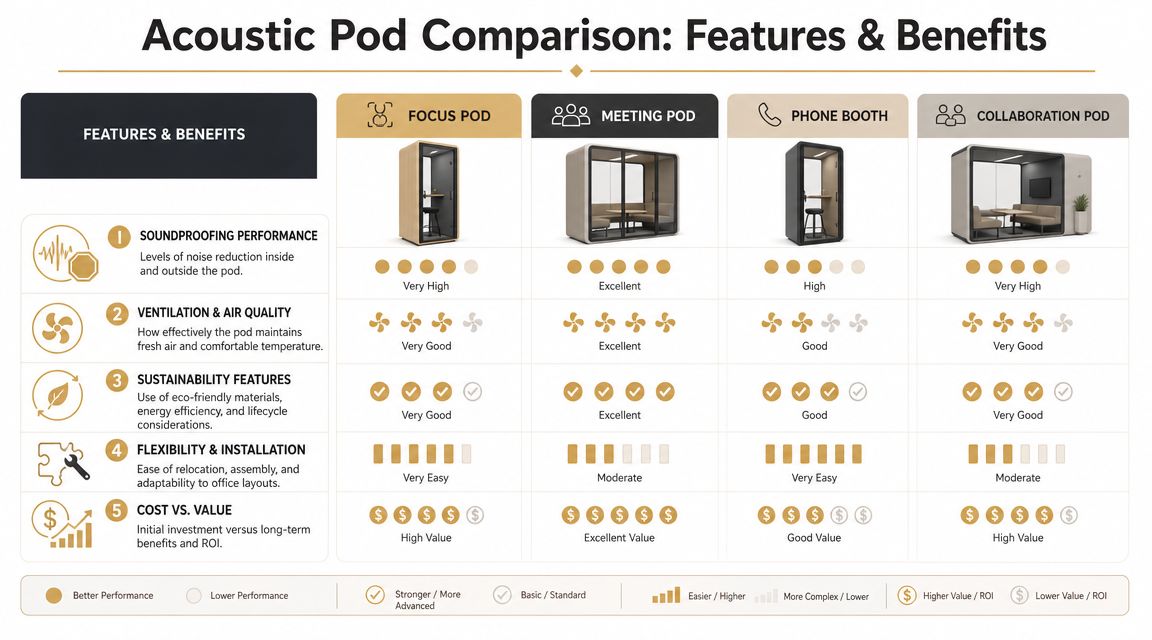
Use pods for the work that carries the highest interruption cost:
- Private calls with clients, candidates, suppliers, or leadership
- Focused solo work that falls apart in a noisy open-plan area
- Small meetings that need speech privacy and reliable audibility
- Temporary decanting when internal works remove normal meeting or focus space
Later in the decision process, seeing pod performance in action helps. This short overview is useful:
Choosing the right pod for the job
Different pod ranges fit different operational needs, footprint limits, and finish standards.
Single-person focus and call use
BlockO pods fit workplaces that need compact quiet space without a major footprint penalty.Premium workplace integration
Framery pods suit organisations that need polished finishes, strong user experience, and dependable spaces for calls and meetings.Flexible contemporary settings
Kabin pods work well where design, privacy, and practical deployment all need to balance.Architectural acoustic environments
Vetrospace pods are relevant when the workplace brief includes stronger visual presence as well as acoustic separation.Outdoor and external-use solutions
The Meeting Pod Co external pods are useful where the requirement sits beyond the main office interior.
If you are comparing formats, sizes, and layouts, these meeting pods for sale for UK workplaces give a useful view of the options available. Gibbsonn supplies and installs these pod ranges for UK workplaces.
A practical view of pod options
| Primary Use Case | Example Solution | Key Benefit |
|---|---|---|
| Individual calls | Framery or BlockO single pod | Protects speech clarity and privacy during noisy periods |
| Focus work | Kabin solo booth | Gives staff a dependable retreat from open-plan disruption |
| Small team meetings | Vetrospace meeting pod | Keeps collaboration going without relying on scarce meeting rooms |
| Outdoor breakout or meeting use | The Meeting Pod Co external pod | Extends usable quiet space beyond the main office footprint |
The main business case is straightforward. Pods preserve work that would otherwise stall. That means fewer delayed meetings, fewer failed calls, less lost concentration, and less pressure on already scarce enclosed rooms. For a facilities manager handling live disruption, that is a stronger return than waiting for the contractor to make the site quieter.
Smart Procurement Pods for a Flexible and Sustainable Future
The procurement question isn't just which pod to choose. It's how to deploy one without creating a budget problem or locking the workplace into the wrong solution.
That matters because construction noise is sometimes temporary, but the need for quiet space often isn't. Once staff start using protected spaces properly, the demand tends to remain. A good procurement decision should handle both the immediate disruption and the longer workplace need.
Buy hire or subscribe
An outright purchase makes sense when the requirement is permanent and the layout is settled. But that isn't every project.
For many facilities teams, flexibility is the better answer:
- Hire for short-term disruption when construction, refurbishment, or temporary decanting is the main issue
- Subscribe for agility when headcount, layout, or project timelines may change
- Buy for long-term use when the pod will become part of the workplace baseline
That's why office pod hire deserves serious attention. Instead of waiting for a capital approval cycle, teams can get acoustic capacity into the building faster. Framery Subscribed is particularly relevant for organisations that want access to premium pod solutions with more flexibility.
For teams comparing longer-term ownership routes, these meeting pods for sale provide a useful reference point.
The wrong procurement route can delay the solution longer than the noise problem itself.
There's also a practical ROI argument even without forcing dubious numbers into the conversation. If repeated disruption affects hiring interviews, executive calls, focused work, and meeting quality, the cost shows up fast in lost output and staff frustration. A pod protects those activities immediately. That's usually easier to defend than broad acoustic works that take longer and affect more of the office.
Why circular thinking matters
A pod should be treated as a reusable asset, not disposable fit-out.
That's where sustainability and the circular economy become useful procurement filters. High-quality modular pods are built to be moved, reconfigured, and kept in service as office needs change. That supports a smarter lifecycle than one-off interventions that get ripped out when the floorplan changes.
Facilities managers under pressure to justify spend should look at three points:
| Procurement lens | What to check | Why it matters |
|---|---|---|
| Flexibility | Can the pod be relocated or redeployed | It protects the investment if the office layout changes |
| Longevity | Are materials and components designed for continued use | Durable products fit circular thinking better |
| Operational value | Will the pod still solve a problem after construction ends | Good pods remain useful for hybrid work and privacy needs |
For organisations with sustainability targets, Gibbsonn's sustainability approach is worth reviewing because it aligns pod decisions with longer-term circular economy thinking.
The practical conclusion is blunt. If a workplace needs acoustic resilience now, and adaptable space later, flexible pod procurement is usually the smarter move than waiting for a perfect long-term fit-out plan.
Take Control of Your Acoustic Environment Today
Construction noise usually gets treated as a temporary nuisance. That's a mistake. The immediate disruption may be temporary, but the business impact is real the moment calls are interrupted, private discussions become difficult, and focused work starts slipping.
The strongest response is layered. Push for source control. Improve weak points in the building. Then create protected spaces inside the workplace so teams can keep working properly. That last part is where most organisations are still behind.
A useful companion read is CS1 Real Interiors' guide to sound solutions, especially for teams weighing acoustic treatment against stronger sound isolation measures. It helps frame the difference between making a space sound better and making it more protected from external disruption.
A quieter workplace doesn't happen by accident. Someone has to specify it, protect it, and give people the right spaces to use.
Facilities managers don't need to eliminate every external noise event to succeed. They need to make sure the workplace still functions when those events happen. That's the standard worth working to.
If the office is dealing with nearby development, internal refurbishment, or ongoing disruption, now is the time to act. Book an appointment. Visit the showroom in Bishop's Stortford. Test the pods in person and see what real acoustic protection feels like in a working environment.
A practical next step is to speak with Gibbsonn about pod hire, subscription options, permanent pod installations, and workplace acoustic planning. Teams can also book an appointment and visit the Bishop's Stortford showroom to compare solutions in person.