
Monday morning starts with the same complaints. Teams can't hear clearly on calls. Managers can't find a quiet place for sensitive conversations. People wearing headsets still look distracted because the room around them is doing half the talking.
That isn't just an annoyance. It's a workplace performance problem.
Facilities managers usually inherit noise in layers. Open-plan layouts encourage collaboration, but they also allow speech, HVAC hum, printer noise, corridor traffic, and external sound to overlap. The result is a space that feels active yet makes concentration harder than it should be. When that continues through a refurbishment cycle, the cost shows up in missed detail, repeated conversations, poor call quality, and mounting frustration.
The practical question isn't whether noise matters. It's how to reduce background noise without overbuilding, overspending, or making the office feel closed off. The most effective route starts with diagnosis, moves through a clear hierarchy of interventions, and ends with targeted quiet spaces where people need them.
Table of Contents
- The Hidden Cost of a Noisy Office
- Diagnosing Your Office Noise Problem
- Quick Wins for Immediate Noise Relief
- Architectural and Structural Acoustic Treatments
- The Ultimate Solution for Focus and Privacy
- Making a Smart Investment in Office Pods
- Create Your Quiet Revolution Today
The Hidden Cost of a Noisy Office
At 10:15 on a Tuesday, the office can look as if it is working exactly as planned. Desks are full. Calls are happening. Meeting rooms are booked. Then the operational cracks show. A finance lead repeats figures on a video call. A recruiter leaves the floor to handle a confidential conversation. A project team occupies the only enclosed room for work that should have taken 30 minutes because there is nowhere else suitable for focused discussion.

That pattern is expensive.
The technical explanation matters, but the business effect matters more for a facilities manager planning refurbishment. When background noise sits too close to speech levels, people miss words, repeat themselves, raise their voices, and look for somewhere else to work. In open-plan offices, that turns an acoustic problem into a workplace performance problem.
The cost usually shows up in three places:
- Productivity slips: Tasks that need concentration move into meeting rooms, circulation areas, or home-working days.
- Wellbeing pressure increases: Persistent noise adds friction to the working day and can contribute to stress complaints, fatigue, and lower tolerance for the office environment.
- Space efficiency falls: Rooms intended for meetings become overflow focus booths and private call spaces.
“The constant buzz of an office can sound busy while undermining the very work the space is meant to support.”
Facilities teams often see the symptom first, not the cause. Complaints come in about chatter, but the underlying issue may be a poor layout, too many reflective finishes, a lack of enclosed spaces, or building services noise sitting too close to desk areas. In a major refurbishment, that distinction matters because it affects where the budget goes and what return the project can realistically deliver.
Good acoustic strategy is not about making the whole office silent. It is about matching acoustic conditions to task type. Collaboration zones can carry more energy. Routine work areas need control. Private calls, focused work, and sensitive conversations need spaces designed for speech privacy and low distraction.
That is where the business case sharpens. Better noise control improves day-to-day performance, reduces pressure on shared rooms, supports employee experience goals, and helps organisations meet their obligations around workplace health and suitable working conditions. It can also prevent waste. I have seen clients spend heavily on decorative acoustic finishes, then find the actual bottleneck was the lack of dedicated enclosed spaces for calls and concentration.
For facilities managers, the priority is to treat noise as a systems issue with measurable consequences. The strongest schemes start with diagnosis, then apply solutions in order of impact and cost. In many offices, that leads to one conclusion: general acoustic treatment helps, but dedicated pod solutions often deliver the clearest return because they solve focus, privacy, compliance, and space-use problems at the same time.
Diagnosing Your Office Noise Problem
Monday, 10:30 a.m. The complaints start landing with Facilities. One team says the office is too loud to concentrate. Another says meeting rooms are unusable for private calls. A third points to the air handling. In a refurbishment, those complaints should not be treated as one issue. They usually come from different causes, and each cause points to a different spend decision.
That distinction matters because acoustic budgets are easy to waste. I have seen projects spend heavily on visible finishes, then leave the main transmission route untouched or ignore the lack of enclosed space for phone and video calls.
Start with a diagnosis framework
Use the Source, Path, Receiver model. It is simple, but it keeps the team focused on cause rather than symptom.
| Control layer | What to inspect | Typical office examples |
|---|---|---|
| Source | What is generating the noise | HVAC, printers, fan units, chatter, traffic from shared areas |
| Path | How the noise is travelling | Glass, gaps around doors, exposed ceilings, hard floors, open circulation routes |
| Receiver | Who is affected and during which tasks | Call users, focused workers, reception staff, managers handling private conversations |
This model is practical because it supports procurement decisions. If the source is mechanical, the answer may sit with building services. If the path is the problem, partitions, seals, ceiling treatment, or acoustic office screen dividers may help. If the receiver issue is task-based, the right move may be to create dedicated spaces for focus and confidential conversations rather than trying to quiet the whole floor.
Speech clarity is a useful checkpoint. Where background sound sits too close to speech, people stop hearing speech as soft ambience and start processing words. That is when distraction rises and privacy falls.
Run a disciplined site audit before committing budget
A useful audit is straightforward. It should be structured enough to separate isolated complaints from repeatable patterns.
- Walk the floor at several points in the day. Morning setup, lunchtime, mid-afternoon, and peak call periods often reveal different problems.
- Plot complaints on a plan. Clusters usually show a layout or services issue, not an individual preference.
- Record the character of the noise. Continuous fan noise, intermittent impact noise, and intelligible speech need different controls.
- Check enclosed rooms properly. Listen for reverberation, weak door seals, sound leakage through glazing, and transfer above partitions.
- Match task to setting. If concentrated work, circulation, and calls are sharing the same zone, the acoustic outcome is predictable.
One clear test helps. If staff can follow neighbouring conversations word for word, the space has a speech privacy problem, not a manners problem.
Measure what occupants experience
Phone apps can help identify trends, but they are not a substitute for an acoustic assessment. Their best use is comparison. They can show whether one zone is consistently louder than another, or whether a small intervention has reduced a recurring peak.
For refurbishment decisions involving partitions, ceilings, glazing, or MEP changes, formal assessment is usually justified. The aim is not technical complexity for its own sake. The aim is to distinguish between a room that sounds busy, a room with poor reverberation control, and a room with a transmission problem that will keep generating complaints after handover.
That is where many business cases improve. A measured diagnosis gives Facilities something far stronger than anecdote. It supports capex decisions, helps defend scope in front of finance and project stakeholders, and reduces the risk of spending on attractive but low-impact treatments.
Know when to bring in specialist support
Escalate early if the refurbishment includes any of the following:
- Changes to building fabric: glazing, partitions, doors, ceilings, or floor build-ups
- Persistent privacy concerns: especially in HR, legal, healthcare, or senior management areas
- Mechanical services noise: where HVAC, fan coil units, or plant are likely contributors
- Major space replanning: when occupancy density, circulation, meeting room mix, and work settings are all changing together
The goal is not to collect more data than the project needs. The goal is to identify the dominant problem, rank the interventions by impact, and spend where the return is clearest.
Quick Wins for Immediate Noise Relief
Monday, 9:15 a.m. The refurbished floor looks sharp, but complaints have already started. One team is on client calls beside a bank of focus desks, the printer is churning through a large run, and a rattling fan coil is adding a constant mechanical layer that nobody mentioned at handover. Facilities does not need a full rebuild to improve that week. It needs the right first moves.
These measures are useful because they cut disruption fast, test what works before capex is committed, and give stakeholders visible progress while the wider refurbishment programme is still being costed.
Fix the obvious mismatches first
Start with adjacencies. In practice, many noise problems come from conflicting activities sharing the same zone.
Move high-call teams away from heads-down work. Shift collaboration points away from circulation bottlenecks. Relocate printers, lockers, bins, and other repeat-use touchpoints out of quiet areas. If café seating, touchdown benches, and focused desks sit in one open field, speech and movement will spread across all three.
Then reduce how hard the space sounds. Soft finishes will not create confidentiality, but they do lower harsh reflections and make open-plan areas easier to work in. Rugs, curtains, upholstered seating, and better ceiling tiles all help. So do office screen dividers for zoning and acoustic separation when they are placed to interrupt noise paths, not just to decorate the floorplate.
One caution. Temporary screens can improve comfort, but they can also compromise sightlines, daylight, and flexibility if they are overused. Use them where they support a defined work setting.
Tackle small sources before they become recurring complaints
Maintenance usually delivers the fastest return.
Check fan coil units, diffusers, door closers, loose trunking, under-desk pedestals, and anything else that vibrates, rattles, or hums through the day. Rebalance HVAC where air speeds are too aggressive. Replace worn seals. Isolate noisy equipment from hard surfaces. Small service issues often generate disproportionate frustration because they run continuously and are difficult for staff to ignore.
This work is rarely expensive, but it does require discipline. A basic walk-through with Facilities, MEP, and the fit-out team will often identify avoidable noise sources that were never part of the design intent.
A noisy office often reflects poor coordination between layout, services, and furniture, not a lack of rules for staff.
Use masking carefully
Sound masking has a place, particularly where the aim is to reduce speech intelligibility rather than create a quiet room. It can support open-plan settings, reception areas, and some shared support zones.
It is still a secondary measure. If the underlying problem is bad zoning, excessive reverberation, or a noisy building service, masking adds another layer to an already stressed environment. Occupants tend to notice that quickly.
Facilities managers should also keep the business case in view. Quick wins are attractive because they are low-cost and low-disruption, but they rarely solve privacy, call quality, or concentrated work for senior teams, HR, legal, or confidential project groups. Where refurbishment plans already include envelope upgrades, the principles behind how double glazing improves home energy comfort are a useful reminder that acoustic performance, energy efficiency, and occupant comfort often need to be evaluated together.
Architectural and Structural Acoustic Treatments
When noise is built into the room, the room has to change.
Refurbishment decisions carry weight. Surface finishes, glazing, doors, ceilings, and partitions all shape how sound moves. Some absorb it. Some block it. Some do neither and only reflect it around the floorplate.
Absorb what's bouncing around the room
The first category is internal treatment. Acoustic wall panels, suspended baffles, bass traps, and higher-performing ceiling finishes reduce reverberation and limit the build-up of reflected sound. They won't stop every conversation from travelling, but they can make speech feel less intrusive and improve clarity inside the space.
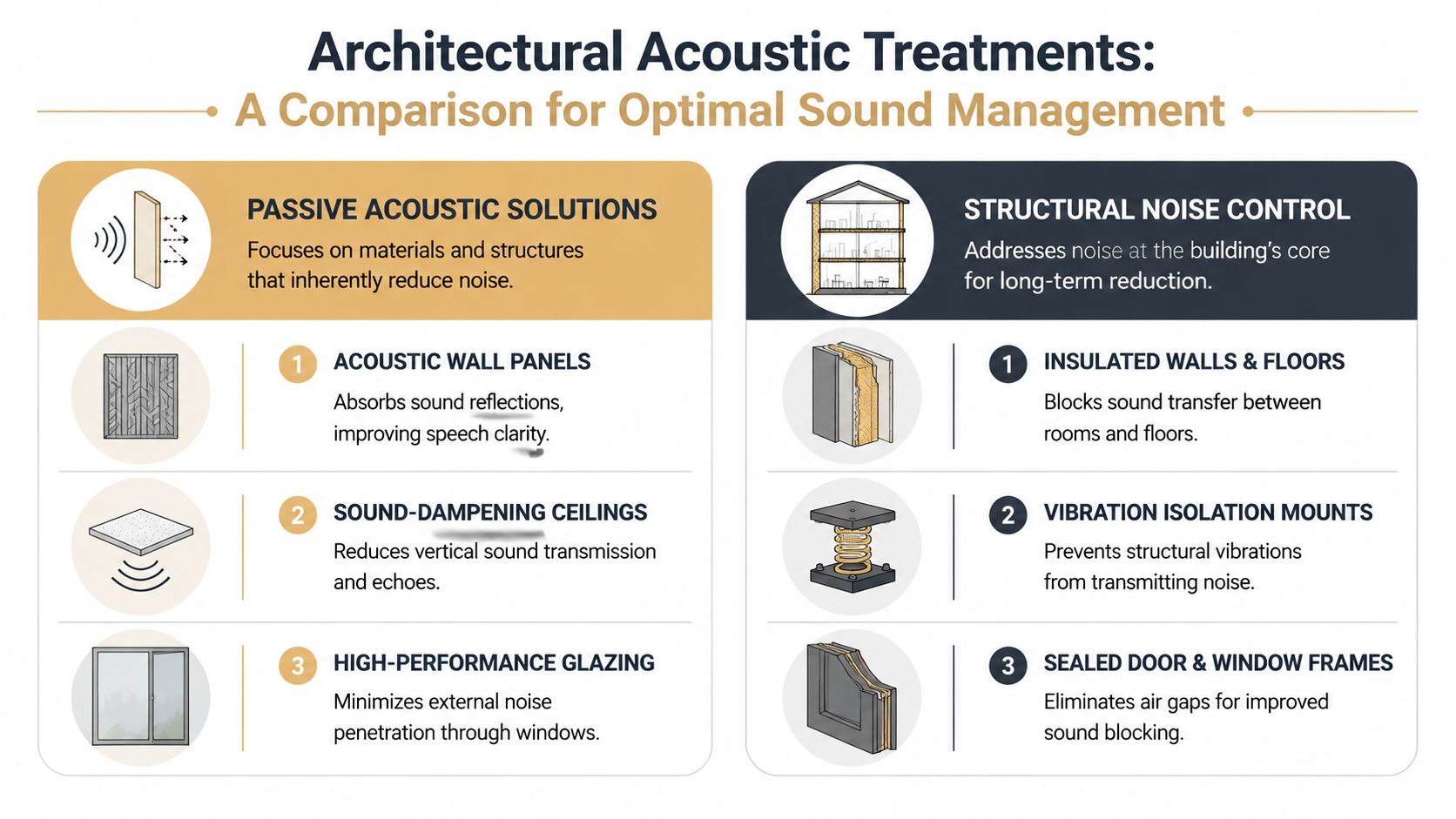
Rooms with hard floors, exposed soffits, and long glazed runs tend to need this kind of treatment first. The gain is practical. Meetings become easier to hear. Open-plan areas feel less sharp. Calls pick up less room echo.
For teams planning these upgrades, acoustic insulation guidance is a useful starting point because it helps separate absorption from true sound blocking. Those two are often confused in project briefs.
Block what shouldn't pass through
The next category is isolation. In this regard, doors, walls, glazing, and perimeter sealing matter.
Air gaps around frames allow sound leakage. Lightweight partitions can look substantial while performing weakly. Window upgrades can also be relevant where external traffic, street activity, or plant noise affects the workspace. For a plain-language explanation of how glazing changes comfort as well as noise performance, this guide on how double glazing improves home energy comfort gives a useful overview of the principles.
A practical specification review should look at:
- Door sets: seals, frames, thresholds, and closers
- Glazing: whether existing units are adequate for external noise conditions
- Wall build-up: especially around meeting rooms and management spaces
- Junctions: ceiling voids and service penetrations are common weak points
- Facade leakage: poorly sealed perimeter details can undo better internal work
Use partitions when flexibility matters
Solid construction isn't always the right answer. In many refurbished offices, the brief calls for adaptability as much as acoustic control. That's where moveable systems can make sense.
For teams considering flexible spatial division, Logika partitions provide an example of how movable partitioning can create separated zones without committing to permanent walls everywhere. The trade-off is straightforward. Flexibility improves. So does phasing and future adaptability. But performance depends heavily on specification, detailing, and how the partition interfaces with the wider room.
Structural investment should follow measurement, not frustration. Once walls, glazing, and ceilings are changed, reversing a poor decision is expensive.
Decide based on disruption as well as performance
Architectural treatments often work well, but they come with disruption. Ceiling and wall systems require programme time. Door and partition changes affect circulation. Glazing and facade work can involve specialist coordination.
That's why measured assessment matters. As noted earlier, advanced acoustic analysis can use STFT to distinguish persistent issues from random noise fluctuation, which helps justify structural spend with stronger evidence rather than anecdote.
The right decision depends on the problem. If the whole floorplate is reverberant, treatment across the space may be justified. If the issue is concentrated around calls, privacy, and short focused tasks, a more targeted intervention may achieve more with less disruption.
The Ultimate Solution for Focus and Privacy
Open-plan offices often try to solve every acoustic problem at the scale of the whole building. That can work, but it's not always the smartest move. Many workplaces don't need silence everywhere. They need reliable quiet in specific places, exactly when people need it.
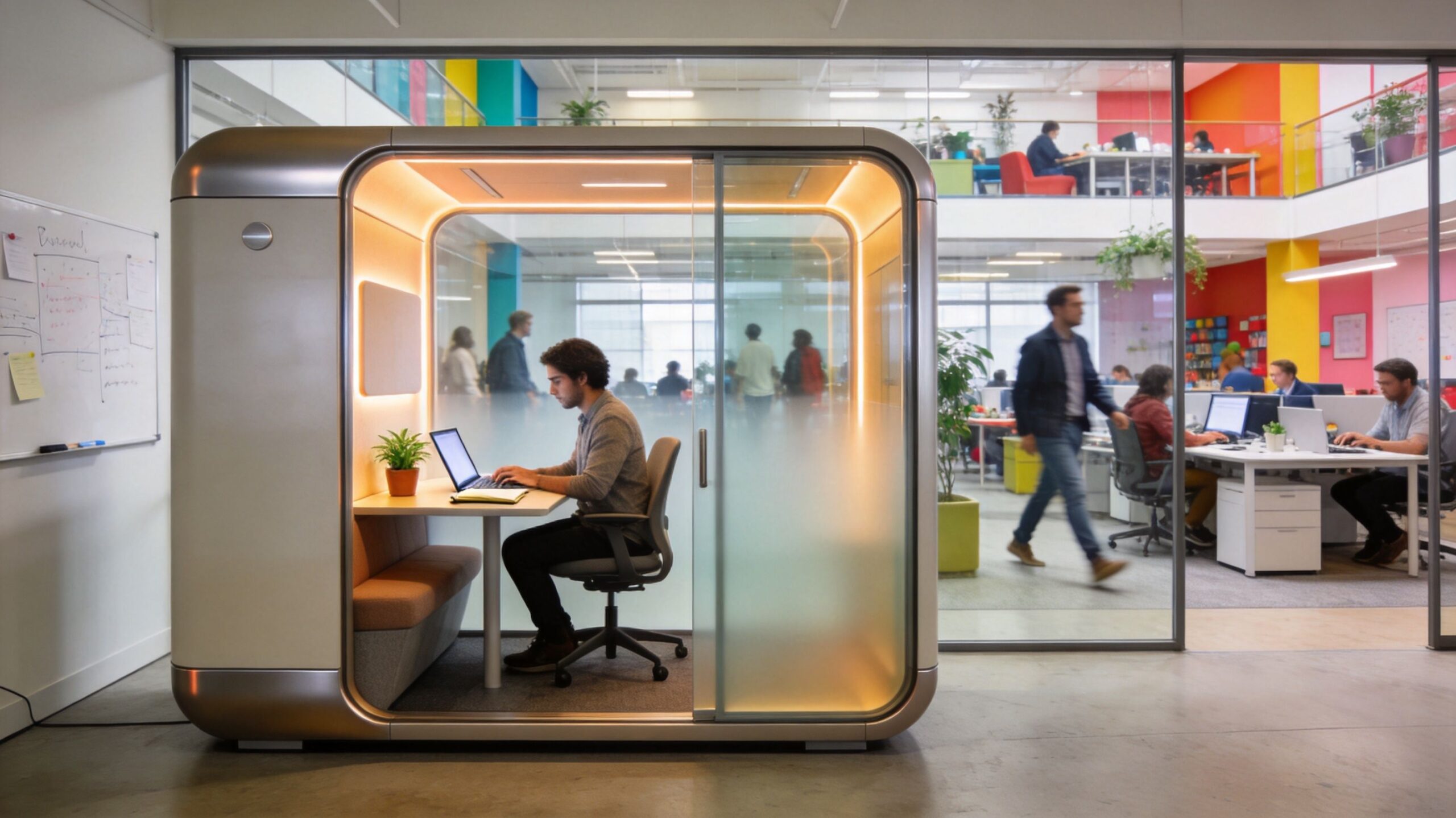
That is where office pods become highly effective. Instead of rebuilding the entire floor, pods insert enclosed acoustic environments into the existing workspace. They support focused work, private calls, one-to-one meetings, and small team sessions without taking on the cost and permanence of full construction.
Why pods outperform improvised quiet areas
A spare corner with a screen isn't a phone booth. A meeting room booked for one person isn't efficient space use. Pods solve both issues because they create acoustically controlled micro-environments where they're needed most.
They also avoid one of the most common refurbishment mistakes. Many offices add more open collaboration furniture while overlooking the need for enclosed solo space. That imbalance then pushes private calls into corridors and focus work into booked rooms.
A well-selected pod gives facilities teams a direct answer to recurring workplace demands:
| Need | Traditional response | Pod-based response |
|---|---|---|
| Private call | Occupy a meeting room | Use a dedicated call pod |
| Heads-down work | Work from home or find a quiet corner | Use a focus pod on site |
| Short confidential discussion | Search for an empty room | Step into a small meeting pod |
| Overflow meeting capacity | Build more fixed rooms | Add enclosed pods with less disruption |
What actually matters inside the pod
Acoustic enclosure is only part of the story. Internal usability matters just as much.
For calls inside a pod or meeting room, reducing the microphone distance is the single most effective way to improve speech-to-noise ratio, and in a typical UK office with 40 dB of ambient noise, proper microphone placement can reduce background noise by 6 to 12 dB, according to this guidance on reducing background noise for clearer audio. That matters because even a strong pod won't compensate for poor user setup on a call.
Facilities managers should therefore assess pods on more than appearance. Look at ventilation, lighting, power, occupancy purpose, ease of cleaning, and how comfortably users can work inside them. Small details affect adoption.
“The right pod doesn't just reduce noise. It gives people confidence that they can take a call, focus properly, or speak privately without disrupting everyone else.”
For spaces where glare and external light also affect concentration, it can help to browse sophisticated office window covering designs alongside acoustic planning. Visual comfort and acoustic comfort often need to be resolved together.
Comparing pod types for different workplace needs
Different pod brands suit different priorities. Selection should follow use case rather than trend.
- Framery pods are often specified where technology integration, refined workplace design, and high-frequency daily use matter.
- BlockO pods fit well where modular planning and flexible deployment are important.
- Kabin pods suit projects looking for a clean, contemporary aesthetic that still supports focused acoustic separation.
- Vetrospace pods are relevant where hygiene, air quality, and user wellbeing are high on the brief.
- The Meeting Pod Co exterior pods provide a route for sites that need enclosed meeting or breakout space outside the main building.
The wider point is strategic. Pods let organisations add the exact room types they are missing without waiting for a major structural overhaul.
A short product walkthrough helps when comparing layouts, capacities, and use cases in real space:
Pods also work well alongside broader acoustic treatments. Ceiling and wall absorption can improve the open plan generally. Pods then handle the high-value tasks that require reliable privacy and concentration.
Making a Smart Investment in Office Pods
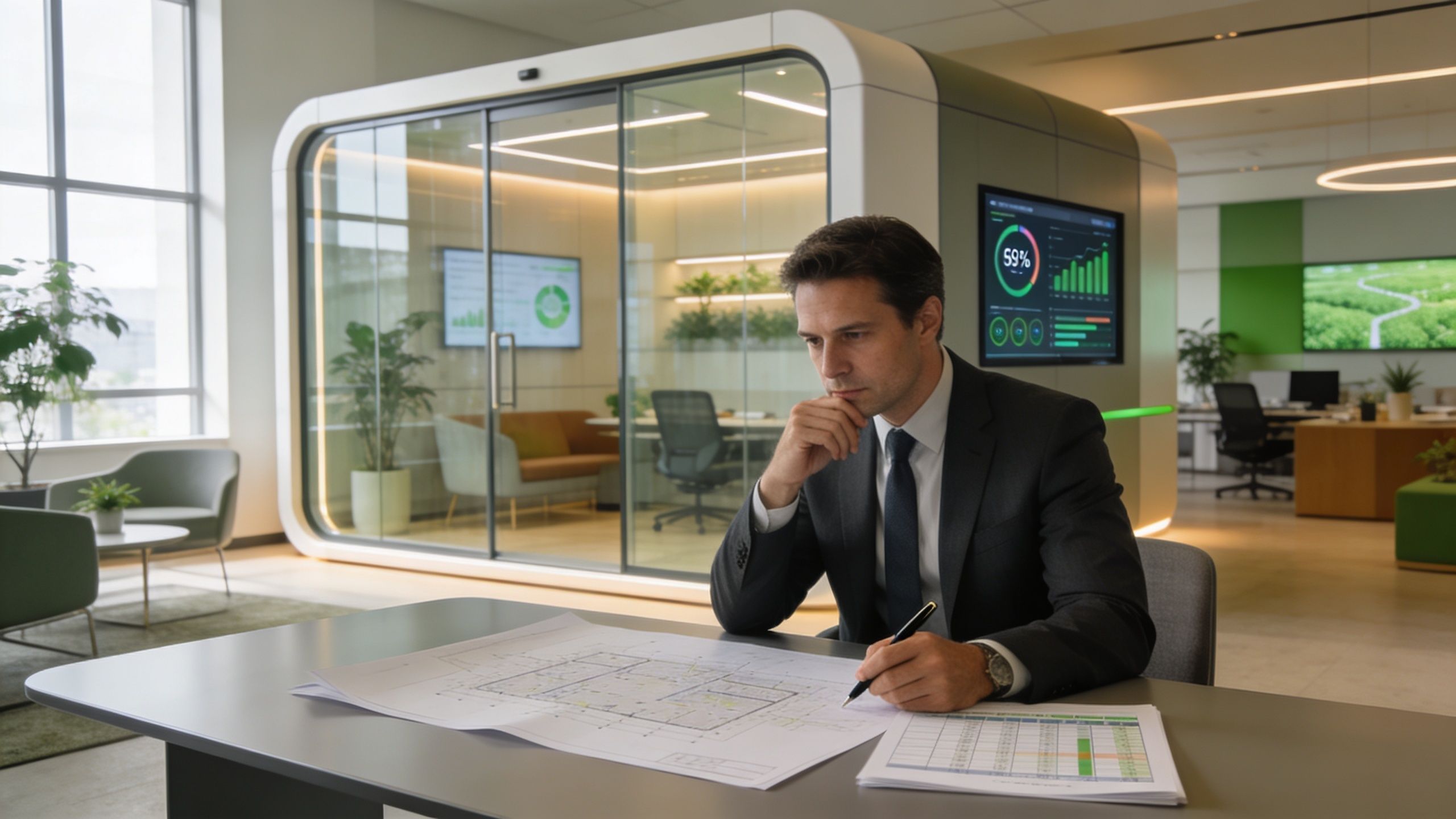
Once the operational case is clear, the next question is commercial. Not every organisation wants to convert a workplace need into fixed construction or immediate capital expenditure. That's one reason pods have become such a practical option in refurbishment planning.
They are assets, but they are also flexible workplace tools. That distinction matters.
Flexibility can be as valuable as acoustic performance
A fixed room assumes the future layout will hold. Many organisations no longer have that certainty. Team size changes, space use patterns shift, and property strategies are reviewed more often than they were a few years ago.
That makes flexible acquisition models attractive. Rather than treating every pod as a permanent purchase, some businesses prefer subscription or hire routes that preserve optionality. Framery Subscribed fits that model by allowing pod rental rather than a traditional outright purchase. For many facilities and workplace leads, that changes the internal conversation from long-term build commitment to adjustable operational provision.
There's also a wider planning benefit. Pods can often be deployed faster and with less site disruption than major structural alterations. That can reduce programme risk during active office refurbishments.
Sustainability should be part of the decision
Noise control and sustainability are often discussed separately. They shouldn't be.
A pod strategy can support the circular economy because it avoids some of the waste tied to repeated demolition and rebuild cycles. A relocatable product that can be reused, reconfigured, or retained through workplace change has a different lifecycle logic from fixed construction. That's especially relevant for organisations under pressure to align workplace spend with ESG commitments.
For teams weighing acoustic investment options, acoustic office solutions can sit within a broader planning mix that includes retained assets, phased upgrades, and adaptable specification. That is usually a stronger long-term route than solving every issue with permanent build.
A sustainability lens also means looking beyond the pod itself. Procurement, maintenance, lifespan, refurbishment potential, and end-of-use pathways all matter. Sustainability at Gibbsonn and its focus on circular thinking is relevant here because facilities teams increasingly need workplace products that fit wider environmental goals, not just immediate functional ones.
Evaluate the investment like a workplace asset
A pod decision should be assessed against a practical set of criteria:
- Use intensity: Will the pod support constant calls, occasional meetings, or focused solo work
- Space efficiency: Does it free up enclosed rooms for larger group activity
- Adaptability: Can it move if the workplace plan changes
- Operational quality: Ventilation, lighting, power, accessibility, and maintenance
- Lifecycle fit: Whether purchase, hire, or subscription suits the organisation better
Investment lens: The smartest acoustic purchase is usually the one that solves the right problem without locking the workplace into yesterday's layout.
Used this way, pods are not just furniture and not quite construction. They sit in a useful middle ground, which is exactly why they make sense for so many refurbishment programmes.
Create Your Quiet Revolution Today
The most effective way to reduce background noise isn't to rely on one tactic. It's to work through the problem in layers.
Start with diagnosis. Fix obvious sources. Improve layout and absorption where those changes will help. Invest in structural treatments when the building fabric is the actual issue. Then place enclosed pod spaces where focus, privacy, and clear communication matter most.
That approach protects budget and improves outcomes. It also gives staff something they notice immediately. Better calls. Better concentration. Fewer workarounds. Less friction in the day.
For facilities managers planning a refurbishment in 2026, the strongest result usually comes from targeted quiet space, not blanket silence. Pods are often the clearest route to that outcome because they solve specific high-value tasks without the delay and disruption of rebuilding the whole office.
Book an appointment and visit the showroom in Bishop's Stortford to experience the difference in person. Testing pod layouts, finishes, and acoustic performance firsthand often makes the decision much clearer.
If your workplace needs quieter calls, better focus, and more privacy without committing to unnecessary building work, Gibbsonn can help assess the options and plan the right mix of acoustic solutions for your refurbishment.