
Poor wellbeing at work isn't a soft issue. It's a cost centre hiding in plain sight.
The UK Government-backed Thriving at Work review estimated that poor mental health costs employers between £33 billion and £42 billion each year, driven by absence, presenteeism, and staff turnover, while 76% of UK workers reported moderate to high stress levels in UK reporting compiled by Meditopia (Meditopia workplace wellness statistics). For facilities managers and architects, that changes the conversation. Workplace wellbeing solutions aren't just about apps, awareness days, or nicer finishes. They're about removing friction from the working day.
That's why acoustic pods deserve more attention than they usually get. They solve practical problems that people feel every hour. Noise. Interruptions. Lack of privacy. No place to decompress. No proper room for a private call. In an open-plan office, those aren't minor annoyances. They're operational faults in the space itself.
Table of Contents
- The True Cost of an Unwell Workplace
- Understanding the Pillars of Wellbeing
- How Acoustic Pods Transform the Workplace
- Wellbeing in Action UK Case Studies
- Selecting the Right Pod Solution
- The Future Flexible and Sustainable Pods
- Build a Healthier Workplace Today
The True Cost of an Unwell Workplace
To judge the value of wellbeing solutions, facilities teams need to track performance loss, absence pressure, and retention risk. The UK Government-backed Thriving at Work review estimated that poor mental health costs employers between £33 billion and £42 billion each year, driven by absence, presenteeism, and staff turnover. As noted earlier, UK stress levels remain high across the workforce. This should be framed as a business continuity problem with direct cost implications.
The cost rarely shows up in one dramatic event. It appears in wasted minutes and repeated interruptions throughout the day. Staff leave their desks to find somewhere quiet. Calls spill into corridors. Managers avoid sensitive conversations because there is nowhere private to hold them. Concentration drops, meeting quality slips, and small delays spread across the whole team.
Physical conditions sit at the centre of that problem. Noise, exposure, poor privacy, and weak environmental quality increase stress and make focused work harder than it should be. For organisations reviewing the basics of healthy space planning, office air quality guidance belongs in the same discussion as speech privacy, acoustic control, and layout.
This is why acoustic pods deserve attention from facilities managers and architects. They are a practical infrastructure fix. A pod gives staff an enclosed place for focused work, confidential calls, decompression between meetings, and one-to-ones that should never happen at an open desk. That has a measurable operational effect. Fewer interruptions. Better use of floor space. Less friction in hybrid offices where demand for privacy changes by the hour.
Why environment beats slogans
Too many employers still spend on support that sits outside the workspace while leaving the daily stressor untouched. The message may be sensible, but the room keeps generating the same problem.
Practical rule: If the workplace keeps creating stress, wellbeing support will only treat the symptom.
A stronger business case starts with one question. Which parts of the environment are creating avoidable strain, distraction, and exposure every day? Once that is clear, acoustic pods stop looking like optional extras and start looking like targeted capital investment that can reduce disruption, support retention, and protect productivity.
For teams building that case, this broader discussion around wellness ROI for enterprise organizations is useful because it treats wellbeing spend as an operational decision tied to output, absence, and turnover.
Understanding the Pillars of Wellbeing
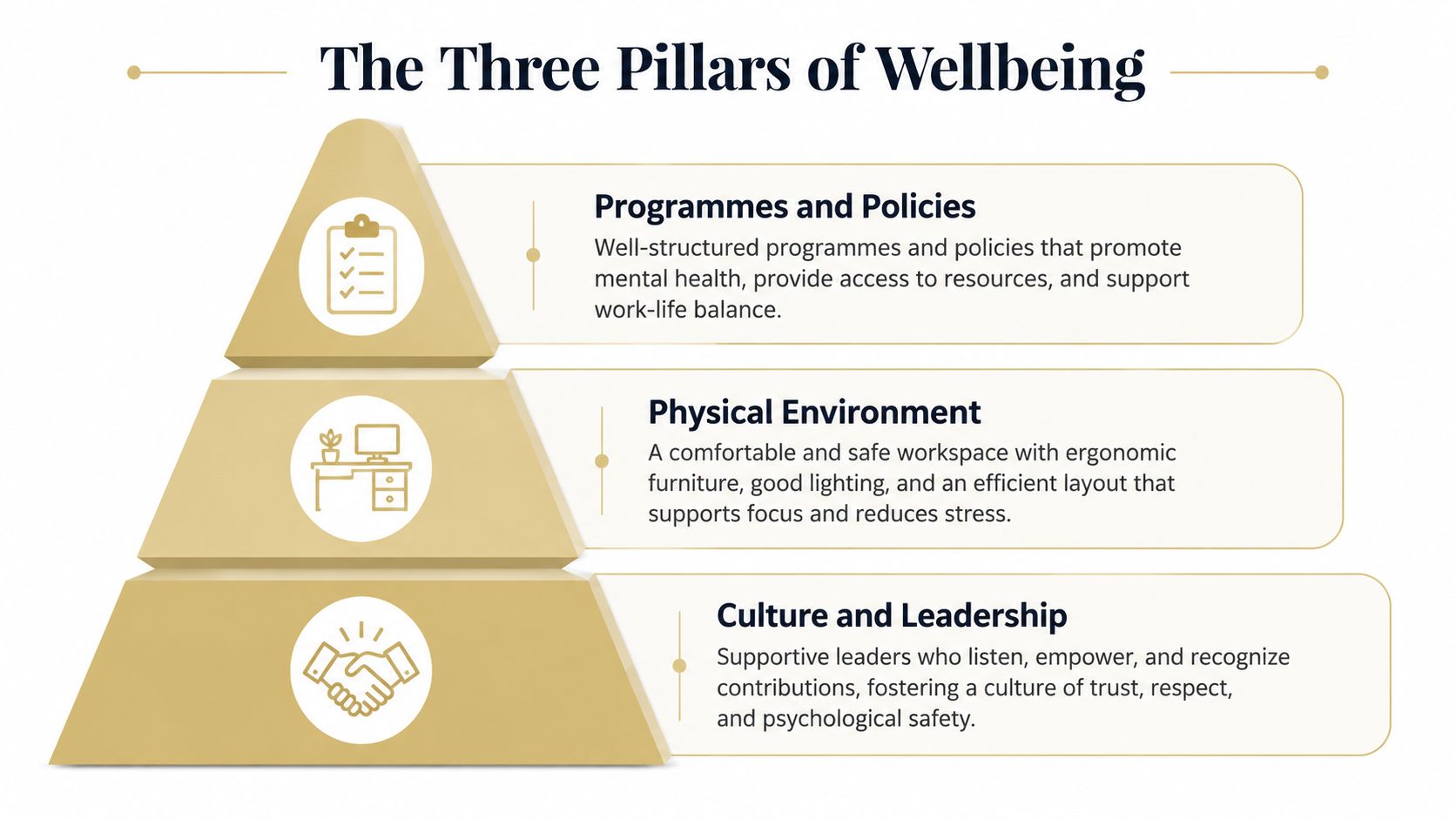
Workplace wellbeing solutions usually fall into three pillars. Most organisations invest in the first two. The third decides whether the first two work.
Programmes still matter
Programmes and policies include mental health support, absence management, flexible working rules, and access to counselling. These are necessary. They give staff formal support and help employers respond consistently.
But they are reactive unless the workspace also changes. If a person returns from stress-related leave to the same noisy, exposed, interruption-heavy floorplate, the underlying trigger hasn't moved.
Technology helps but rarely fixes the room
Apps and digital tools have a role. Pulse surveys, booking platforms, quiet-hour scheduling, and wellbeing dashboards can support better decisions. In hybrid offices, digital overload can also become part of the problem, which is why discussions around managing software assets and digital balance are relevant when teams review the full employee experience.
Still, software can't absorb speech noise. It can't create confidentiality. It can't give a neurodivergent employee a lower-stimulation place to reset. The room wins every time.
The physical environment does the heavy lifting
The strongest evidence points back to the workplace itself. The HSE reports that work-related stress, depression, or anxiety caused 16.4 million lost working days in 2023/24, and the linked discussion highlights how many programmes focused on individual resilience underperform when the work environment remains the main source of strain (workplace wellbeing and organisational design).
That has direct design implications:
- Reduce exposure: Open-plan desks should not be the only setting available for concentrated work.
- Create choice: Staff need access to enclosed and semi-enclosed spaces, not just one default environment.
- Control noise: Acoustic planning should be treated as part of wellbeing, not just speech privacy.
- Use flexible division: Where a full pod isn't needed, high-performance partitions from Logika can help shape calmer zones and improve spatial control.
- Support the body as well as the mind: Seating still matters. Good task seating such as ergonomic mesh desk chairs helps reduce physical strain that compounds mental fatigue.
A workplace can't claim to support wellbeing if it only offers one way to work.
That's why the physical environment should lead the strategy. Programmes and tech support it. They don't replace it.
How Acoustic Pods Transform the Workplace
Acoustic pods work because they solve the right problem. They don't ask staff to become more resilient to distraction. They remove distraction from the task.
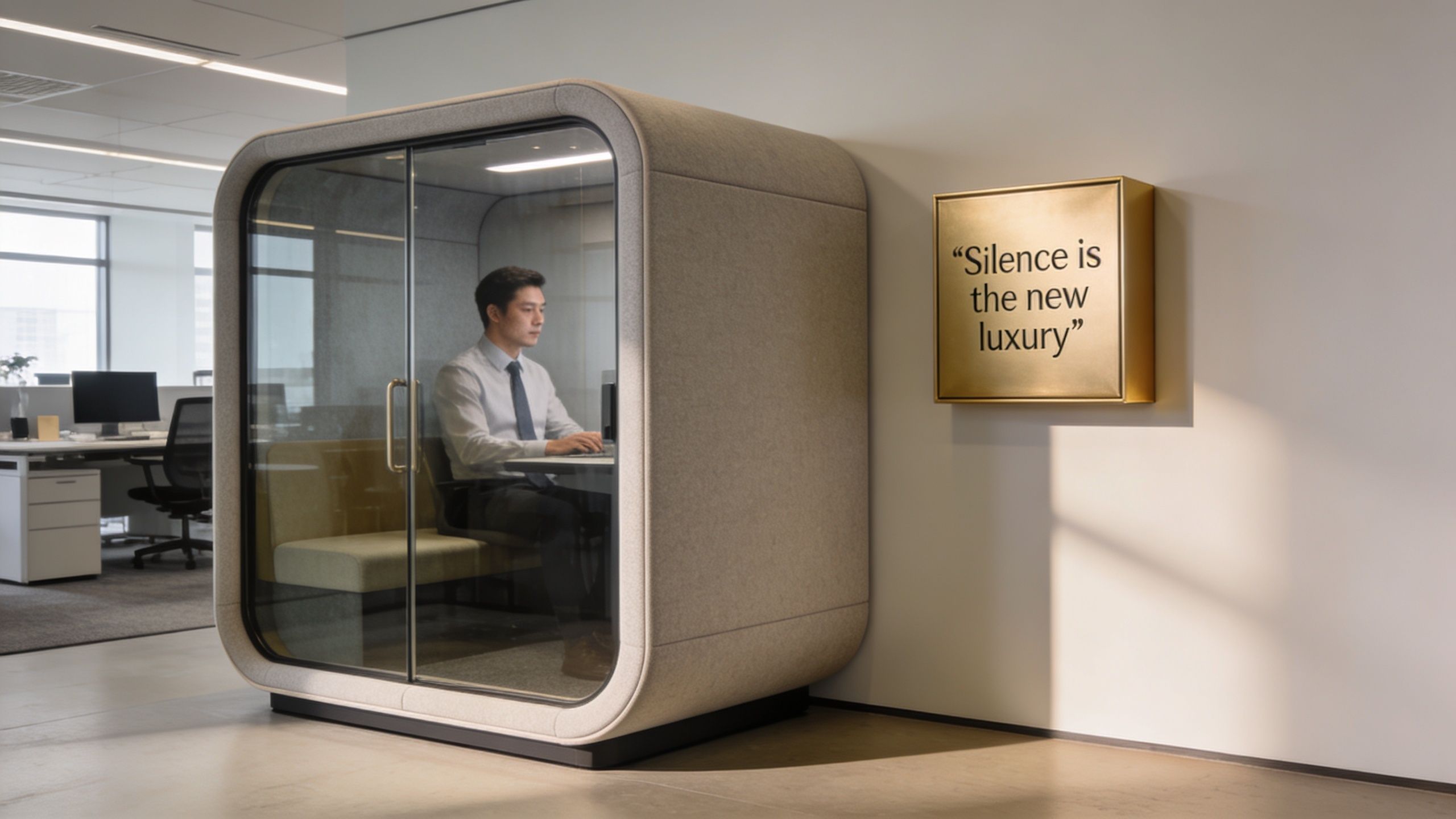
Gallup reports that organisations prioritising employee wellbeing create workplaces with less burnout and greater employee retention. In practical terms, acoustically isolated pods act as a physical control measure that reduces cognitive load and improves perceived work control (Gallup on the importance of employee wellbeing). That is exactly why pods matter. They give people somewhere to think, speak, and recover without battling the room.
What pods fix immediately
Open-plan offices tend to fail in four predictable ways. They expose everyone to speech noise. They remove confidentiality. They make solo focus harder. They force every activity into the same visual and acoustic field.
Pods correct that quickly.
- For calls: A phone booth stops private conversations spilling into the office.
- For focused work: A single-person pod creates a protected deep-work setting without needing a full room.
- For short meetings: A compact meeting pod allows two to four people to talk without disturbing nearby teams.
- For decompression: A quiet enclosed space gives staff a place to reset after overstimulation or difficult conversations.
Facilities teams also need to think beyond acoustics alone. If background office noise is still unchecked, the wider floor can remain fatiguing. ways to reduce background noise should be reviewed alongside pod placement, soft finishes, and zoning.
A short product walkthrough helps visualise how these spaces operate in real offices:
Choosing the right pod family
Not all pods do the same job. A good specification starts with use case, not brand loyalty.
BlockO pods fit well where teams need practical, flexible privacy spaces across a varied floorplate. Framery pods suit organisations that want highly refined call and meeting environments with strong user appeal. Kabin pods work well where aesthetics and compact footprints matter. Vetrospace pods are often a strong fit for calm, health-conscious interiors where visual quality and user comfort are part of the brief.
One supplier can coordinate multiple pod types, planning, installation, and aftercare. Gibbsonn does that across interior and exterior pod projects in the UK.
Pods shouldn't be treated as furniture. They're task-specific environments dropped into the building where the building is failing.
That's the shift that matters. Once a pod is seen as infrastructure, the ROI discussion becomes far easier.
Wellbeing in Action UK Case Studies
A London tech office that needed focus fast
A fast-moving technology team had the usual open-plan symptoms. Product staff were taking confidential calls in stairwells. Managers were booking formal meeting rooms just to get half an hour of peace. Developers wore headphones all day and still complained about interruption.
The office didn't need more policy. It needed better settings. The fit-out introduced a cluster of phone and focus pods near the busiest team zone, with larger enclosed units for short project huddles. The result was straightforward. Sensitive calls moved off the open floor. Quiet work had a home. Meeting rooms returned to actual meetings.
The biggest benefit wasn't visual. It was behavioural. People stopped improvising privacy. That reduced daily friction and gave staff more control over how they worked.
An education setting that needed privacy without stigma
A busy education environment faced a different problem. Students and staff both needed quiet space, but the existing building offered a harsh choice between being in the middle of everything or leaving the area altogether. There was no neutral setting for decompression, pastoral conversations, or individual study when the main spaces became too stimulating.
The estates team added enclosed pods in a central but discreet location. That changed how the space was used. Students who needed lower stimulation had somewhere to go without feeling singled out. Staff could hold private conversations without hunting for an empty office. The environment became more inclusive because privacy was built into the plan instead of treated as an exception.
The most useful wellbeing spaces are the ones people can use without asking permission or explaining themselves.
These examples matter because they show the same principle working in different sectors. The brief may be different. The underlying issue is usually the same. People need more than one kind of workspace.
Selecting the Right Pod Solution
Specifying pods well means treating them like part of the building system. A pod that looks good but lands in the wrong place, lacks ventilation, or solves the wrong task won't deliver much value.
The strongest approach is to measure first. The National Safety Council points to the NIOSH Worker WellBQ as a structured way to assess wellbeing across quality of working life, conditions outside work, and physical and mental health status. For pod projects, the practical application is simple. Measure baseline distraction, place pods in high-interruption zones, then monitor changes in focus and absenteeism to prove ROI (workplace wellbeing measurement and data collection).
What to assess before specifying
Procurement tends to focus on finishes. That's a mistake. Facilities managers should concentrate on operational fit.
- Acoustic purpose: Is the pod for confidential calls, concentrated solo work, or short team meetings?
- Ventilation and comfort: If users feel stuffy after a short session, the pod will be underused.
- Footprint and circulation: A pod must improve the floor, not clog it.
- Power and technology: Occupants need charging, lighting, and reliable support for video calls.
- Ease of relocation: Modular units are far easier to adapt when teams change.
- Usage visibility: Booking systems, occupancy indicators, or simple utilisation checks help prove whether the mix is right.
For larger sites, external pods may solve a capacity problem more cleanly than forcing more change into the core office. That's where exterior pod options from The Meeting Pod Co become relevant for campuses, business parks, healthcare estates, and overflow collaboration space.
Pod Type by Use Case
| Pod Type | Primary Use | Typical Capacity |
|---|---|---|
| Phone pod | Private calls and short video meetings | 1 person |
| Focus pod | Deep work and low-distraction tasks | 1 person |
| Duo pod | One-to-one meetings and interviews | 2 people |
| Small meeting pod | Team check-ins and private discussions | 2 to 4 people |
| Large meeting pod | Collaboration, workshops, and hybrid meetings | 4 or more people |
| External pod | Extra meeting or focus space outside the main building | Varies by model |
A simple decision rule helps. If a team complains about noise, don't ask only how loud the office is. Ask what task they can't complete because of it. The answer usually identifies the pod type faster than any brochure.
The Future Flexible and Sustainable Pods
Wellbeing investment now has to clear two tests. It must work for people, and it must stay adaptable as the workplace changes.

Recent UK surveys show stress remains the top cause of long-term absence, with growing pressure on employers to support mental health inclusively. The practical value of acoustic pods is that they create private, stigma-free spaces for focus work, personal calls, neurodivergent needs, and decompression, embedding support directly into the environment (workplace wellbeing resources and guidance).
Why circular thinking matters
Traditional construction is slow to change and hard to reverse. Pods offer a more agile model. They can be moved, reused, reconfigured, and integrated into a new layout without rebuilding half the office. That makes them a sensible fit for the circular economy.
For architects and workplace teams under pressure to reduce waste, that matters. A modular pod can stay in use through churn, expansion, and relocation. That is a stronger long-term story than building fixed partitions for every short-term need. Sustainability should also include material choices, maintenance, and whole-life planning, which is why Gibbsonn's sustainability approach is worth reviewing when a project brief includes environmental targets.
Why rental now belongs in the conversation
Not every organisation wants to buy immediately. Some need to test demand. Others are managing uncertain headcount or phased refurbishments. That makes rental a practical route, not a compromise.
Framery Subscribed is especially relevant here because it gives organisations access to pod infrastructure through a flexible rental model. For workplace teams, that changes the procurement conversation. A pod can be deployed, evaluated, and scaled without locking the business into a fixed purchase too early.
Flexible workplaces need flexible privacy. If the space can change but the acoustic strategy can't, the design is already behind.
Build a Healthier Workplace Today
Poor workplace conditions show up in hard costs first. Absence rises, turnover creeps up, and teams lose productive hours to noise, interruption, and a lack of privacy. Workplace wellbeing solutions underperform when the physical environment keeps creating the same daily friction.
Acoustic pods give facilities managers and architects a direct fix they can specify and measure. They reduce noise exposure, protect confidential conversations, create space for focused work, and give staff somewhere to reset during a demanding day. Those outcomes matter because they affect concentration, error rates, meeting quality, and whether people feel they can do their job properly in the office.
This is infrastructure, not decoration.
If you want wellbeing spend to hold up under scrutiny, start with the parts of the building that are causing stress and lost time. Review where calls spill into open-plan areas, where private conversations are being forced into unsuitable spaces, and where staff have no reliable place to focus. Then assign the right pod type to each problem and track usage, feedback, and operational impact.
For teams comparing broader programme options, Benely's guide to employee wellness is a useful reference. Use that wider support alongside changes to the physical workspace, because policy alone will not solve an office layout that is actively undermining wellbeing.
A healthier workplace starts with better space decisions. To discuss interior pods, exterior pods, office pod hire, or a full workplace review, book an appointment with Gibbsonn and visit the showroom in Bishop's Stortford to see the pod options in person.